Citizenship
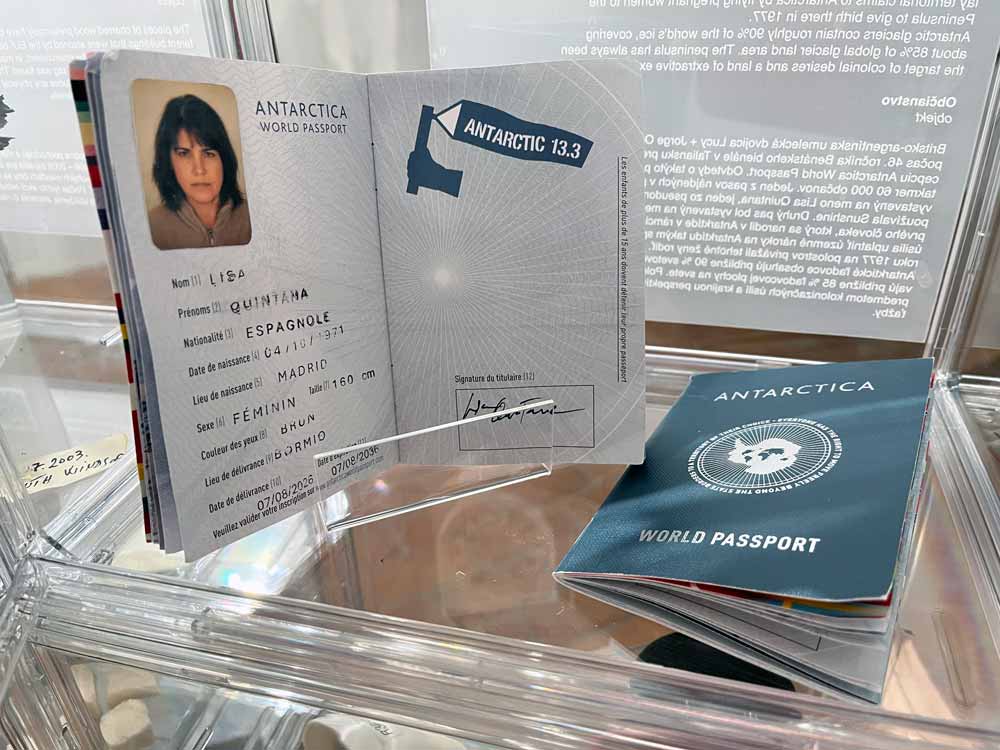
object, 8,5 x 12,5
The British-Argentinian artist duo Lucy+Jorge Orta presented the Antarctica World Passport concept at the XLVI Biennale di Venezia in Italy in 1995. Since then almost 60000 citizens have applied for it. One of the passports found in the crate indicates the name Lisa Quintana as its holder, which is one of the aliases used by Sunshine. The second passport has been filled with the name of Emilio Palma, the first person to be born in Antarctica as a result of Argentina’s efforts to lay territorial claims to Antarctica by flying pregnant women to the Peninsula to give birth there in 1977.
Antarctic glaciers contain roughly 90% of the world’s ice, covering about 85% of global glacier land area. The peninsula has always been the target of colonial desires and a land of extractive expectations.
OpenAI. (2026). ChatGPT (GPT-5.6) [Large language model]. See prompts at the end
Colonial claims, extractive expectations and ecological rupture on the borderless continent
Scope: The two Lucy + Jorge Orta passport objects; Antarctic territorial and quasi-colonial claims from the late eighteenth century to the present; the roles of sealing, whaling, coal, petroleum and metallic minerals; and the ecological and climatic situation as documented up to 27 July 2026. The report distinguishes the installation’s parafictional attributions from verified history.
Abstract
Two Antarctica World Passports place the fiction of borderless citizenship beside a history of territorial possession. Antarctica first entered capitalist geography as a sealing and whaling frontier; between 1908 and 1940 seven states converted discovery, mapping, economic use, contiguity and inherited imperial rights into territorial sectors. The 1959 Antarctic Treaty did not abolish those claims but froze them, while science, bases, naming and civilian presence continued as forms of “treaty sovereignty”. Emilio Palma’s birth at Argentina’s Esperanza Base on 7 January 1978 belongs to this post-Treaty performance of permanence, although it created no new legal title. Extraction was initially biological. Coal, petroleum and metallic minerals later intensified strategic expectations, but no commercial Antarctic reserve has been demonstrated; gold is geologically documented, not historically decisive. The 1991 Environmental Protocol bans mineral-resource activity other than science and does not expire in 2048. Today Antarctica is undergoing sustained ice-sheet loss, a cluster of exceptionally low sea-ice years, ocean and ecosystem disruption, and rising tourism and biosecurity pressures. The passports therefore connect utopian planetary citizenship to a continent whose legal neutrality remains layered over colonial claims, extractive imaginaries and accelerating climate change.
Project links and cross-references: Citizenship (this object) · Nations (flags, Ingrid Christensen and territorial performance) · Ice/mining axe and Drill baby, drill! (extractive expectations) · Sunshine (Lisa Quintana alias) · Glacier Express / Gaze (tourist spectatorship)
Contents
1. The passport object: citizenship against sovereignty
2. Antarctica as colonial territory: concise chronology
3. From animal extraction to mineral expectation
4. Ecological and climatic situation, July 2026
5. Interpretive synthesis: passport, claim and climate archive
6. Numbered academic reference list
Appendix: User prompts
1. The passport object: citizenship against sovereignty
Lucy + Jorge Orta presented the Antarctica World Passport concept at the XLVI Biennale di Venezia in 1995. The work proposes a voluntary, no-borders citizenship organised around a charter of solidarity, environmental responsibility and freedom of movement. Passport offices installed in exhibitions and international forums convert this proposition into a participatory performance: applicants are registered, assigned a unique number and located on a global map.
The current Studio Orta catalogue records nine printed editions totalling 92,000 copies through 2025. That figure is a production total, not a verified count of registered citizens. The exhibition label’s “almost 60,000 citizens” may represent an earlier registration count, but the accessible official material does not presently document its date or calculation. This distinction should be retained in publication rather than converting copies into citizens.
One object bears the name Lisa Quintana. “Lisa Rachelle Quintana” and “Lisa R. Quintana” are among the aliases listed by the FBI for Josephine Sunshine Overaker; the attribution of this specific passport to Sunshine remains part of the installation’s parafictional find narrative. The second bears the name Emilio Palma. He was born at Argentina’s Esperanza Base on 7 January 1978 after his mother was flown there late in pregnancy. The birth formed part of Argentina’s wider strategy of demonstrating settled, civilian life in its claimed sector. Under Article IV of the Antarctic Treaty, however, post-1959 activities cannot create, strengthen or deny sovereignty rights.
Academic source links: Frozen Empires: An Environmental History of the Antarctic Peninsula | Sovereignty Watch: Claimant States, Resources, and Territory in Contemporary Antarctica | Latin America and Antarctica
References: [4], 231-243; [6], especially chapters 6-8; [7].
Primary / institutional evidence links: Antarctica World Passport project history | Studio Orta: Antarctica World Passport editions | FBI: Josephine Sunshine Overaker aliases | Antarctic Treaty: Article IV and claimant states
2. Antarctica as colonial territory: concise chronology
The table separates commercial penetration, formal annexation and post-Treaty sovereignty performance. “Claim” here refers to acts intended to establish or display authority; international recognition remains limited, and seven claimant positions are held in abeyance under the Treaty.
Date(s) | Actor(s) and action | Colonial or strategic significance |
1775-1825 | British, US and French sealers: South Georgia, the South Shetlands and the Antarctic Peninsula entered European and North American maps through successive hunting voyages. | A mobile resource frontier: animal depletion drove exploration southward. Commercial secrecy and extraction preceded formal government administration. |
1840-1843 | France, Britain and the United States: Dumont d’Urville named and claimed Adélie Land for France; James Clark Ross named Victoria Land and planted the British flag; Charles Wilkes mapped a long East Antarctic coast. | Exploration, naming, cartography and flag-planting supplied later “first discovery” narratives. The United States did not formalise a sector claim. |
1904-present | Argentina: Argentina assumed the meteorological station at Laurie Island in the South Orkneys and maintained continuous occupation. | Scientific administration and permanence became central arguments for Argentine rights in the South Atlantic and Antarctic Peninsula region. |
1908; 1917 | United Kingdom: Letters Patent created and then revised the Falkland Islands Dependencies, extending a sector to the South Pole. | The first formal continental sector claim. Whaling licences, taxation and regulation linked imperial jurisdiction directly to extractive commerce. |
1923-1924 | United Kingdom, New Zealand and France: Britain placed the Ross Dependency under New Zealand administration; France reaffirmed Adélie Land. | Imperial transfer and discovery claims converted exploration into territorially administered sectors. |
1929-1933 | Britain and Australia: The BANZARE expeditions under Douglas Mawson mapped and proclaimed large areas; Britain transferred the Australian Antarctic Territory in 1933. | Science, mapping and occupation were mobilised to pre-empt Norwegian whaling interests and complete an imperial division of East Antarctica. |
1929-1939 | Norway: Norway claimed Peter I Island and, in 1939, Queen Maud Land after expeditions financed substantially by whaling entrepreneur Lars Christensen. | A direct conjunction of private whaling capital, aerial mapping and state sovereignty. The Queen Maud Land claim also pre-empted German expansion. |
1938-1939 | Nazi Germany: The German Antarctic Expedition photographed and mapped “Neuschwabenland” and dropped marked metal darts from aircraft. | A symbolic and cartographic assertion linked to securing whaling supplies and national prestige; it did not become an internationally maintained territorial claim. |
1940 | Chile: Chile defined the Chilean Antarctic Territory, overlapping the British and Argentine sectors. | Contiguity, security and inherited Spanish imperial rights were used to frame a South American claim against British imperial control. |
1942-1947 | Argentina: Argentina formalised its sector through decrees, maps, postal and administrative acts and increasingly permanent bases. | A state-building programme of effective presence; rivalry with Britain and Chile intensified on the Peninsula. |
1943-1945 | United Kingdom: Operation Tabarin established permanent wartime bases in the Peninsula and island region. | A military-scientific occupation intended to deny enemy use and reinforce British sovereignty. Its bases became the foundation of the post-war Falkland Islands Dependencies Survey. |
1946-1959 | United States and international science: Operation Highjump, later US expeditions and the International Geophysical Year expanded logistics, aerial survey and permanent scientific stations. | The United States reserved a “basis of claim” without declaring a sector. Science became both cooperative practice and a gatekeeping credential for Antarctic governance. |
1959-1961 | Antarctic Treaty parties: Twelve states signed the Treaty; it entered into force in 1961. Seven prior claims were preserved but frozen, with no new or enlarged claims permitted. | A legal suspension rather than decolonisation: peaceful science internationalised activity while leaving the colonial cartography intact. |
1977-1985 | Argentina and Chile: Families, schools, civil registries and births were introduced at Esperanza and Villa Las Estrellas. Emilio Palma was born at Esperanza on 7 January 1978. | Civilian settlement performed permanence and national normality. Article IV prevents these acts from creating new legal title. |
1961-present | Claimant and non-claimant states: Bases, maps, place-names, heritage, logistics, flags, stamps, science and public culture continue to project national presence. | Dodds’s “treaty sovereignty”: claims remain dormant in law but active as recurrent performances, anxieties and infrastructural investments. |
Academic source links: Claiming Empty Space | Norway and the “Winning” of Australian Antarctica | The European Antarctic | An International Hierarchy of Science
References: [2], 360-367; [6], chapters 1-8; [9], 317-319; [10], 19-41; [12], chapters 1-7; [13], 995-1019.
Primary / institutional evidence links: Antarctic Treaty: claims and Article IV
3. From animal extraction to mineral expectation
Antarctica’s colonial economy began with living bodies, not mines. Seal skins, elephant-seal oil and whale oil made the Southern Ocean legible as a profitable frontier. Whaling stations, factory ships, licences and taxes were among the clearest material links between extraction and the British, Norwegian, Australian, Argentine and Chilean projects of authority. Geological resources entered policy later, especially as exploration technology improved and the oil shocks of the 1970s made remote reserves appear strategically imaginable.
Resource / regime | Documented position | Relation to colonial ambition |
Seals and whales | Commercial sealing from the late eighteenth century and industrial whaling from the early twentieth century drove discovery, occupation, mapping and administration. South Georgia’s 1904 whaling station and the competition between British regulation and Norwegian capital were particularly consequential. | Direct and well documented. Biological extraction was a principal motive behind several early sovereignty acts. |
Coal | Coal-bearing strata are known, notably in the Transantarctic Mountains. Occurrences are geographically remote, commonly ice-covered and unsupported by transport or market infrastructure; no Antarctic coal mine exists. | Not a demonstrated driver of the 1908-1940 sector claims. Coal later reinforced the image of Antarctica as a latent industrial reserve. |
Oil and natural gas | Sedimentary basins on and around the continental shelf generated speculation, but no commercially proven Antarctic petroleum reserve has been established and no production has occurred. Mineral-resource diplomacy intensified from the 1970s and produced CRAMRA in 1988. | A major late twentieth-century strategic expectation rather than a basis for the original claims. CRAMRA was signed but never entered into force. |
Metallic minerals and gold | Iron, copper, chromium and other mineral occurrences are geologically documented. The Dorn deposit in northern Victoria Land is a peer-reviewed example of Antarctic gold mineralisation. | Occurrence is not an economically recoverable reserve. No reliable evidence located shows gold motivating the original territorial claims. |
Current legal status | The 1991 Madrid Protocol designates Antarctica a natural reserve devoted to peace and science. Article 7 prohibits mineral-resource activities except scientific research. The Protocol entered into force in 1998. | The ban has no expiry date. From 2048 a review conference may be requested, but amendment is neither automatic nor sufficient by itself to authorise mining; removal of Article 7 would require a binding mineral regime and consensus conditions. |
Academic source links: Claiming Empty Space | Latin America and Antarctica | The Dorn Gold Deposit in Northern Victoria Land | Sovereignty Watch
References: [2], 360-367; [3], 128-140; [4], 231-243; [7]; [10], 19-41; [12], chapters 3-7.
Primary / institutional evidence links: CRAMRA status: did not enter into effect | New Zealand treaty record: CRAMRA signed but unratified | Madrid Protocol and the 2048 misconception
4. Ecological and climatic situation, July 2026
Antarctica contains about 90% of the world’s glacier ice by volume and accounts for roughly 85% of the planet’s glacier-covered land area. The two percentages in the object label are therefore broadly supportable when they are clearly distinguished as volume and area. The present situation is severe but spatially uneven. West Antarctica and the Antarctic Peninsula show the clearest sustained ice loss and ecosystem disruption; East Antarctica contains areas of short-term snowfall gain as well as vulnerable marine-based sectors. Sea ice is highly variable, so the recent sequence of low years should be read as an emerging regime change rather than a simple uniform trend across every metric.
System | Current evidence | Why it matters |
Ice-sheet mass and sea level | The Antarctic Ice Sheet lost 2,671 ± 530 gigatonnes between 1992 and 2020, raising mean sea level by 7.4 ± 1.5 mm. NASA’s GRACE/GRACE-FO indicator estimates about 135 Gt of loss per year during 2002-2025, equal to roughly 0.4 mm of sea-level rise annually. | Ocean-driven ice-shelf thinning and accelerated discharge in West Antarctica dominate; East Antarctic balance remains more uncertain and variable. |
Sea ice | The minima of 2022, 2023, 2024 and 2025 were the four lowest in the 47-year satellite record. The 2025 minimum was 1.98 million km², tied for second lowest. NSIDC cautions that the full-record linear minimum trend was not yet statistically significant. | A post-2016 cluster of exceptional lows reduces habitat, changes ocean-atmosphere exchange and removes buffering in front of ice shelves. |
Ocean and global circulation | Southern Ocean warming and freshening are linked to weakened overturning, altered heat and carbon uptake and greater basal melting of ice shelves. Recent synthesis identifies plausible abrupt changes rather than only gradual response. | Antarctica is not isolated: circulation changes redistribute heat, carbon and nutrients and affect global sea level and climate. |
Sea-ice-dependent wildlife | Four of five studied emperor penguin colonies in the central and eastern Bellingshausen Sea suffered probable total breeding failure after early ice break-up in 2022. In April 2026 the IUCN listed the emperor penguin and Antarctic fur seal as Endangered. | Breeding platforms and food webs are being disrupted; projected changes in sea ice and krill availability create continent-scale conservation risks. |
Terrestrial and coastal biosecurity | Warming, more ice-free ground and increased movement of people and cargo raise the probability that non-native plants, invertebrates and pathogens establish, especially in the Peninsula region. | Human access amplifies climate-driven ecological opening. Prevention is more feasible than eradication after establishment. |
Tourism and footprint | IAATO reported 113,518 visitors for 2025-26: 85,195 landed visitors, 27,217 cruise-only visitors and 1,106 deep-field visitors. Activity remains concentrated around the Peninsula and a limited set of landing sites. | Tourism produces transport emissions, wildlife disturbance and biosecurity pressure, while also converting climate change into a consumable spectacle. |
Governance | The Antarctic Treaty System retains strong peace, inspection and environmental rules, but consensus decision-making must respond to rapid climate change, fisheries pressure, tourism growth and strategic competition. | The legal ban on mining is robust, yet national infrastructure and “treaty sovereignty” continue to shape whose science, access and protection priorities count. |
Academic source links: Emerging Evidence of Abrupt Changes in the Antarctic Environment | Mass Balance of the Greenland and Antarctic Ice Sheets, 1992-2020 | Record Low 2022 Antarctic Sea Ice and Emperor Penguin Breeding Failure | Invasive Non-Native Species in the Antarctic Peninsula Region
References: [1], 621-633; [5]; [8], 2702-2716; [11], 1597-1616.
Primary / institutional evidence links: NASA Earth indicator: ice sheets | NSIDC: 2025 Antarctic sea-ice minimum | IUCN: emperor penguin and Antarctic fur seal Endangered | IAATO: 2025-26 visitor statistics | BAS / Royal Geographical Society: Antarctic ice statistics
5. Interpretive synthesis: passport, claim and climate archive
The two passports stage an opposition between citizenship and possession. The Orta passport offers belonging without territorial exclusion: a citizen accepts ethical obligations to a continent that cannot confer ordinary nationality. The Emilio Palma passport reverses this proposition. It names a real person whose birth was organised within a national programme of permanence, turning the intimate fact of birth into geopolitical evidence. The Lisa Quintana passport introduces a third condition: the fugitive identity. A state-issued wanted notice confirms the alias, while the found passport remains a parafictional bridge between the stateless ideal and Sunshine’s evasion of state jurisdiction.
Read beside Nations, the passports show that flags, births, maps and artistic documents are all technologies of inscription, but they do not have equal legal force. The territorial chronology clarifies why minerals have such symbolic power even where extraction is technologically remote and legally prohibited: the resource is first produced as an expectation, a future claim on matter. Read beside Glacier Express and Gaze, the 2025-26 tourism figures reveal another form of appropriation. The continent is consumed visually and logistically even while it is represented as untouched, borderless and protected.
Antarctica is therefore neither an empty commons nor a completed utopia. It is a climate archive whose ice records planetary history, a colonial map whose sectors have been legally suspended but not erased, and a political theatre where science, conservation, tourism and national infrastructure compete to define legitimate presence. The passport’s no-borders promise gains force precisely because it is placed against this unresolved material history.
6. Numbered academic reference list
Chicago bibliography style. This numbered list contains only scholarly books, chapters and peer-reviewed journal articles. Official and institutional records are linked in the relevant sections and are not included here.
1. Abram, Nerilie J., Ariaan Purich, Sharon A. Robinson, et al. “Emerging Evidence of Abrupt Changes in the Antarctic Environment.” Nature 644 (2025): 621-633. DOI
2. Barrett, Noel D. “Norway and the ‘Winning’ of Australian Antarctica.” Polar Record 45, no. 4 (2009): 360-367. DOI
3. Crispini, Laura, Laura Federico, Giovanni Capponi, and Franco M. Talarico. “The Dorn Gold Deposit in Northern Victoria Land, Antarctica: Structure, Hydrothermal Alteration, and Implications for the Gondwana Pacific Margin.” Gondwana Research 19, no. 1 (2011): 128-140. DOI
4. Dodds, Klaus J. “Sovereignty Watch: Claimant States, Resources, and Territory in Contemporary Antarctica.” Polar Record 47, no. 3 (2011): 231-243. DOI
5. Fretwell, Peter T., Aude Boutet, and Norman Ratcliffe. “Record Low 2022 Antarctic Sea Ice Led to Catastrophic Breeding Failure of Emperor Penguins.” Communications Earth & Environment 4 (2023): 273. DOI
6. Howkins, Adrian. Frozen Empires: An Environmental History of the Antarctic Peninsula. New York: Oxford University Press, 2017. Publisher record
7. Howkins, Adrian. “Latin America and Antarctica.” Oxford Research Encyclopedia of Latin American History. Oxford University Press, 2017. DOI
8. Hughes, Kevin A., Oliver L. Pescott, Jodey Peyton, et al. “Invasive Non-Native Species Likely to Threaten Biodiversity and Ecosystems in the Antarctic Peninsula Region.” Global Change Biology 26, no. 4 (2020): 2702-2716. DOI
9. Mancilla, Alejandra. “A Continent of and for Whiteness?: ‘White’ Colonialism and the 1959 Antarctic Treaty.” Polar Record 55, no. 5 (2019): 317-319. DOI
10. Mancilla, Alejandra. “Claiming Empty Space.” In From Sovereignty to Guardianship: Governing Antarctica, Governing the World, 19-41. Oxford: Oxford University Press, 2026. DOI
11. Otosaka, Inès N., Andrew Shepherd, Erik R. Ivins, et al. “Mass Balance of the Greenland and Antarctic Ice Sheets from 1992 to 2020.” Earth System Science Data 15, no. 4 (2023): 1597-1616. DOI
12. Roberts, Peder. The European Antarctic: Science and Strategy in Scandinavia and the British Empire. New York: Palgrave Macmillan, 2011. Publisher record
13. Yao, Joanne. “An International Hierarchy of Science: Conquest, Cooperation, and the 1959 Antarctic Treaty System.” European Journal of International Relations 27, no. 4 (2021): 995-1019. DOI
Appendix: User prompts related to this report
Prompts are reproduced chronologically as a research-process record. Obvious typographic spacing has been normalised, while wording and sequence are retained.
1. The next object is two passports, the accompanying text reads:
object
The British-Argentinian artist duo Lucy+Jorge Orta presented the Antarctica World Passport concept at the XLVI Biennale di Venezia in Italy in 1995. Since then almost 60000 citizens have applied for it. One of the passports found in the crate indicates the name Lisa Quintana as its holder, which is one of the aliases used by Sunshine. The second passport has been filled with the name of Emilio Palma, the first person to be born in Antarctica as a result of Argentina’s efforts to lay territorial claims to Antarctica by flying pregnant women to the Peninsula to give birth there in 1977.
Antarctic glaciers contain roughly 90% of the world’s ice, covering about 85% of global glacier land area. The peninsula has always been the target of colonial desires and a land of extractive expectations.
1. make a research and provide a short concise history in the form of a table of the historical attempts in which Antarctica was targeted as a possible colonial territory
2. develop on the instances where the coal, oil or minerals (gold?) were the motivation of colonial ambitions
3. summarize the actual ecological and climatic situation of Antarctica
2. The dates are missing from 2. Antarctica as colonial territory: concise chronology section.
Complete, adjust the first column with dates, and resend.
2. General remarks:
1. I have been asking you to create individual reports on different topics.
2. Nonetheless these materials should converge into a unity which is the archive itself and the supporting physical installation. This convergence should be based on a synthesys of all of my other topics, questions and criteria raised in all of the other chat sessions, which are all part of the same project the main scope of which is an art installation and a supporting archive that grows by time. The archive is meant for both professional and nonprofessional use, it should be informative within its artistic and pedagogical scope as well.
3. the main line of thoughts of the project departs from panoptic tourism and concludes to ecoterrorism in a narrative line. Therefore all the reports should follow this general direction in their approach and references.
4. The reports we are working on now will all serve as a background research material published on the project website for the set of objects that will be on display, Each object will have its own page (see: https://glacial-archaeology.net/category/exhibition/). See: Szabolcs KissPál – The sunshine find_for translation. I am also adding the brief description of the project’s general concept, see: Szabolcs KissPál – The sunshine find. The website will have a separate but interconnected section for both the exhibition and the supporting archive. https://glacial-archaeology.net/an-archive-of-narratives-on-global-warming-copy/ Inspect the site while note that it doesn’t have its final structure yet!
5. the scope with the reports is to produce a set of background research material for each object in part that should refer to each other, and should be unified in their narrative and typographic structure, tone, and scope. Pay attention to snychronise the focus points of different partial research tasks when possible with cross references!
6. I am attaching two of your previous reports (noahs_ark_expeditions_1959_1990_academic_sources_new_tab_links.docx, Container_Mount_Scorluzzo_WWI_Shelter_Research_Report). Please develop and and apply to these reports a uniform structure both content wise and in formal aspects while mostly keeping their original content.
7. Main further formal criteria:
– you should always start with an abstract summarizing your finds in a text no longer than 200 words.
– you should always enlist at the very end of the document all my prompts related to that topic
– the external links should always open in a different tab
– you should be using only valid, peer reviewed academic sources listed and numbered at the end of the documents
– you should apply a somewhat unified narrative structured and a unified formatting (including typeface styles, subtitles structure, etc.
8. – note and memorise the above in your cross-chat memory for rurther tasks