From Institutional Green Politics to Ecological Sabotage
The Formation, Operation, and Historical Significance of the Earth Liberation Front
Abstract 1.
The Earth Liberation Front (ELF) emerged in the early 1990s at the intersection of radical environmentalism, deep ecology, anarchist political thought, and traditions of direct action. Its development reflected a broader tension within modern environmental politics: while environmental protection became increasingly institutionalized through professional organizations, green parties, state regulation, and international cooperation, some activists regarded these processes as insufficient, overly bureaucratic, or vulnerable to political and economic compromise.
Originating within the British Earth First! milieu, the ELF adopted a decentralized model of “leaderless resistance” based on autonomous cells without formal membership, centralized leadership, or a unified command structure. Actions carried out under its name primarily targeted property and infrastructure associated with logging, urban development, biotechnology, industrial agriculture, animal exploitation, and high-consumption lifestyles. The movement presented economic sabotage as a means of increasing the financial costs of ecological destruction and formally emphasized the avoidance of harm to humans and animals. Nevertheless, the use of arson and politically motivated property destruction generated substantial legal, ethical, and conceptual controversy.
Read the study here
Earth Liberation Front
Incident Timeline,
1992–2009
Abstract 2.
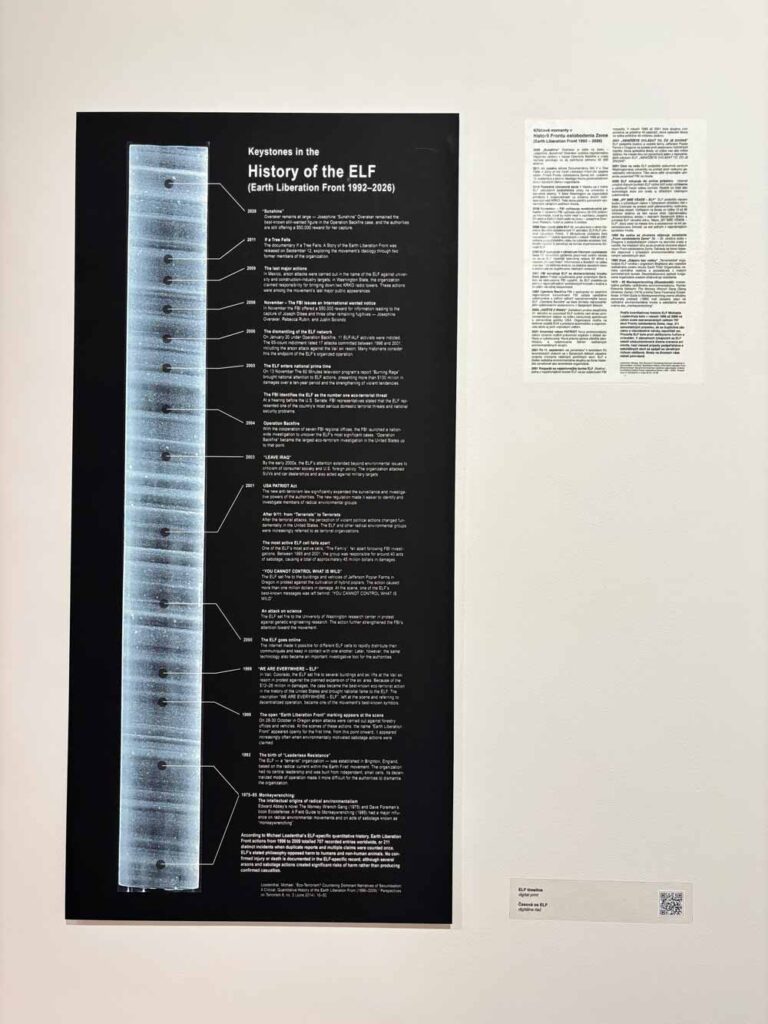
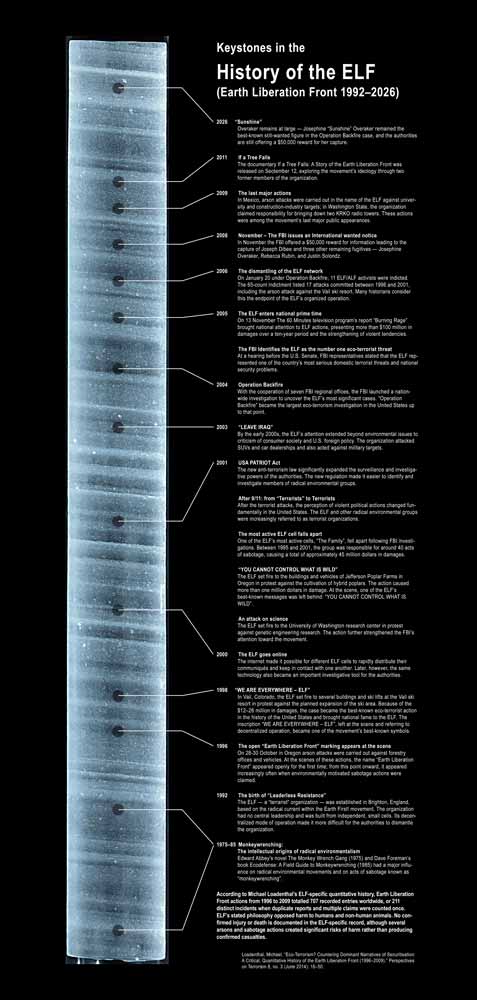
This report restructures a 122-record chronology covering three organisational milestones (1992–1994) and 119 attributed or claimed actions (1996–2009). It preserves usable event descriptions while standardising English terminology, separating academic interpretation from legal, media and activist evidence, and marking duplicate, corrupted or unresolved records. Six high-confidence duplicate groups reduce the corpus to a minimum of 112 distinct incidents plus three milestones; three further overlap groups remain uncertain. Property development, forestry, biotechnology, animal industries and SUVs dominate the retained target categories, while arson, graffiti and vandalism recur across multiple records. The chronology should not be treated as a complete catalogue: a major scholarly dataset identifies a substantially larger universe of ELF targets and events for the same period. The strongest comparative study found no reported human injuries or fatalities in its dataset, although arson and a small number of threat-oriented actions created evident risk; claims about animal harm remain unevenly documented. Within The Sunshine Find, the timeline marks the project’s transition from the organised consumption of landscapes to clandestine intervention, and from environmental sabotage to its securitisation during the Green Scare.
View the detailed timeline