Elixir
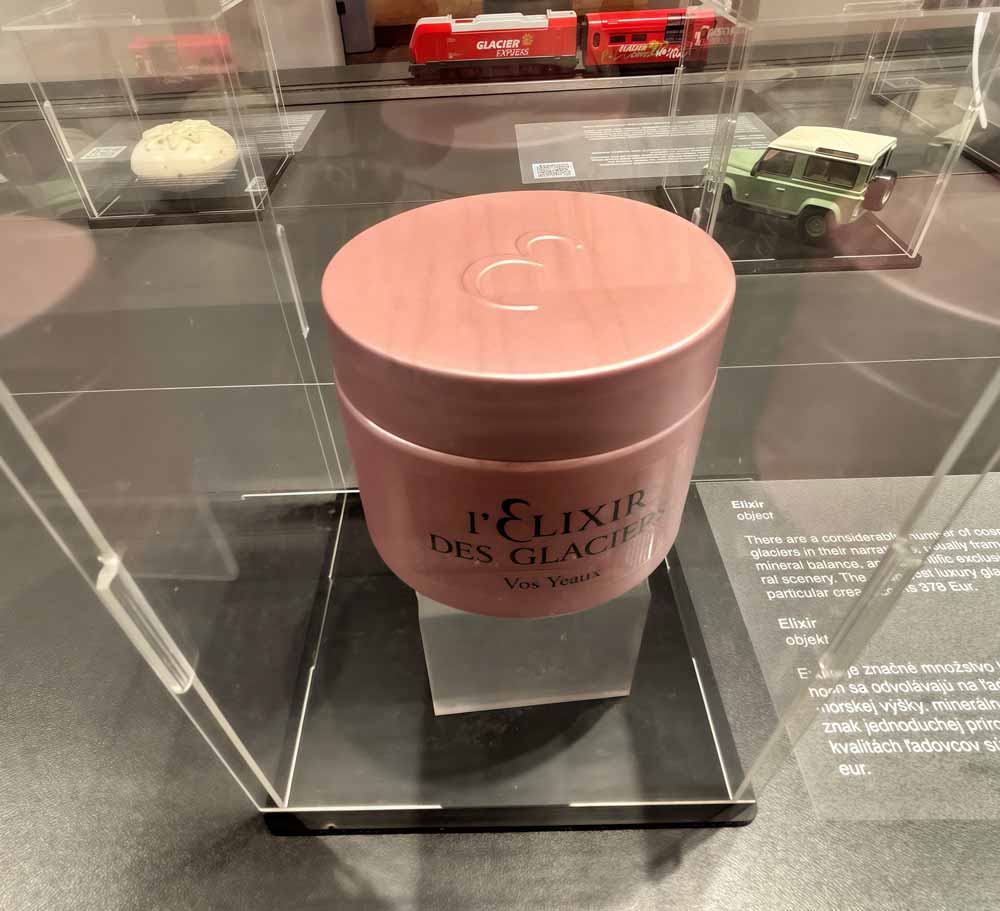
object, plastic, glass, 4 x 6 x 1 cm
There are a considerable number of cosmetics that are referring to glaciers in their narratives, usually framed as signs of purity, altitude, mineral balance, and scientific exclusivity rather than as simple natural scenery. The strongest luxury glacier narratives are Swiss. This particular cream costs 378 Eur.
OpenAI. (2026). ChatGPT (GPT-5.6) [Large language model]. See prompts at the end
Elixir: Glacier Narratives in Luxury Cosmetics
A history of alpine purity marketing, environmental burden, production contradictions and ecological protest
Scope: Glacier- and glacial-water-referencing cosmetics from the late twentieth century to July 2026, with emphasis on Swiss luxury skincare, the probable Valmont object associated with the €378 label price, life-cycle environmental impacts, carbon-accounting limits, contested environmental claims and documented ecological direct actions. Product efficacy is not clinically adjudicated, and the chronology does not claim to be a complete census of every glacier-branded cosmetic.
Abstract
The uploaded dossier identifies a growing field of cosmetics in which glaciers signify purity, altitude, mineral balance, cold preservation and scientific exclusivity. Swiss brands dominate the luxury tier: Valmont, NIANCE and later firms join alpine water to biotechnology, cellular renewal and anti-ageing. The €378 figure is consistent with a current retail listing for Valmont’s L’Elixir des Glaciers Vos Yeux, although the object cannot be securely identified without its packaging record. Environmental analysis shifts attention from the named water to the whole product system: petrochemical and agricultural feedstocks, energy and water use, volatile ingredients, heavy or composite packaging, global logistics, wastewater and end-of-life leakage. No academically defensible global percentage for cosmetics’ share of greenhouse-gas emissions was located; widely repeated single-number estimates lack transparent boundaries. The clearest branding-production tensions involve luxury supply-chain disclosure, plastic sachets, microplastics and ‘reef friendly’ sunscreen claims. Ecological direct action has concentrated on palm-oil deforestation and plastic packaging, especially Greenpeace campaigns against Dove and Unilever. The glacier in the jar thus converts a visibly threatened climate archive into a prestige material while concealing the industrial network required to extract, formulate, package and circulate it.
Contents
1. Object identification and extracted dossier
2. Historical genealogy of glacier rhetoric
3. Environmental life cycle of cosmetics
4. Carbon accounting and comparison with other sectors
5. Branding-production contradictions and documented controversies
6. Ecological direct action targeting cosmetics and personal care
7. Primary and institutional evidence register
8. Interpretive synthesis: the glacier in the jar
9. Numbered academic reference list
Appendix: User prompts related to this report
1. Object identification and extracted dossier
The dossier’s strongest candidate for the object titled Elixir is Maison Valmont’s L’Elixir des Glaciers line. A July 2026 retail listing offers the 15 ml Vos Yeux eye-contour cream at €378, exactly matching the label price supplied for the installation. Prices vary substantially by market and SKU, and the uploaded report contains no object photograph or stock-keeping identifier; the identification is therefore probable rather than conclusive.
Field | Documented information |
Installation title | Elixir |
Probable product family | Maison Valmont, L’Elixir des Glaciers |
Probable SKU | Vos Yeux / eye-contour cream, 15 ml — provisional |
Object-label price | €378 |
Price verification | A current European retailer lists Vos Yeux at €378; other retailers and other L’Elixir SKUs differ. |
Evidence status | Product-family identification strong; exact SKU identification provisional. |
Primary / corporate evidence links: Valmont L’Elixir des Glaciers | €378 Vos Yeux retail listing
References: [1], 1–17; [2], article 71; attached dossier, 1–15.
1.1 Chronology extracted and normalised from the attached dossier
The dossier records fifteen dated or provisionally dated products and four further lines whose initial launch date was not established. Asterisks mark the earliest public evidence located by the earlier search rather than a verified first day of sale. The normalised chronology below preserves that distinction.
Year | Product / brand | Origin | Position | Dominant glacier rhetoric | Date status |
2006 | Switzerland | Luxury | Alpine water + ‘haute couture’ cellular science | Dated | |
2007 | Swiss Glacier Complex / Premium Glacier Facial Cream — NIANCE | Switzerland | Luxury | Longevity, microbiome, mineral-biotech complex | Dated |
2012 | France / Iceland | Luxury | Purity, brightening and ‘skin transparency’ | Dated | |
2017 | Switzerland | Prestige | Minerals, trace elements, red snow algae | Dated | |
2020 | United States | Premium | Frontier authenticity, minerals, Alaskan botanicals | Dated | |
2020* | South Tyrol, Italy | Premium spa | High-altitude spring, glacial mica, regional ritual | Earliest evidence | |
2021* | Canada | Luxury spa | Glacial oceanic minerals and Canadian sublime | Earliest evidence | |
2022* | Germany / Switzerland | Premium | Encapsulation, resilience and anti-pollution defence | Earliest evidence | |
2022* | Switzerland | Natural luxury | Everyday climate comfort and ecological softness | Earliest evidence | |
2023 | Core collection with encapsulated Swiss Glacier Water — Louminology | US / Switzerland | Luxury | Liposomal delivery, radiance and personal ritual | Dated |
2024* | UK / Switzerland | Premium | Masculine biohacking, anti-toxin Swissness | Earliest evidence | |
2024* | South Korea / NZ narrative | Premium hybrid | Cooling, hydration and oil control | Earliest evidence | |
2024* | South Korea | Premium / masstige | Direct hydration and freshness | Earliest evidence | |
2024* | India | Premium | Imported Swiss efficacy technology | Earliest evidence | |
2025* | Switzerland | Premium natural | Cleansing purity, glacier water and botanicals | Earliest evidence |
Further lines identified without secure launch dating: SNO Swiss Organic; Swiss Prestige Cosmetics; ICECODE; and additional GLACISSE products. The earlier dossier’s negative controversy checks are retained only as search results: they mean that no prominent case was located in that search, not that the brands have been independently certified as impact-free.
Primary / corporate evidence links: Uploaded dossier’s Valmont page | NIANCE Swiss Glacier Complex | Dior–Icelandic Glacial announcement
References: Attached dossier, 2–12; [1], 185–240; [3], 212–248.
1.2 Five recurrent narrative families
Narrative family | Representative brands | Rhetorical operation |
Swiss biotech prestige | Valmont, NIANCE, Louminology | Glacial water is joined to laboratories, cellular research, encapsulation, longevity and precision. |
Brightening / transparency science | Diorsnow | Water purity is translated into optical and dermatological language associated with clarity and brightness. |
Hydration / cooling performance | mixsoon, Parnell, nooii | The glacier becomes a functional reservoir of freshness, soothing and moisture. |
Alpine spa and mineral therapy | GLACISSE, MS Swiss Cosmetics | Spring water, rock, altitude and regional wellness rituals evoke therapeutic landscape traditions. |
Frontier or national authenticity | Alaska Glacial, Céla, ICECODE | Remote northern territory authenticates minerals, wilderness and place-specific purity. |
References: [2], article 71; [3], 212–248; [1], 1–17.
2. Historical genealogy of glacier rhetoric
Glacier cosmetics do not arise from a single invention. They combine older therapeutic-water traditions, the nineteenth-century industrial reconciliation of ‘nature’ and laboratory manufacture, twentieth-century Swiss medical and precision branding, and the contemporary market value of climate-threatened rarity.
2.1 Mineral water, spa medicine and therapeutic landscape
Long before ‘glacier water’ became an ingredient name, bathing cultures and mineral-water resorts framed particular waters as geographically specific therapeutic substances. Their value lay in place, mineral composition, controlled access and professional interpretation. Modern alpine skincare inherits this spatial logic: the source is not generic water but a named elevation, spring, glacier or mountain region whose remoteness supposedly guarantees exceptional properties.
Academic source links: History of Natural Ingredients in Cosmetics | Beauty Imagined
References: [2], article 71; [1], 1–44.
2.2 Industrial cosmetics: nature made compatible with science
From the late nineteenth century, industrial beauty firms used botanical and mineral imagery while simultaneously emphasising standardisation, hygiene and laboratory control. Historical advertising research shows that ‘natural’ ingredients were already visual and verbal tools for making manufactured products appear wholesome and morally safe. Glacier rhetoric intensifies this older formula because ice connotes pre-industrial time, absence of contamination and preservation, yet it is sold through highly engineered emulsions, peptides, preservatives and delivery systems.
Academic source links: Can Nature Sell Beauty? | Beauty Imagined
References: [3], 212–248; [1], 45–184.
2.3 Swissness: clinic, precision and Alpine purity
The Swiss luxury cluster adds a national-industrial code to the natural landscape. Brand narratives combine Alpine water and plants with clinics, biotechnology, patents, cellular research and quality control. This pairing solves a central luxury-marketing problem: nature supplies authenticity and rarity, while science supplies repeatability and authority. The attached dossier shows this most clearly in Valmont’s ‘haute couture’ framing, NIANCE’s Swiss Glacier Complex and Louminology’s encapsulated water.
Academic source links: Luxury and Sustainable Development | History of Natural Ingredients in Cosmetics
References: [14], 1896–1903; [2], article 71.
2.4 The glacier as anti-ageing paradox
Glacier marketing translates geological age into biological youth. Ice signifies ancient duration, cold preservation and slow mineral accumulation; skincare promises accelerated renewal, brightness and the delay of visible ageing. The paradox is sharpened by climate change: retreating glaciers become more culturally valuable as signs of threatened purity. Scarcity can therefore increase symbolic exclusivity even when the product’s material use of glacier-derived water is small. This is an interpretation of the marketing structure, not evidence that brands deliberately celebrate glacier loss.
Academic source links: The Drivers of Greenwashing | Can Nature Sell Beauty?
References: [15], 64–87; [3], 212–248.
2.5 Recurrent rhetorical devices and evidentiary questions
Device | Marketing function | Source-critical question |
Purity / untouched origin | Remote source is treated as protection from contamination. | Was source quality independently tested against ordinary purified cosmetic water? |
Altitude / resilience | Plants, algae or minerals appear stronger because they survive extreme conditions. | Is the survival metaphor linked to a measured effect at finished-product concentration? |
Mineral balance | Trace minerals imply remineralisation or cellular vitality. | Are composition, concentration, bioavailability and comparison data published? |
Swiss science | Patents, complexes and laboratories convert landscape into controlled technology. | Is the claim supported by peer-reviewed finished-product evidence or supplier/brand studies? |
Ancient ice / longevity | Geological duration becomes an anti-ageing promise. | Is this metaphor clearly separated from clinical efficacy? |
Scarcity / exclusivity | Threatened or remote origin increases luxury distinction. | Are extraction volume, local hydrology and logistics disclosed? |
References: [3], 212–248; [15], 64–87; [14], 1896–1903.
3. Environmental life cycle of cosmetics
A jar of cream is a multi-stage industrial system. Its environmental profile cannot be inferred from the beauty or remoteness of one named ingredient. Life-cycle assessment follows raw materials, formulation, packaging, distribution, use and end-of-life; the dominant stage changes by product type. Rinse-off products may be dominated by heated water in use, while a leave-on luxury cream more often concentrates impacts in ingredients, packaging and distribution.
3.1 Raw materials: petrochemicals, agriculture, minerals and biotechnology
Cosmetic formulations combine water, oils, surfactants, emulsifiers, polymers, silicones, fragrances, preservatives, pigments and active ingredients. Their feedstocks may come from fossil chemistry, plantation agriculture, mining or fermentation. Environmental pressures include energy use, land conversion, deforestation risk, biodiversity loss, irrigation, fertiliser and pesticide inputs, mineral extraction and solvent-intensive processing. A ‘natural’ ingredient is not automatically lower-impact: yield, land use, extraction method, transport and substitution effects matter. Conversely, a synthetic ingredient is not automatically worse; functional performance and dose can reduce or increase life-cycle burdens.
Academic source links: A Step Forward on Sustainability in the Cosmetics Industry | Sustainability Paradigm in the Cosmetics Industry
References: [4], 270–290; [7], article 100057.
3.2 Water: ingredient, process medium and consumer demand
Water enters cosmetics as formula base, cleaning medium, cooling resource and indirect input to raw-material production. For shampoo, cleanser and other rinse-off products, the user’s hot water can dominate selected impact categories. Waterless formats, concentrates and cold-process manufacturing can reduce burdens, but only when they avoid rebound effects, preserve product safety and do not shift impacts into packaging or ingredients. Glacier-water creams are usually leave-on products; their direct use-stage water demand is low, which makes source extraction, purification, formulation and packaging more important relative to the rinse-off category.
Academic source links: Water Sustainability: A Waterless Life Cycle for Cosmetic Products | A Sustainable Life Cycle for Cosmetics
References: [6], 35–51; [5], article 101178.
3.3 Manufacturing, energy and volatile emissions
Heating, cooling, mixing, homogenising, drying, cleaning and clean-room operation require electricity and thermal energy. Fragrances, solvents, propellants and other volatile chemical products also contribute to urban organic emissions. The influential United States study by McDonald and colleagues covers a broad class of volatile chemical products that includes personal-care products; it does not show that cosmetics alone are the largest source. The relevance is methodological: direct factory energy is only one part of the atmospheric burden, and use-phase evaporation can matter for some formats.
Academic source links: Volatile Chemical Products Emerging as Largest Petrochemical Source of Urban Organic Emissions | A Sustainable Life Cycle for Cosmetics
References: [13], 760–764; [5], article 101178.
3.4 Packaging: the luxury intensifier
Packaging protects microbiological safety, dosing and shelf life, but prestige cosmetics often add environmental intensity through thick glass, metallised components, pumps, mirrors, magnets, multi-material closures, inserts, cellophane, secondary cartons and small product-to-package ratios. Heavy glass is not inherently preferable to plastic: furnace energy and transport mass can offset recyclability advantages. Composite pumps and decorative finishes can make otherwise recyclable materials difficult to separate. Refill systems can improve performance only after sufficient reuse and when return, cleaning, refill packaging and consumer behaviour are included in the assessment.
Academic source links: Reducing the Environmental Impacts of Plastic Cosmetic Packaging | Towards Sustainable Color Cosmetics Packaging
References: [9], article 34; [10], article 139.
3.5 Microplastics, synthetic polymers and wastewater
Cosmetics have used solid plastic microbeads as exfoliants and a wider range of synthetic polymers as film formers, opacifiers, rheology modifiers, glitter and encapsulation materials. Early studies extracted thousands to tens of thousands of polyethylene microbeads from a single product use, demonstrating a direct pathway to wastewater. Regulation has narrowed the use of intentionally added microplastics, but definitions and long transition periods mean that ‘microbead-free’ does not necessarily mean ‘plastic-free’. Packaging fragmentation adds a separate, much larger plastics problem.
Academic source links: Characterisation of Microplastics Extracted from Cosmetics | Plastics and Microplastic in the Cosmetic Industry
References: [12], 178–185; [11], article 4576.
Primary / institutional evidence links: EU restriction on intentionally added microplastics | UK rinse-off microbead ban
3.6 Luxury cosmetics: what can and cannot be concluded
Luxury feature | Environmental implication | Evidentiary caution |
Higher price | Does not itself measure environmental impact. | Never use retail price as a carbon proxy. |
Heavier, more complex packs | Frequently plausible and visible; supported by packaging literature. | Requires product-specific mass and material data. |
Smaller batches / air freight | Can raise per-unit impacts, but brand logistics are rarely public. | Treat as a hypothesis unless shipment mode and volume are known. |
Rare botanicals or glacier water | May increase sourcing distance and traceability risk. | Material quantity and source hydrology must be disclosed. |
Refills and durable cases | Can reduce impacts after enough cycles. | Break-even reuse number must be calculated, not assumed. |
Longer desirability / lower volume | Luxury durability logic may reduce replacement in some sectors. | Weak fit for consumable creams that are depleted by use. |
No peer-reviewed global comparison located for this report proves that every luxury cosmetic has a higher carbon footprint per millilitre than every mass-market equivalent. The strongest defensible conclusion is narrower: luxury packaging and global prestige distribution create identifiable risk factors that require product-level life-cycle data.
Academic source links: Luxury and Sustainable Development | Reducing Environmental Impacts of Cosmetic Packaging
References: [14], 1896–1903; [9], article 34.
4. Carbon accounting and comparison with other sectors
No transparent, peer-reviewed global inventory was located that isolates cosmetics and beauty as a fixed percentage of total world greenhouse-gas emissions. The sector is embedded in chemicals, agriculture, glass, plastics, paper, freight, retail, electricity, water heating and waste. Company reports use different organisational and product boundaries, while online figures often mix cosmetics with personal care or the wider consumer-goods sector. For this reason, the report does not repeat the popular claim that beauty contributes ‘about 1%’ of global emissions as an established fact.
4.1 Where sector emissions are likely to occur
Stage | Main carbon / environmental mechanisms | Interpretive limit |
Raw materials | Agricultural and petrochemical feedstocks, processing, land-use change | Carbon Trust review estimates roughly 30–50% for the companies and boundaries it analysed; not a universal constant. |
Packaging | Glass, plastics, aluminium, paperboard, decoration and conversion | Material mass, recycled content, furnace energy and end-of-life strongly alter results. |
Manufacturing | Electricity, heat, cooling, cleaning and process losses | Often well reported because factories are under direct control, but may be a minority of total Scope 3 impact. |
Distribution / retail | Freight, air shipment, warehouses, stores and e-commerce | Luxury launches and global distribution can be material; public mode data are limited. |
Consumer use | Hot water for rinse-off products, aerosol release and product loss | Can dominate shampoo or cleanser footprints; much lower for leave-on cream. |
End-of-life | Wastewater, residual formula, packaging collection, recycling, landfill or leakage | Actual local infrastructure matters more than ‘recyclable’ design alone. |
Primary / institutional evidence links: Carbon Trust, Greenhouse Gloss
References: [4], 270–290; [5], article 101178; [7], article 100057.
4.2 Comparison table: different boundaries, not a league table
Sector | Reported global contribution | Metric / boundary | Comparison caution |
Cosmetics / beauty | No robust global share established | CO₂e / mixed boundaries | The absence of a defensible total is itself a finding; do not present consultancy estimates as settled. |
Aviation | ≈2.4% of anthropogenic CO₂ in 2018; ≈3.5% of net anthropogenic climate forcing | CO₂ and effective radiative forcing | Non-CO₂ effects make warming contribution larger than CO₂ share. |
International shipping | ≈2.9% of anthropogenic CO₂ in 2018 | CO₂ | Official IMO estimate; includes international maritime transport, not all logistics. |
Cement process emissions | ≈4% of fossil-fuel CO₂ emissions in 2018 | CO₂ from calcination | Excludes part of fuel and electricity burden; broader ‘cement/concrete’ figures use different boundaries. |
Global tourism | ≈8% of global greenhouse-gas emissions in 2013 | Consumption-based CO₂e | Includes transport, accommodation, food, shopping and supply chains; much broader than a product category. |
Academic source links: Aviation climate forcing, 2000–2018 | Carbon Footprint of Global Tourism | Global CO₂ Emissions from Cement Production
Primary / institutional evidence links: Fourth IMO Greenhouse Gas Study
References: [16], article 117834; [17], 522–528; [18], 1675–1710.
4.3 Implication for the €378 glacier cream
A product-level carbon figure would require at minimum: formula bill of materials and supplier locations; source and treatment of the named glacier water; energy used in formulation and filling; package weights and recycled content; decoration and secondary packaging; freight modes; retail energy allocation; expected product loss; and realistic recycling rates. None of these data were available for the probable object. Its environmental meaning therefore cannot be reduced to the origin of the water or the retail price.
References: [5], article 101178; [9], article 34.
5. Branding-production contradictions and documented controversies
The cases below are not equivalent. Some concern alleged legal breaches, some expose corporate target reversals, and some are industry-wide material contradictions. The table records the evidentiary status of each case.
Case | Public image | Production / material tension | Status |
Dior / LVMH contractor supply chains, 2024 | Luxury craft, responsibility and controlled quality | Italian scrutiny of contractor labour conditions and questions over Dior’s UK modern-slavery disclosure and social-responsibility statements. | Documented regulatory / reporting controversy; primarily social and governance, not a carbon case. |
Dove / Unilever plastic sachets, 2022–26 | Care, ‘real beauty’, purpose and plastic-reduction messaging | Greenpeace and investigative reporting contrasted the brand image with billions of hard-to-recycle sachets and Unilever’s 2024 weakening of plastic targets. | Documented ecological campaign and corporate-target controversy. |
Banana Boat / Hawaiian Tropic ‘reef friendly’, 2020–24 | Marine-safe sun protection | Australia’s competition regulator alleged that more than 90 products contained filters that could harm or risk harming reefs while ‘reef friendly’ claims were used. | Active court allegation from 2025; not a final judicial finding. |
Microbeads / ‘clean’ or ‘natural’ beauty | Gentle, pure and environmentally benign cleansing | Intentionally added plastic particles travelled directly from rinse-off products to wastewater; voluntary phase-outs and narrow bans left definitional gaps. | Industry-wide historical contradiction, supported by research and regulation. |
Glacier-water prestige | Remote, untouched, low-contamination nature | Extraction, purification, encapsulation, packaging and international distribution are hidden behind the source image. | Structural contradiction; no unlawful conduct inferred. |
Luxury refill / glass claims | Durability, circularity and premium permanence | Heavy glass and complex pumps may require multiple reuse cycles before outperforming lighter alternatives. | Product-specific LCA question; not a blanket claim against glass or refills. |
5.1 Dior: glacier purity inside a contested luxury supply chain
The 2012 Diorsnow partnership presented Icelandic Glacial water as a complete replacement for ordinary formula water and as an optimised basis for ‘skin transparency’. In 2024, Reuters reported separate scrutiny of Dior’s supply-chain disclosure and contractor conditions in Italy. The controversy does not show that Diorsnow’s water claim was false; it reveals the distance between a tightly controlled scientific-luxury image and outsourced production systems that are harder for consumers to see.
Primary / institutional evidence links: Diorsnow–Icelandic Glacial partnership | Reuters: Dior supply-chain disclosure scrutiny
References: [15], 64–87; attached dossier, 4–5.
5.2 Dove and Unilever: the caring brand and the sachet economy
Unilever’s Dove branding provides an unusually clear image-production conflict because ‘care’ and corporate purpose are central to the brand, while sachets distribute shampoo and personal-care products in laminated, low-value formats that are extremely difficult to recycle. Greenpeace estimated that Unilever sold about 1,700 sachets per second in 2023. This is an advocacy estimate, not an independently audited global inventory, but it became the factual basis of repeated direct actions. The conflict intensified when Unilever reduced the ambition of several environmental and social targets in 2024.
Primary / campaign evidence links: Greenpeace sachet estimate and methodology | Unilever plastic commitments
References: [15], 64–87; [10], article 139.
5.3 ‘Reef friendly’ sunscreen claims
In July 2025, the Australian Competition and Consumer Commission began Federal Court proceedings against Edgewell companies over Banana Boat and Hawaiian Tropic claims. The regulator alleged that the absence of oxybenzone and octinoxate was used to imply reef safety even though products contained other filters alleged to harm, or risk harming, coral and marine life. Because the matter was ongoing at the time of research, the report records allegations rather than a finding of liability.
Primary / institutional evidence links: ACCC media release and allegations | ACCC concise statement
References: [15], 64–87.
5.4 Regulation is moving from ingredients to rhetoric
The EU’s 2023 REACH restriction introduced staged limits on intentionally added microplastics, with different transition periods for rinse-off and leave-on cosmetics. Directive (EU) 2024/825 targets generic environmental claims and sustainability labels that lack recognised certification or adequate substantiation; Member States were required to transpose it by 27 March 2026 and apply measures from 27 September 2026. These developments are significant for glacier cosmetics because words such as ‘pure’, ‘natural’, ‘clean’ and ‘eco’ increasingly require evidence across more than the hero ingredient.
Primary / institutional evidence links: EU microplastics restriction 2023/2055 | Directive (EU) 2024/825
References: [15], 64–87; [11], article 4576.
6. Ecological direct action targeting cosmetics and personal care
Environmental action against the sector has usually targeted parent companies and shared supply chains rather than isolated cream manufacturers. The dominant issues are palm-oil deforestation, microplastics and single-use packaging. ‘Direct action’ is used here for physical intervention, occupation, blockade or disruptive display; consumer scanning, petitions and database work are identified separately as campaign infrastructure.
Date | Action / target | Tactic and ecological claim | Documented outcome / status |
April 2008 | Greenpeace / Dove–Unilever palm-oil campaign, UK | Activists dressed as orangutans chained themselves to supply lines at Unilever’s Merseyside site and demonstrated at London offices; a parody of Dove advertising linked palm oil to Indonesian deforestation. | Unilever supported calls for a moratorium and strengthened sourcing commitments; implementation remained contested. |
2012 onward | Beat the Microbead | Plastic Soup Foundation and partners built an international NGO coalition, public product database and scanning app to identify plastic ingredients in cosmetics. | Campaign infrastructure rather than a single physical action; contributed to public pressure and regulation. |
September 2018 | Greenpeace occupation of Wilmar refinery, Indonesia | Activists occupied infrastructure belonging to a major palm-oil trader linked by Greenpeace to consumer brands including Unilever personal-care products. | Targeted an upstream supplier, making the hidden ingredient chain physically visible. |
7 February 2024 | Greenpeace scales Unilever headquarters, London | Activists installed a ‘Profit Warning – Plastic Polluted Money’ message before company results and demanded an end to sachets and a transition from single-use plastic. | Non-violent disruptive action focused on Dove shampoo sachets and corporate influence in plastics negotiations. |
5 September 2024 | Greenpeace blockade of Unilever House, London | Entrances were blocked with giant Dove-product barricades and a ‘Dead Dove’ image. Thirty-five activists were arrested; charges against 34 were later dropped. | Action explicitly attacked the gap between Dove’s caring image and plastic output. |
16 July 2026 | Greenpeace USA action at Dove USA headquarters | Activists unfurled a 50-foot banner calling on Dove to ‘Kick Plastic Out’, timed around the brand’s football sponsorship visibility. | Current continuation of brand-focused plastics campaigning. |
Primary / campaign evidence links: 2008 Dove palm-oil protest | Beat the Microbead annual account | February 2024 Unilever HQ action | September 2024 blockade | July 2026 Dove USA action
References: [11], article 4576; [12], 178–185; [15], 64–87.
6.1 Relation to environmental sabotage and the ELF archive
No verified Earth Liberation Front action specifically directed at a cosmetics manufacturer for ecological reasons was located in the scholarly, legal and reliable news material reviewed for this report. The documented pattern is instead public, non-violent and brand-focused: occupations, blockades, banner drops, parody and consumer-information campaigns. This difference matters within The Sunshine Find. Elixir and Mythos can be connected to the archive’s later direct-action material through shared questions of commodification and ecological harm, but the historical record should not be rewritten to imply an ELF cosmetics campaign.
7. Primary and institutional evidence register
The following sources support current product, regulatory, corporate, litigation and protest details. They are intentionally excluded from the numbered academic bibliography.
1. Valmont, L’Elixir des Glaciers product family
2. NIANCE, Premium Glacier Facial Cream
3. Icelandic Glacial, Dior Diorsnow 2012 partnership
4. Carbon Trust, Greenhouse Gloss
5. European Commission, Regulation (EU) 2023/2055
6. European Parliament and Council, Directive (EU) 2024/825
7. UK Defra, microbead manufacture ban
8. ACCC, reef-friendly sunscreen proceedings
9. Reuters, Dior supply-chain disclosure scrutiny
10. Greenpeace UK, Unilever HQ action, February 2024
11. Greenpeace UK, Unilever blockade, September 2024
12. Greenpeace USA, Dove action, July 2026
8. Interpretive synthesis: the glacier in the jar
Elixir converts a glacier from landscape into formula, from public climate evidence into private skin ritual. Its rhetoric begins where panoptic tourism leaves off: the distant Alpine view is no longer merely seen from a train, road or hotel but miniaturised, sealed and carried away. Like the Edelweiss soap and seeds, it turns altitude into a portable authenticity code. Like Thirst, it depends on the cultural authority of exceptional water. The commodity promises intimate access to a remote environment while its industrial infrastructure remains largely outside the frame.
The life-cycle evidence complicates the purity image without simply reversing it. Glacier water may be responsibly sourced, and a luxury product may have lower impacts than a particular mass-market alternative; the available evidence does not decide this. What can be shown is that the hero ingredient cannot represent the whole system. The environmental burden is distributed across chemical and agricultural feedstocks, energy, packaging, freight, use and waste, while the marketing image concentrates attention on a single named origin. This asymmetry is the central archival value of the object.
References: [3], 212–248; [4], 270–290; [14], 1896–1903; [15], 64–87.
9. Numbered academic reference list
Chicago bibliography style. The numbered list contains only scholarly books and peer-reviewed journal articles.
1. Jones, Geoffrey. Beauty Imagined: A History of the Global Beauty Industry. New York: Oxford University Press, 2010. DOI / publisher record
2. McMullen, Roger L., and Giorgio Dell’Acqua. “History of Natural Ingredients in Cosmetics.” Cosmetics 10, no. 3 (2023): 71. DOI / publisher record
3. Gopakumar, Sridevi, and Madhava Priya Dananjayan. “Can Nature Sell Beauty? Historicising Cosmetic Advertising and Its Modern Greenwashing Parallels.” Journal of Historical Research in Marketing 17, nos. 3–4 (2025): 212–248. DOI / publisher record
4. Bom, Sara, Joana Jorge, Helena M. Ribeiro, and Joana Marto. “A Step Forward on Sustainability in the Cosmetics Industry: A Review.” Journal of Cleaner Production 225 (2019): 270–290. DOI / publisher record
5. Martins, Ana M., and Joana M. Marto. “A Sustainable Life Cycle for Cosmetics: From Design and Development to Post-Use Phase.” Sustainable Chemistry and Pharmacy 35 (2023): 101178. DOI / publisher record
6. Aguiar, Joana B., Ana M. Martins, Cristina Almeida, Helena M. Ribeiro, and Joana Marto. “Water Sustainability: A Waterless Life Cycle for Cosmetic Products.” Sustainable Production and Consumption 32 (2022): 35–51. DOI / publisher record
7. Rocca, Roberto, Federica Acerbi, Luca Fumagalli, and Marco Taisch. “Sustainability Paradigm in the Cosmetics Industry: State of the Art.” Cleaner Waste Systems 3 (2022): 100057. DOI / publisher record
8. Mondello, Alice, Roberta Salomone, and Giovanni Mondello. “Exploring Circular Economy in the Cosmetic Industry: Insights from a Literature Review.” Environmental Impact Assessment Review 105 (2024): 107443. DOI / publisher record
9. Vassallo, Nicole, and Paul Refalo. “Reducing the Environmental Impacts of Plastic Cosmetic Packaging: A Multi-Attribute Life Cycle Assessment.” Cosmetics 11, no. 2 (2024): 34. DOI / publisher record
10. Dube, Manu, and Sema Dube. “Towards Sustainable Color Cosmetics Packaging.” Cosmetics 10, no. 5 (2023): 139. DOI / publisher record
11. Cubas, Anelise Leal Vieira, Ritanara Tayane Bianchet, Izamara Mariana Aparecida Souza dos Reis, and Isabel C. Gouveia. “Plastics and Microplastic in the Cosmetic Industry: Aggregating Sustainable Actions Aimed at Alignment and Interaction with UN Sustainable Development Goals.” Polymers 14, no. 21 (2022): 4576. DOI / publisher record
12. Napper, Imogen E., Adil Bakir, Steven J. Rowland, and Richard C. Thompson. “Characterisation, Quantity and Sorptive Properties of Microplastics Extracted from Cosmetics.” Marine Pollution Bulletin 99, nos. 1–2 (2015): 178–185. DOI / publisher record
13. McDonald, Brian C., Joost A. de Gouw, Jessica B. Gilman, Shantanu H. Jathar, Ali Akherati, Christopher D. Cappa, Jose L. Jimenez, et al. “Volatile Chemical Products Emerging as Largest Petrochemical Source of Urban Organic Emissions.” Science 359, no. 6377 (2018): 760–764. DOI / publisher record
14. Achabou, Mohamed Akli, and Sihem Dekhili. “Luxury and Sustainable Development: Is There a Match?” Journal of Business Research 66, no. 10 (2013): 1896–1903. DOI / publisher record
15. Delmas, Magali A., and Vanessa Cuerel Burbano. “The Drivers of Greenwashing.” California Management Review 54, no. 1 (2011): 64–87. DOI / publisher record
16. Lee, David S., David W. Fahey, Agnieszka Skowron, Myles R. Allen, Ulrich Burkhardt, Qiong Chen, Sarah J. Doherty, et al. “The Contribution of Global Aviation to Anthropogenic Climate Forcing for 2000 to 2018.” Atmospheric Environment 244 (2021): 117834. DOI / publisher record
17. Lenzen, Manfred, Ya-Yen Sun, Futu Faturay, Yuan-Peng Ting, Arne Geschke, and Arunima Malik. “The Carbon Footprint of Global Tourism.” Nature Climate Change 8 (2018): 522–528. DOI / publisher record
18. Andrew, Robbie M. “Global CO₂ Emissions from Cement Production, 1928–2018.” Earth System Science Data 11 (2019): 1675–1710. DOI / publisher record
Appendix: User prompts related to this report
Prompts are reproduced chronologically as a research-process record. Typographic correction is limited to line breaks.
1. Next object’s description:
object
There are a considerable number of cosmetics that are referring to glaciers in their narratives, usually framed as signs of purity, altitude, mineral balance, and scientific exclusivity rather than as simple natural scenery. The strongest luxury glacier narratives are Swiss. This particular cream costs 378 Eur.
1. inspect the attached report and extract the information
2. expand the research on the environmental impact of cosmetic industry, especially the luxury cosmetics
3. analyse their marketing rhetoric connected to glaciers from historical perspective
4. research and enlist the cases of controversy between image branding and production technologies, check the CO2 share of the industry, compare it to other industries
5. research and enlist the activist direct actions that targeted the cosmetic industry for ecological reasons
2. General remarks:
1. I have been asking you to create individual reports on different topics.
2. Nonetheless these materials should converge into a unity which is the archive itself and the supporting physical installation. This convergence should be based on a synthesys of all of my other topics, questions and criteria raised in all of the other chat sessions, which are all part of the same project the main scope of which is an art installation and a supporting archive that grows by time. The archive is meant for both professional and nonprofessional use, it should be informative within its artistic and pedagogical scope as well.
3. the main line of thoughts of the project departs from panoptic tourism and concludes to ecoterrorism in a narrative line. Therefore all the reports should follow this general direction in their approach and references.
4. The reports we are working on now will all serve as a background research material published on the project website for the set of objects that will be on display, Each object will have its own page (see: https://glacial-archaeology.net/category/exhibition/). See: Szabolcs KissPál – The sunshine find_for translation. I am also adding the brief description of the project’s general concept, see: Szabolcs KissPál – The sunshine find. The website will have a separate but interconnected section for both the exhibition and the supporting archive. https://glacial-archaeology.net/an-archive-of-narratives-on-global-warming-copy/ Inspect the site while note that it doesn’t have its final structure yet!
5. the scope with the reports is to produce a set of background research material for each object in part that should refer to each other, and should be unified in their narrative and typographic structure, tone, and scope. Pay attention to snychronise the focus points of different partial research tasks when possible with cross references!
6. I am attaching two of your previous reports (noahs_ark_expeditions_1959_1990_academic_sources_new_tab_links.docx, Container_Mount_Scorluzzo_WWI_Shelter_Research_Report). Please develop and and apply to these reports a uniform structure both content wise and in formal aspects while mostly keeping their original content.
7. Main further formal criteria:
– you should always start with an abstract summarizing your finds in a text no longer than 200 words.
– you should always enlist at the very end of the document all my prompts related to that topic
– the external links should always open in a different tab
– you should be using only valid, peer reviewed academic sources listed and numbered at the end of the documents
– you should apply a somewhat unified narrative structured and a unified formatting (including typeface styles, subtitles structure, etc.
8. – note and memorise the above in your cross-chat memory for rurther tasks