Glacier Express
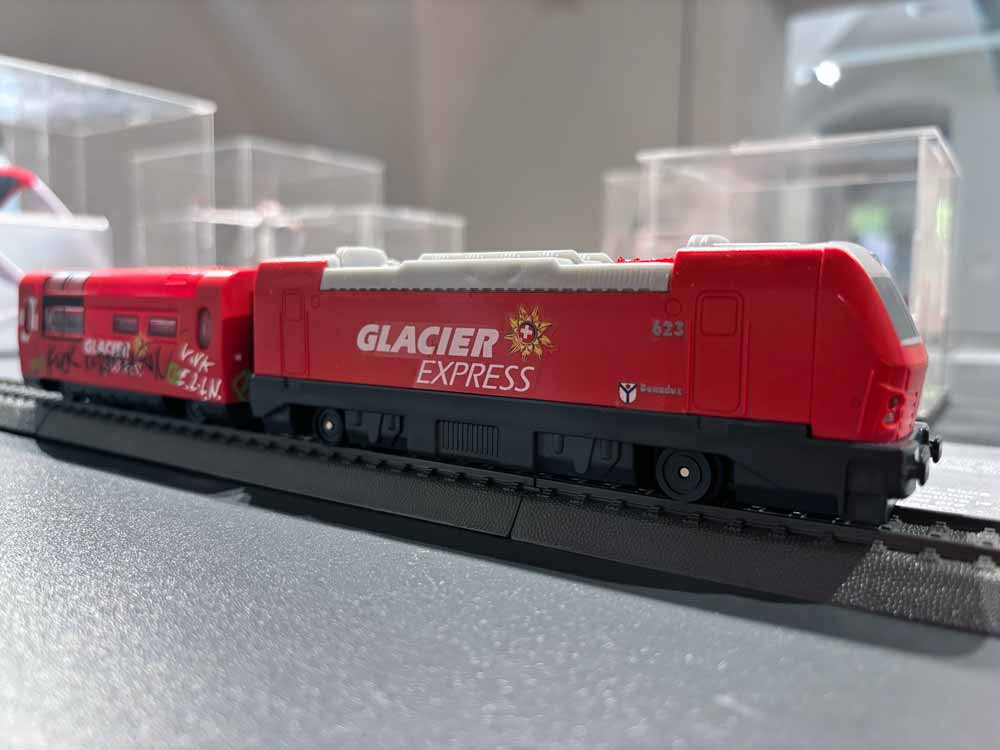
object (diorama), metal, plastic, 260 x 90 x 100 cm
The Swiss luxury train Glacier Express runs among the Swiss glaciers. It started its service in 1930, and since then the service has had an estimated grand total of 9–10 million passengers. It is one of the emblematic symbols of panoptic tourism.
Some of the materials of the present find (notes, objects) suggest that Sunshine visited its route. In 2019 the train was vandalised, the perpetrator was never revealed.
OpenAI. (2026). ChatGPT (GPT-5.6) [Large language model]. See prompts at the end
History, ownership, panoptic tourism, passenger development, incidents and model culture
Scope: Establishment and major turning points; ownership; place within Swiss tourism; panoptic and photographic forms of looking; passenger numbers; disturbances, accidents and vandalism evidence; railway models; and the Märklin my world Glacier Express Starter Set.
Abstract
The Glacier Express is a branded through-service rather than a single independently owned railway line. Its route was assembled from metre-gauge networks completed between 1891 and 1926, and the first through train ran on 25 June 1930. The Furka Base Tunnel transformed it into a year-round product in 1982; panorama cars, unified red branding, UNESCO-associated scenery, Excellence Class and digital narration subsequently made the act of looking its principal commodity. Since 2017 Glacier Express AG, owned equally by the Rhaetian Railway and Matterhorn Gotthard Bahn, has managed the brand while operations remain distributed across the two railway systems. Recent official totals rose from 281,340 passengers in 2023 to 313,863 in 2025. The train exemplifies panoptic tourism by organising Alpine landscape into a reserved, narrated and photographically reproducible field of view. Its Märklin my world starter set translates that apparatus into a child-oriented miniature. No reliable record was found for a specific 2019 vandalism incident; the project should therefore distinguish documented network graffiti from the parafictional role of the graffitied door in Tag!
Project links and cross-references: Project website · Exhibition pages · Supporting archive
Contents
1. Establishment and major historical turning points
2. Ownership and organisational structure
3. Tourism and the panoptic gaze
4. Passenger numbers and demand
5. Disturbances, incidents and vandalism
6. Appearance, model culture and the Märklin starter set
7. Conclusions
Numbered academic reference list
Appendix: User prompts
1. Establishment of the line and major historical turning points
1.1 The route was assembled, not founded at once
The expression “establishment of the Glacier Express line” can be misleading. The Glacier Express did not originate as a newly constructed railway between Zermatt and St. Moritz. It emerged when three existing railway companies coordinated a through tourist train across a chain of separately built metre-gauge lines. This distinction matters because the route’s history is simultaneously technical, corporate and promotional.
At the western end, the Visp–Zermatt railway opened in 1891, providing access to Zermatt during the era in which Alpine health, climbing and scenic tourism were turning remote villages into international resorts. In the east, the Rhaetian Railway’s Albula line reached St. Moritz in 1904. The line’s viaducts, spiral tunnels and carefully engineered gradients made the Upper Engadin accessible and later became attractions in their own right.
The difficult central connection across the Furka and Oberalp region was completed by the Furka–Oberalp Railway in 1926 after earlier financial difficulties and reorganisation. By the end of the 1920s, the infrastructure existed for a long-distance through service linking Zermatt, Brig, Andermatt, Disentis, Chur and St. Moritz.
Table 1. Formation and development timeline
Date | Turning point | Significance |
1891 | Visp–Zermatt railway opens | Creates rail access to the western resort terminus. |
1903–04 | Albula line opens and reaches St. Moritz | Engineering landscape later central to Glacier Express imagery and UNESCO status. |
1926 | Furka–Oberalp through route completed | Closes the central gap between the western and eastern networks. |
25 Jun 1930 | First Glacier Express | Tourism-specific through service from Zermatt to St. Moritz. |
1942 | Remaining Furka–Oberalp steam operation ends | Through journey becomes fully electric. |
1948 | Post-war service resumes | Re-establishes international tourist operation after wartime suspension. |
26 Jun 1982 | Furka Base Tunnel opens | Enables year-round, avalanche-protected operation. |
1984–85 | Reservation and capacity expansion | Product becomes easier to package and market internationally. |
1993–94 | Panorama trains; passenger total exceeds 250,000 | The viewing experience becomes the defining product. |
2003 | BVZ and Furka–Oberalp merge as MGB | Simplifies the western operating partner. |
2006 | New panorama stock and unified design | Red livery and slanted Swiss cross strengthen global recognition. |
2008 | Albula/Bernina lines gain UNESCO status | Engineering route is formalised as world heritage. |
2017 | Glacier Express AG founded | Brand management separated into a jointly owned company. |
2019 | Excellence Class launched | High-end hospitality becomes a distinct tier. |
2021 | Refurbishment and infotainment | Digital narration and passenger photography are further integrated. |
Academic source links: The Railway Journey | The three systems of rail tourism | Promoting Swiss tours, 1888–1939 | How skiing transformed the Alps after 1930
References: [1]; [6], 31–40; [7], 31–47; [8], 78–108.
1.2 The inaugural service of 1930
The first Glacier Express departed on 25 June 1930. The original service used first-, second- and third-class passenger or saloon cars together with a dining car. It was conceived from the outset as a tourism-specific railway offer linking the fashionable destinations of Zermatt and St. Moritz, rather than as an ordinary regional stopping service.
The first route crossed the high Furka summit section and the 2,162-metre summit tunnel. This offered proximity to the Rhône Glacier and gave the train its name, but it also imposed a fundamental weakness: deep snow and avalanche danger prevented winter operation. The “express” was consequently a seasonal, slow, multi-company journey whose prestige came from continuity across a difficult mountain geography, not from speed.
1.3 War, electrification and post-war modernisation
The service was suspended during the Second World War and resumed in 1948. In parallel, the route’s traction was modernised: RhB had completed its network electrification earlier, while steam operation on the Furka–Oberalp section continued until 1942. Post-war improvements to rolling stock, comfort and journey time gradually made the service more consistent and widened the dining-car operation.
These changes did not yet produce the fully standardised “red panorama train” familiar today. The Glacier Express remained a coordinated train made up of vehicles and locomotives supplied by the partner railways. Its identity was therefore initially carried by the timetable, route name, dining service and destination pairing more than by a uniform exterior design.
1.4 The Furka Base Tunnel and the invention of a year-round product
The 15.4-kilometre Furka Base Tunnel opened on 26 June 1982. By bypassing the exposed summit route, it created an avalanche-protected winter connection and converted the Glacier Express from a seasonal attraction into a year-round tourism product. This was not merely an infrastructure improvement: it changed the economics of tour packaging, staffing, international marketing and fleet utilisation.
The transformation was rapid. Individual seat reservations were introduced in 1984; television exposure and international promotion expanded; and additional trains were added in 1985. Glacier Express AG’s historical account states that passenger numbers doubled to 184,000 within a year. The official figure is useful as an indicator of the post-tunnel surge, although the page does not supply a detailed statistical table for the preceding year.
1.5 Panorama cars and the consolidation of the visual brand
In 1993, the first modern panorama trains combined a nostalgic dining car with five cars glazed up to the ceiling. This architectural change made the window view—not merely the destination—the central commodity. Passenger numbers exceeded 250,000 in 1994, and official history records 2.75 million travellers between 1982 and 1996.
The 2005 seventy-fifth anniversary was followed by the delivery of a new generation of panorama cars in 2006. A unified red exterior, large “Glacier Express” lettering and the slanted white Swiss cross transformed a multi-company service into a highly recognisable visual object. Service at the seat and on-board catering further integrated hospitality into the railway journey.
1.6 Heritage, luxury and digital mediation
In 2008 the Albula and Bernina lines were inscribed on the UNESCO World Heritage List. Although the Glacier Express does not use the Bernina line, the designation strengthened the heritage status of its Albula section. UNESCO describes the railway and surrounding landscape as an outstanding technical, architectural and environmental ensemble whose social and economic consequences for mountain communities were substantial and lasting. [8]
Excellence Class, introduced in 2019, formalised an ultra-premium segment with low-density seating and elaborate gastronomy. The 2021 refurbishment of first- and second-class cars added multilingual infotainment and an entrance-door window that can be opened for glare-free photography. These details are historically significant: the product now anticipates not only viewing but also the production and circulation of images.
2. Ownership and organisational structure
2.1 Glacier Express AG
Glacier Express AG was founded in Andermatt on 23 August 2017. RhB and MGB each hold 50 per cent. The new company was created to place organisation, commercial responsibility and brand positioning “in one hand”, particularly in response to online booking, social media, shorter itinerary preferences and the need for a unified international market presence.
This does not mean that Glacier Express AG owns the full 291-kilometre railway infrastructure. The train continues to operate across the networks of the two partner railways. The separate company manages the Glacier Express product and brand; infrastructure, train operations, maintenance and regional public-transport obligations remain embedded in the partner systems. BVZ reporting records the operating services and track charges associated with the Glacier Express as transactions among related companies.
Table 2. Simplified ownership and operating structure
Entity | Ownership / control | Function in the system |
Glacier Express AG | 50% RhB; 50% MGB/BVZ side | Brand, sales, product development, market positioning and coordination. |
Rhaetian Railway (RhB) | Public-law-oriented private joint-stock company; 51.3% Canton Graubünden, 43.1% Swiss Confederation, remainder municipalities/private | Eastern infrastructure and operations, including the UNESCO Albula route. |
Matterhorn Gotthard Bahn (MGB) | Operating and infrastructure entities within the BVZ Group structure | Western and central sections from Zermatt via Brig and Andermatt to Disentis. |
Panoramic Gourmet AG | Joint 50% participation in BVZ reporting | On-board catering and hospitality services associated with panoramic trains. |
Academic source links: The three systems of rail tourism
References: [6], 31–40.
2.2 Public infrastructure and a commercial tourism brand
RhB’s shareholder structure shows why the Glacier Express cannot be understood simply as a private luxury operator. RhB is legally a joint-stock company, but its dominant shareholders are the Canton of Graubünden and the Swiss Confederation. It combines public-service mobility, freight, infrastructure and tourism. On the western side, BVZ Group similarly combines subsidised regional mobility with market-based tourism businesses.
The Glacier Express therefore sits at the boundary between public infrastructure and commercial spectacle. The route’s reliability, tunnels, stations, snow protection and emergency response depend on railway systems serving residents and freight, while the branded train extracts added value through reservations, premium service, gastronomy, international distribution and visual distinction.
3. The Glacier Express in tourism and the “panoptical” gaze
3.1 Position in the Swiss tourism industry
The Glacier Express is a flagship of Swiss rail tourism and a component of the wider Grand Train Tour of Switzerland. It links globally recognised resort brands, supports multi-day packages, and can also be sold in partial sections or as a day excursion from cities such as Zurich, Bern, Lucerne and Interlaken. Its sales materials are explicitly designed for tour operators, group allotments and international itinerary construction.
The product integrates multiple tourism sectors: hotels at both termini and intermediate destinations; travel agencies and tour operators; reservation platforms; on-board catering; regional food supply; souvenir sales; UNESCO interpretation; destination marketing; and onward mountain railways such as Gornergrat. Railway tourism research stresses that such stakeholder coordination can spread benefits across local businesses and enhance the competitiveness of regions that would otherwise be peripheral. [6, 7]
Historically, this role continues a long pattern in which organised tours, photography, printed itineraries and transport companies made the Swiss Alps legible and purchasable for foreign visitors. Dominici and Maitland’s study of the Polytechnic Touring Association shows that Swiss tours were already central to the transition from educational travel to commercial tourism before the Glacier Express was launched. [7]
3.2 From panoramic perception to the tourist gaze
Wolfgang Schivelbusch argued that railway travel introduced a “panoramic perception”: the traveller no longer encounters the landscape at walking pace but sees it as a moving sequence framed by the carriage. The Glacier Express intensifies this condition. The journey’s length, low average speed, reserved seating and ceiling-high windows turn the carriage into a mobile viewing chamber. [1]
Urry and Larsen’s “tourist gaze” adds a social dimension. Tourists do not simply look freely; guidebooks, advertising, media and tourism organisations teach them which views are significant. Glacier Express marketing identifies the Landwasser Viaduct, Rhine Gorge, Oberalp Pass, Matterhorn, villages, glaciers and UNESCO areas as a canonical visual sequence. The on-board infotainment system reinforces this choreography by timing information to the passing landscape. [2]
The phrase “panoptical tourism” is most useful here through Chaim Noy’s concept of tourism’s “panoptic photo-industry”. Noy examines how tourism institutions stage photographic situations and organise visitors as both viewers and visible participants. On the Glacier Express, the passenger observes a broad Alpine panorama while simultaneously producing photographs, videos and social-media posts that reproduce the train’s branded viewpoint. [3]
INTERPRETIVE DEFINITION In this report, “panoptical tourism” means a tourism arrangement that offers extensive visual command over a landscape while also organising, recording and commercialising the act of looking. It is not a claim that the Glacier Express is a literal surveillance institution. |
3.3 The carriage as a viewing apparatus
Several design choices make the train function as a viewing apparatus:
- Ceiling-high panoramic glazing minimises the visible boundary between passenger and landscape.
- Reserved seats stabilise the passenger’s viewing position and make the experience pre-allocatable to tour groups.
- The route is narrated as a sequence of named highlights rather than as undifferentiated everyday territory.
- Food is served at the seat, reducing the need to leave the visual field and merging consumption with observation.
- The openable photography window acknowledges that image production is a designed part of the service.
- Official image libraries, branded merchandise and model trains extend the view beyond the journey into circulation, memory and collecting. [9]
3.4 Benefits and tensions
The benefits are substantial. The train gives international visibility to mountain regions, supports hospitality and distribution networks, encourages rail-based rather than car-based itineraries, and presents historic engineering as a living heritage system. UNESCO recognition also connects spectacular scenery to a more serious account of technological adaptation and the socio-economic opening of Alpine communities. [6, 8]
The same process can narrow the landscape. Marketing tends to foreground scenic emptiness, technical icons, traditional villages and a generalised “Swissness”. It can background maintenance labour, regional commuters, freight, ordinary settlement, tourism pressure and the climate vulnerability of the glaciers invoked by the brand. Mele and Egberts show that representations of the Swiss Alps often reproduce aesthetic and commercial conventions, even when travel narratives also contain counter-images of everyday life and local culture. [4]
Gyimóthy’s analysis of Bollywood-related tourism in the Swiss Alps demonstrates that Alpine destinations are continually retextured by media, global audiences and imported cultural scripts. The Glacier Express is part of the same process: it does not merely reveal an already existing landscape but participates in producing what the landscape means to international visitors. [5]
Academic source links: The Railway Journey | The Tourist Gaze 3.0 | Tourism’s panoptic photo-industry | Representations of the Swiss Alps | Destination texture in the Swiss Alps | The three systems of rail tourism | Promoting Swiss tours, 1888–1939 | How skiing transformed the Alps after 1930 | Motivations for glacier tourism in the European Alps
References: [1]; [2]; [3], 48–62; [4], 785–806; [5], 292–314; [6], 31–40; [7], 31–47; [8], 78–108; [10], 1373–1393.
4. Passenger numbers and demand
Passenger numbers reveal three broad phases: a post-1982 step change after year-round operation became possible; rapid growth during the reservation, marketing and panorama-car era; and a current high-volume market above 300,000 annual passengers. The historical series is incomplete, so the safest presentation combines explicitly reported milestones with recent annual totals.
Table 3. Reported Glacier Express passenger figures
Period / year | Passengers | Interpretive note |
1984–85 context | 184,000 | Official history says numbers doubled within a year after reservation/marketing changes; baseline not tabulated. |
1982–1996 | 2.75 million total | Cumulative figure across fifteen years; arithmetic mean about 183,000 per year, but distribution was uneven. |
1994 | >250,000 | First year above the quarter-million threshold. |
2023 | 281,340 | Published in Sales Manual 2025. |
2024 | 288,218 | +2.4% compared with 2023; published in Sales Manual 2026. |
2025 | 313,863 | +8.9% compared with 2024 and +11.6% compared with 2023; published in Sales Manual 2027. |
Figure 1. Recent operator-reported Glacier Express passenger totals, 2023–2025.
Figure 1. Recent annual passenger totals reported by Glacier Express AG. The 2025 total represents an 8.9% increase over 2024.
The recent rise is commercially significant because it occurs in a mature premium product rather than a newly opened attraction. The 2025 total of 313,863 is the strongest of the three recent figures and is approximately 11.6 per cent above 2023. The data nevertheless should not be treated as a complete measure of regional tourism impact: they do not show origin markets, length of journey, expenditure, repeat visitation, load factors or substitution from ordinary trains.
The passenger counts also reflect product flexibility. Glacier Express is sold both end-to-end and in shorter bookable sections. This widens the addressable market, allows passengers to combine the train with city stays or other scenic railways, and increases the possibility that a “passenger” represents a partial rather than full-route journey.
5. Disturbances, incidents and vandalism
5.1 Structural exposure to Alpine hazards
Disturbance is built into the geography of the route. Snow, avalanches, floods, rockfall, erosion and difficult access can damage infrastructure or lengthen recovery. The original Furka summit route made this vulnerability most visible: winter closure was unavoidable until the base tunnel opened in 1982. Modern tunnels, galleries, retaining structures and hazard monitoring reduce risk but cannot eliminate it.
Table 4. Selected documented disturbances and incidents
Date | Event | Effect | Category |
1930–1981 | Seasonal closure of Furka summit section | Snow and avalanche danger prevented winter Glacier Express operation. | Operational / natural hazard |
Second World War; resumed 1948 | Service suspension | International tourist service interrupted by wartime conditions. | Political / operational |
23 Jul 2010 | Fiesch accident, train 906 | Rear vehicles tipped in a 35 km/h curve after excessive speed; one passenger killed and 42 injured. | Safety / human factors |
Jun–Aug 2024 | Flood damage on MGB network | Fiesch–Oberwald closed about one week; Visp–Täsch closed 21 June–26 August; bus replacement used. | Natural hazard / infrastructure |
10–11 Jul 2025 | Rockfall on Albula line | Overhead line and infrastructure damaged; Glacier Express diverted via Prättigau and Vereina. | Natural hazard / infrastructure |
Ongoing network issue | Graffiti on RhB infrastructure | RhB reports annual removal costs of several hundred thousand francs across its network; no recurring GEX-specific pattern established. | Vandalism / maintenance |
5.2 The 2010 Fiesch accident
On 23 July 2010, Glacier Express train 906 was involved in the route’s most serious modern accident between Lax and Fiesch. The Swiss federal investigation concluded that the train entered or remained within a curve restricted to 35 km/h at excessive speed. The vehicles did not tip because of defective track or adverse geology; excessive centrifugal force caused the rear portion of the train to overturn. One Japanese passenger died and 42 passengers were injured.
The accident is analytically important because it contrasts with the brand’s imagery of effortless, controlled slowness. It also illustrates that a multi-company scenic product remains a safety-critical railway operation governed by ordinary rules of braking, speed restrictions, train length and infrastructure. The official investigation attributed the event to operation at excessive speed rather than to the panorama-car design or the mountain environment.
5.3 Floods and rockfall
At the end of June 2024, flood damage strongly affected the BVZ/MGB system. The Fiesch–Oberwald section was closed for roughly a week, while rail operation between Visp and Täsch was interrupted from 21 June until 26 August. Bus replacement kept Zermatt accessible, but the event imposed approximately CHF 1 million in mobility-segment impact by the end of June and required difficult infrastructure reconstruction.
In July 2025, rockfall on the Albula line damaged the overhead line and infrastructure between Thusis and Tiefencastel. Replacement buses were used, while Glacier Express and Bernina Express trains were diverted through Prättigau and the Vereina route. The line reopened after inspection and clearance. This incident shows the value of network redundancy, but a diversion also alters the very landscape itinerary being sold.
5.4 Vandalism: what is and is not documented
No reliable source located for this report documents a sustained campaign of vandalism specifically targeting Glacier Express trains. The strongest evidence concerns RhB’s wider infrastructure. In 2025, Swiss public broadcaster SRF reported that RhB sought to maintain a graffiti-free network and spent several hundred thousand Swiss francs annually on removal. Graffiti was treated as criminal damage and as a safety issue for workers conducting cleaning near railway operations.
This distinction should be preserved. It is reasonable to include graffiti and vandalism among the maintenance and image-management concerns of the operating networks, but it would be inaccurate to present vandalism as a defining or frequent Glacier Express incident on the present evidence. The branded train’s reputation is more clearly affected by accidents, weather and route disruption than by targeted malicious damage.
6. Appearance, model culture and the Märklin starter set
6.1 Evolution of the real train’s appearance
The Glacier Express’s present appearance is the result of gradual standardisation. The 1930 train was a mixed consist of partner-railway vehicles, including saloon and passenger cars from several classes and a dining car. Its identity was primarily textual and operational. Later red RhB and Furka–Oberalp/MGB vehicles made the train more visually coherent, but the decisive change was the panorama-car era.
The 1993 cars turned the roofline into glass and made the interior view outward the defining feature. The 2006 generation established the now familiar system: bright red bodies, dark panoramic glazing, large white “Glacier Express” wordmarks and a dynamically angled Swiss cross. Excellence Class added a more restrained luxury interior, while the refurbished standard classes retained the panoramic architecture and added digital interpretation.
6.2 The model market: accuracy, scale and memory
Model trains translate the Glacier Express from a timed journey into an object that can be owned, arranged and replayed. Susan Stewart’s study of miniatures and souvenirs is useful here: miniaturisation creates a controlled, interior world that appears complete because complexity has been reduced. A model Glacier Express condenses landscape, railway engineering, tourism memory and national branding into a train that circles a domestic track. [9]
BEMO and LGB occupy the fidelity-oriented end of this spectrum. BEMO’s H0m range uses metre-gauge track and offers individual panorama cars, dining cars and locomotives associated with RhB and MGB. BEMO also markets adapted H0 standard-gauge versions, showing that even enthusiast models may compromise track gauge to fit established layouts. LGB’s G-scale vehicles emphasise large physical presence, detailed paint and lettering, and the recreation of first-, second- and Excellence Class cars.
Table 5. Comparing the prototype and selected model systems
Object | Scale / system | Primary audience | Fidelity | Main compromise |
Actual Glacier Express | Metre gauge; multi-operator railway | Passengers / tourism | Operationally authentic | Traction and consist vary by route and timetable. |
BEMO H0m | H0m, 12 mm track | Adult modeller / collector | High | Requires specialist narrow-gauge layout and separate vehicles. |
BEMO H0 adapted | H0, 16.5 mm track | Mainstream H0 modeller | Medium–high visually | Normal-gauge bogies compromise the metre-gauge prototype. |
LGB | G scale / garden railway | Collector / family garden railway | High visual and livery fidelity | Large-scale system necessarily compresses full train length. |
Märklin my world 29348 | Nominal H0 / battery plastic track | Children aged 3+ | Brand-based rather than prototype-based | Fictional Vectron-style locomotive, short consist, magnetic couplers, simplified dimensions. |
6.3 Märklin my world “Glacier Express” Starter Set, article 29348
Märklin’s set is officially classified as H0 / 1:87, but it belongs to the my world children’s system rather than Märklin’s conventional electrically powered scale-model railway. It contains a battery-powered locomotive, two panorama cars and a dining car. The train is approximately 50 centimetres long and operates on rugged plastic track controlled by a wireless Power Control Stick.
The locomotive offers three speeds in both directions, three sound functions and controllable triple headlights. It charges by USB. The cars have transparent and removable roofs, interior details and childproof magnetic couplers. The set includes sixteen curved track sections, ten straight sections, left and right turnouts, the controller, charging cable, batteries and stickers.
The most revealing detail is Märklin’s “prototype information”, which imagines the train hauled by a powerful “Vectron” electric locomotive. The real Glacier Express is a metre-gauge service using RhB and MGB traction suited to adhesion and rack operation; a standard-gauge Vectron is not its authentic locomotive. The choice creates a familiar contemporary locomotive shape that works within the my world fleet, but it turns the set into a branded fantasy rather than a technical reproduction.
Nevertheless, the toy accurately identifies the elements through which the public recognises the Glacier Express: red colour, white lettering, panoramic glazing, a dining car, mountain-viewing passengers and Swiss food. In semiotic terms, these signs carry more weight for the starter-set audience than correct bogies, rack equipment, train length or locomotive class. The model therefore teaches the brand before it teaches railway engineering.
ASSESSMENT OF THE MÄRKLIN SET Article 29348 is best described as a robust, child-oriented interpretation of the Glacier Express, not a scale-faithful model of a real consist. Its value lies in recognisability, playability and narrative clarity; its principal historical limitation is the fictional traction and compressed four-vehicle formation. |
Academic source links: On Longing: miniature, souvenir and collection
References: [9].
7. Conclusions
- The Glacier Express was established as a service in 1930, but its route was the outcome of four decades of staged railway construction. It remains a branded through-train rather than a separately owned line.
- The Furka Base Tunnel in 1982 was the most consequential technical turning point because it converted a seasonal Alpine crossing into a year-round commercial tourism product.
- Panorama cars, reservations, a unified livery, UNESCO status, premium gastronomy and digital narration progressively shifted value from transportation alone to a curated experience of looking. [2, 3, 8]
- Ownership is deliberately hybrid: Glacier Express AG is a 50/50 commercial joint venture, while the journey relies on publicly embedded railway companies and infrastructure.
- Official recent passenger totals show substantial demand: 281,340 in 2023, 288,218 in 2024 and 313,863 in 2025. The absence of a continuous audited series limits longer-term quantitative claims.
- The major documented risks are Alpine hazards, infrastructure interruption and railway safety. The 2010 Fiesch accident remains the most serious modern incident. Evidence does not support portraying targeted vandalism as a characteristic Glacier Express problem.
- Models extend the train’s tourism image into domestic play and collecting. BEMO and LGB pursue prototype fidelity; Märklin my world extracts the brand’s most recognisable signs and reorganises them for safe, accessible play. [9]
Supplement to Section 5: archive / parafiction boundary
5.4 Evidentiary boundary: the 2019 vandalism claim
The exhibition synopsis currently refers to vandalism of the Glacier Express in 2019. The research undertaken for this report did not locate a peer-reviewed, official safety, police or high-quality contemporary record that confirms a specific 2019 attack on the branded train. Graffiti and cleaning costs are documented across the wider Rhaetian Railway network, but that is not equivalent to a verified Glacier Express incident.
For the project, this gap should be handled as an explicit boundary between archive and parafiction. The graffitied train door in Tag! can operate as an artistic object connecting tourism, property, marking and sabotage, but the website background text should not present the date or perpetrator as established history unless a verifiable primary record is later found.
Cross-references within the installation
Read with the Noah’s Ark report, the train extends the project’s analysis of an expeditionary gaze that converts mountains into legible signs. Read with Mount Scorluzzo, it shows the tourism infrastructure surrounding Alpine landscapes that climate change is also converting into archaeological archives. Read with Tag!, Sabotage and Future, it demonstrates how the same branded object can move from consumption and collecting into the vocabulary of marking, property damage and imagined direct action.
Primary evidence links
These operator, public-authority and manufacturer records support exact operational and product data. They are not part of the numbered academic bibliography.
- Glacier Express AG: official history and milestones
- Glacier Express AG: company, route and joint ownership
- Matterhorn Gotthard Bahn: history of the Furka–Oberalp Railway
- Rhaetian Railway: corporate history
- Rhaetian Railway: legal form and shareholders
- Glacier Express sales manual 2025: operator-reported 2023 passenger total
- Glacier Express sales manual 2026: operator-reported 2024 passenger total
- Glacier Express sales manual 2027: operator-reported 2025 passenger total
- Swiss accident-investigation final report: Glacier Express train 906, 23 July 2010
- UNESCO: Rhaetian Railway in the Albula / Bernina Landscapes
- Märklin my world Glacier Express Starter Set, article 29348
- BEMO Glacier Express and panorama-car models
- LGB Glacier Express model range
Numbered academic reference list
Chicago bibliography style. The numbered list contains only peer-reviewed journal articles and scholarly books or chapters issued by academic publishers.
1. Schivelbusch, Wolfgang. The Railway Journey: The Industrialization of Time and Space in the Nineteenth Century. Berkeley: University of California Press, 1986. Persistent link
2. Urry, John, and Jonas Larsen. The Tourist Gaze 3.0. 3rd ed. London: SAGE, 2011. Persistent link
3. Noy, Chaim. “Staging Portraits: Tourism’s Panoptic Photo-Industry.” Annals of Tourism Research 47 (2014): 48–62. https://doi.org/10.1016/j.annals.2014.04.004. Persistent link
4. Mele, Emanuele, and Linde Egberts. “Exploring Travel Blogs on Tourism and Landscape Heritage: Representations of the Swiss Alps.” Journal of Heritage Tourism 18, no. 6 (2023): 785–806. https://doi.org/10.1080/1743873X.2023.2237617. Persistent link
5. Gyimóthy, Szilvia. “Transformations in Destination Texture: Curry and Bollywood Romance in the Swiss Alps.” Tourist Studies 18, no. 3 (2018): 292–314. https://doi.org/10.1177/1468797618771692. Persistent link
6. Blancheton, Bertrand, and Jean-Jacques Marchi. “The Three Systems of Rail Tourism: French Case.” Tourism Management Perspectives 5 (2013): 31–40. Persistent link
7. Dominici, Sara, and Robert Maitland. “The PTA: Promoting Swiss Tours, 1888–1939.” Annals of Tourism Research 60 (2016): 31–47. https://doi.org/10.1016/j.annals.2016.05.010. Persistent link
8. Denning, Andrew. “From Sublime Landscapes to ‘White Gold’: How Skiing Transformed the Alps after 1930.” Environmental History 19, no. 1 (2014): 78–108. https://doi.org/10.1093/envhis/emt105. Persistent link
9. Stewart, Susan. On Longing: Narratives of the Miniature, the Gigantic, the Souvenir, the Collection. Durham, NC: Duke University Press, 1993. Persistent link
10. Salim, Emmanuel, Marius Mayer, Philipp Sacher, and Ludovic Ravanel. “Visitors’ Motivations to Engage in Glacier Tourism in the European Alps: Comparison of Six Sites in France, Switzerland, and Austria.” Journal of Sustainable Tourism 31, no. 6 (2023): 1373–1393. https://doi.org/10.1080/09669582.2022.2044833. Persistent link
Appendix: User prompts related to this report
Prompts are reproduced as a research-process record. Minor typographic normalisation has been limited to quotation marks and line breaks; wording and instructions are otherwise retained.
1. Make a research on the Swiss train Glacier Express.
1. establishment of the line, major turning points in its history
2. ownership
3. its place and relation to tourism industry (see panoptical tourism)
4. passanger numbers,
5. Distubances and incidents, vandalism
6. the appearance of its models, and the Märklin Glacier Express Starter Set
7. use reliable peer reviewed sources,
8. create structured word document, add a numbered list of the sources at the end in Chicago style
2. General remarks and new request:
1. I have been asking you to create individual reports on different topics, in this case the train service and model of Glacier Express.
2. Nonetheless these materials should converge into a unity which is the archive itself and the supporting physical installation. This convergence should be based on a synthesys of all of my other topics, questions and criteria raised in all of the other chat sessions, which are all part of the same project the main scope of which is an art installation and a supporting archive that grows by time. The archive is meant for both professional and nonprofessional use, it should be informative within its artistic and pedagogical scope as well.
3. the main line of thoughts of the project departs from panoptic tourism and concludes to ecoterrorism in a narrative line. Therefore all the reports should follow this general direction in their approach and references.
4. The reports we are working on now will all serve as a background research material published on the project website for the set of objects that will be on display, Each object will have its own page (see: https://glacial-archaeology.net/category/exhibition/). See: Szabolcs KissPál – The sunshine find_for translation. I am also adding the brief description of the project’s general concept, see: Szabolcs KissPál – The sunshine find. The website will have a separate but interconnected section for both the exhibition and the supporting archive. https://glacial-archaeology.net/an-archive-of-narratives-on-global-warming-copy/ Inspect the site while note that it doesn’t have its final structure yet!
5. the scope with the reports is to produce a set of background research material for each object in part that should refer to each other, and should be unified in their narrative and typographic structure, tone, and scope. Pay attention to snychronise the focus points of different partial research tasks when possible with cross references!
6. I am attaching two of your previous reports (noahs_ark_expeditions_1959_1990_academic_sources_new_tab_links.docx, Container_Mount_Scorluzzo_WWI_Shelter_Research_Report). Please develop and and apply to these reports a uniform structure both content wise and in formal aspects while mostly keeping their original content.
7. Main further formal criteria:
– you should always start with an abstract summarizing your finds in a text no longer than 200 words.
– you should always enlist at the very end of the document all my prompts related to that topic
– the external links should always open in a different tab
– you should be using only valid, peer reviewed academic sources listed and numbered at the end of the documents
– you should apply a somewhat unified narrative structured and a unified formatting (including typeface styles, subtitles structure, etc.
8. – note and memorise the above in your cross-chat memory for rurther tasks
– return the three reports keeping their main content but slightly modified (!) according to the above