Mythos
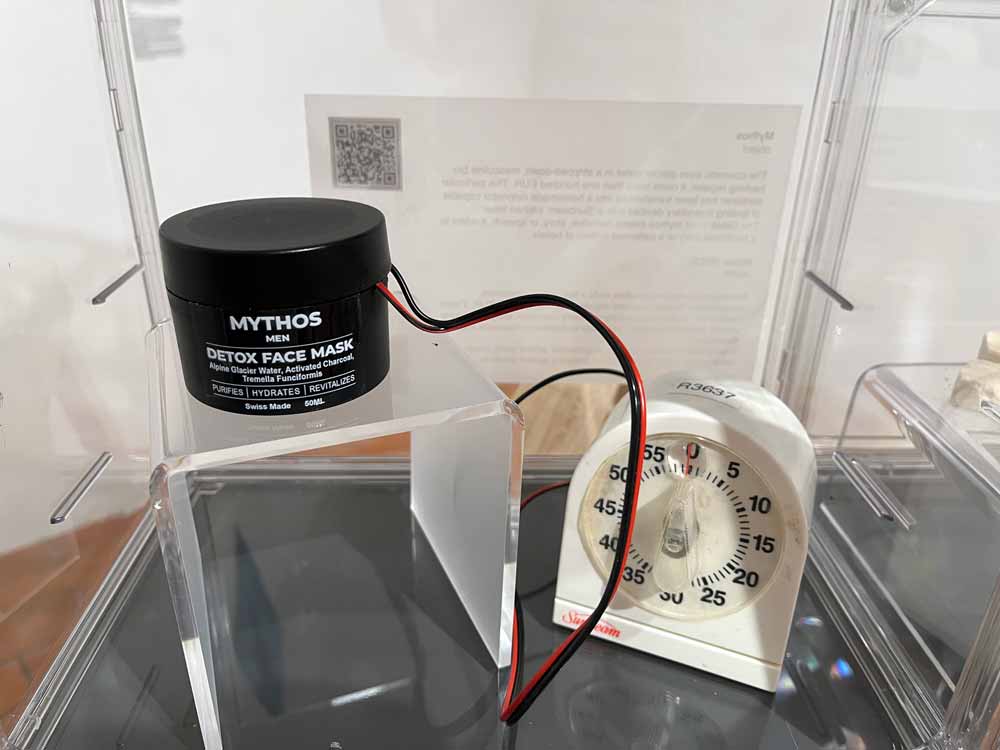
objects, 6 x 4,5 cm
The cosmetic uses glacier water in a stripped-down, masculine biohacking register, it costs more than one hundred EUR. This particular container has been transformed into a homemade detonator capable of igniting incendiary devices with a ‘Sunbeam’ kitchen timer.
The Greek word mythos means narrative, story, or speech, it refers to a traditional story or a patterned system of beliefs.
OpenAI. (2026). ChatGPT (GPT-5.6) [Large language model]. See prompts at the end
Mythos Detox face mask and Sunbeam incendiary timer
Glacier-water cosmetics, masculine self-optimisation and the evidentiary limits of an ELF association
Scope: The Mythos Detox Face Mask, its producer and current market status; glacier-water and biohacking rhetoric; the term mythos; documented Earth Liberation Front use of delayed incendiary devices in the United States, principally 1996–2001; and the distinction between verified history and the installation’s parafictional transformation. Operational construction, wiring, fuel-mixture, placement and deployment details are deliberately excluded.
Abstract
The Mythos Detox Face Mask is currently marketed as a Swiss-made, 50 ml skincare product whose formula is framed through “Alpine Glacier Water”, activated charcoal, purification and anti-ageing. The attached March 2026 dossier correctly identified MYTHOS SKINCARE LTD and the absence of filed revenue figures, although its precise May 2023 availability date rests on an unreproduced social-media trace. The brand’s 2024 redesign explicitly combined biohacking, masculine self-improvement, dark mineral textures and an “ancient wisdom / modern science” formula. Academic research places such grooming within changing but carefully managed masculine consumption. ELF-associated cases prosecuted through Operation Backfire document timed improvised incendiary attacks against property, including ranger stations, industrial facilities, a ski resort and a university horticulture centre.
Project links and cross-references: Elixir (glacier-branded luxury cosmetics) · Thirst (commercialised glacial water) · Sunshine and ELF Timeline (Operation Backfire and Josephine Sunshine Overaker) · No Sprawl (ELF arson targets) · Burn Baby, Burn! and Ignite (combustion objects) · Future (parafictional target list)
Contents
1. Findings extracted from the attached report
2. Product, producer, release evidence and current status
3. Glacier water and the masculine biohacking register
4. Mythos: word, brand and patterned belief
5. ELF incendiary campaigns and delayed ignition
6. The Sunbeam timer: verified history and parafictional boundary
7. Project synthesis and cross-references
8. Numbered academic reference list
Appendix: User prompts
Primary / institutional evidence links: Official Detox Face Mask page | Companies House company overview | Official Mythos article, 14 January 2024
2. Product, producer, release evidence and current status
2.1 Current product data
Field | Documented information |
Official name | Detox Face Mask. |
Brand | Mythos; the earlier “Mythos Men” address now redirects to gomythos.com. |
Format | 50 ml jar. |
Current official price | £45, checked 27 July 2026. |
Manufacturing claim | “Swiss made”; the public product page does not identify the manufacturing site. |
Glacier claim | Marketing names “Alpine Glacier Water” and describes it as sourced from Alpine peaks. |
Ingredient disclosure | The INCI list begins with “Aqua”. The list does not independently identify the water’s geographic origin, so “Alpine Glacier Water” remains a provenance and marketing claim rather than a fact verifiable from the ingredient name alone. |
Promised functions | Hydration, pore cleansing, purification and anti-ageing; these are brand claims and are not independently assessed here. |
Primary / institutional evidence links: Current official product page | Companies House overview
3. Glacier water and the masculine biohacking register
The brand’s commissioned design account explicitly calls Mythos Men a “biohacking brand” and describes a 2024 identity built around ancient wisdom, modern science, minimalist typography, dark colours, charcoal and stone textures, strength, authenticity and health-conscious masculinity. The current product page reinforces this register through “clean”, “high-performance”, anti-ageing and expert-endorsed language, including a testimonial attributed to a leading UK biohacker. The cosmetic is therefore not sold primarily as sensuous luxury; it is presented as a disciplined optimisation tool.
Research on men’s grooming describes skincare as a form of consumption that can remain partly “invisible”: men may use products while avoiding signs coded as feminine, and may justify them through functionality, improvement, health, work or self-management. Mythos fits this pattern. Its glacier-water and charcoal imagery converts a facial mask into a technical, mineral and purifying procedure, while the stripped-down black container reduces the visual vocabulary of conventional beauty.
The glacier reference also belongs to the wider cosmetic use of water as both substance and narrative. Cosmetics commonly rely on water in formulation and throughout manufacturing, cleaning, raw-material production and packaging. A claim of rare or pristine source water does not by itself establish a reduced environmental footprint. No product-specific life-cycle assessment or independently verified water-footprint data for Mythos was located.
Academic source links: Men’s grooming as “invisible consumption” | Water sustainability across the cosmetic life cycle
References: [1], 146–167; [2], 35–51.
Primary / institutional evidence links: Mythos Men branding case study | Current official product and ingredient page
4. Mythos: word, brand and patterned belief
The Greek word mythos has a historical semantic range that includes word, speech, account and story. It should not be reduced to the modern everyday meaning of a falsehood. Scholarship on myth emphasises its political and ideological work: narratives become “mythic” through the authority, identity and significance they organise, and through the actions they make intelligible.
The brand name therefore operates on two levels. First, it promises recovered ancient knowledge, now authenticated by modern science. Second, it creates a patterned belief system around purity, toxicity, optimisation and pristine Alpine origin. This does not mean the product’s ingredients are fictitious. It means that factual ingredients and therapeutic promises are assembled into a larger narrative structure: the glacier becomes a source of moral and bodily renewal, while “science” and “ancient wisdom” jointly authorise the purchase.
Within the exhibition, the semantic hinge is sharper. A container called Mythos is altered from an apparatus of self-care into a supposed apparatus of sabotage. The transition is not evidence about the commercial brand; it is the project’s parafictional operation on the object and on the stories attached to it.
Academic source links: Bruce Lincoln, Theorizing Myth | Chiara Bottici, A Philosophy of Political Myth
References: [3], especially 3–66 and 207–224; [4], 83–130 and 177–260.
5. ELF incendiary campaigns and delayed ignition
5.1 Organisational form and tactical context
The Earth Liberation Front is best understood not as a conventional membership organisation with a central command, but as a decentralised banner or “leaderless resistance” model under which small autonomous groups claimed actions. Scholarly accounts disagree over the usefulness and political effects of the terrorism label, but agree that arson and property destruction became central to the movement’s public identity in the United States during the late 1990s and early 2000s.
In the Operation Backfire case, a 2006 federal indictment alleged that a group calling itself “the Family” used improvised incendiary devices with homemade timers in attacks from 1996 to 2001. The listed targets included ranger stations, wild-horse facilities, meat and lumber businesses, an energy facility and a Colorado ski resort. Later FBI summaries attributed more than forty criminal acts to the group and reported fifteen guilty pleas among seventeen people indicted. These institutional totals and cost estimates changed across official publications and should be treated as case-history estimates rather than a single stable dataset.
Academic source links: Leader and Probst, “The Earth Liberation Front and Environmental Terrorism” | Ackerman, “Beyond Arson?” | Joosse, “Leaderless Resistance and Ideological Inclusion” | Loadenthal, “Deconstructing ‘Eco-Terrorism’”
References: [5], 37–58; [6], 143–170; [7], 351–368; [8], 92–117.
Primary / institutional evidence links: DOJ Operation Backfire indictment announcement | FBI Operation Backfire case history
5.2 Selected documented incidents involving delayed ignition
Date | Target / place | Documented outcome and evidentiary status | Evidence |
19 Oct. 1998 | Vail ski facility, Colorado | An arson claimed in the ELF milieu became the best-known “Family” attack. Later FBI estimates placed damage at $26 million; earlier official estimates differed. No death is reported in the cited case records. | FBI case history; indictment |
Oct. 1998 | Wray Gun Club, Colorado | A 2006 guilty-plea statement records an attempted arson in which the timing devices failed. The case is significant because it directly documents delayed ignition while also showing technical failure and residual danger. | DOJ guilty plea |
21 May 2001 | University of Washington Center for Urban Horticulture, Seattle | Guilty pleas established participation in an arson that destroyed the centre and endangered research collections. The DOJ stated that a destructive device was placed inside the building and that reconstruction cost more than $7 million. | DOJ guilty plea |
The table deliberately omits device components, assembly, timing intervals, concealment, placement and ignition procedures. A timer’s historically relevant function is described only at the general level: it permitted delayed ignition, which could separate the act of placement from the outbreak of fire. Delay did not remove risk to occupants, emergency responders, neighbouring property, animals or ecosystems.
Primary / institutional evidence links: DOJ indictment announcement and site list | DOJ guilty pleas in the UW arson case | FBI Operation Backfire case history
Primary / institutional evidence links: Current FBI wanted notice for Josephine Sunshine Overaker
8. Numbered academic reference list
Chicago bibliography style. Only scholarly books and peer-reviewed journal articles appear in this numbered list. Product pages, registries, branding materials and government case records are identified separately as primary/institutional evidence.
1. Byrne, Angela, and Katie Milestone. “He Wouldn’t Be Seen Using It…” Men’s Use of Male Grooming Products as a Form of Invisible Consumption.” Journal of Consumer Culture 23, no. 1 (2023): 146–167. https://doi.org/10.1177/14695405211066314
2. Aguiar, Joana B., Ana M. Martins, Cristina Almeida, Helena M. Ribeiro, and Joana Marto. “Water Sustainability: A Waterless Life Cycle for Cosmetic Products.” Sustainable Production and Consumption 32 (2022): 35–51. https://doi.org/10.1016/j.spc.2022.04.008
3. Lincoln, Bruce. Theorizing Myth: Narrative, Ideology, and Scholarship. Chicago: University of Chicago Press, 2000. Publisher record
4. Bottici, Chiara. A Philosophy of Political Myth. Cambridge: Cambridge University Press, 2007. https://doi.org/10.1017/CBO9780511498626
5. Leader, Stefan H., and Peter Probst. “The Earth Liberation Front and Environmental Terrorism.” Terrorism and Political Violence 15, no. 4 (2003): 37–58. https://doi.org/10.1080/09546550390449872
6. Ackerman, Gary A. “Beyond Arson? A Threat Assessment of the Earth Liberation Front.” Terrorism and Political Violence 15, no. 4 (2003): 143–170. https://doi.org/10.1080/09546550390449935
7. Joosse, Paul. “Leaderless Resistance and Ideological Inclusion: The Case of the Earth Liberation Front.” Terrorism and Political Violence 19, no. 3 (2007): 351–368. https://doi.org/10.1080/09546550701424042
8. Loadenthal, Michael. “Deconstructing ‘Eco-Terrorism’: Rhetoric, Framing and Statecraft as Seen through the Insight Approach.” Critical Studies on Terrorism 6, no. 1 (2013): 92–117. https://doi.org/10.1080/17539153.2013.765702
9. Taylor, Bron. “Religion, Violence and Radical Environmentalism: From Earth First! to the Unabomber to the Earth Liberation Front.” Terrorism and Political Violence 10, no. 4 (1998): 1–42. https://doi.org/10.1080/09546559808427480
Appendix: User prompts related to this report
Prompts are reproduced chronologically as a research-process record. The wording is retained apart from minor typographic normalisation.
1. Next object description:
The cosmetic uses glacier water in a stripped-down, masculine biohacking register, it costs more than one hundred EUR. This particular container has been transformed into a homemade detonator capable of igniting incendiary devices with a ‘Sunbeam’ kitchen timer.
The Greek word mythos means narrative, story, or speech, it refers to a traditional story or a patterned system of beliefs.
1. Inspect the attached report and extract information from it.
2. connect it to the usage of incendiary devices used by ELF
2. General remarks:
1. I have been asking you to create individual reports on different topics.
2. Nonetheless these materials should converge into a unity which is the archive itself and the supporting physical installation. This convergence should be based on a synthesys of all of my other topics, questions and criteria raised in all of the other chat sessions, which are all part of the same project the main scope of which is an art installation and a supporting archive that grows by time. The archive is meant for both professional and nonprofessional use, it should be informative within its artistic and pedagogical scope as well.
3. the main line of thoughts of the project departs from panoptic tourism and concludes to ecoterrorism in a narrative line. Therefore all the reports should follow this general direction in their approach and references.
4. The reports we are working on now will all serve as a background research material published on the project website for the set of objects that will be on display, Each object will have its own page (see: https://glacial-archaeology.net/category/exhibition/). See: Szabolcs KissPál – The sunshine find_for translation. I am also adding the brief description of the project’s general concept, see: Szabolcs KissPál – The sunshine find. The website will have a separate but interconnected section for both the exhibition and the supporting archive. https://glacial-archaeology.net/an-archive-of-narratives-on-global-warming-copy/ Inspect the site while note that it doesn’t have its final structure yet!
5. the scope with the reports is to produce a set of background research material for each object in part that should refer to each other, and should be unified in their narrative and typographic structure, tone, and scope. Pay attention to snychronise the focus points of different partial research tasks when possible with cross references!
6. I am attaching two of your previous reports (noahs_ark_expeditions_1959_1990_academic_sources_new_tab_links.docx, Container_Mount_Scorluzzo_WWI_Shelter_Research_Report). Please develop and and apply to these reports a uniform structure both content wise and in formal aspects while mostly keeping their original content.
7. Main further formal criteria:
– you should always start with an abstract summarizing your finds in a text no longer than 200 words.
– you should always enlist at the very end of the document all my prompts related to that topic
– the external links should always open in a different tab
– you should be using only valid, peer reviewed academic sources listed and numbered at the end of the documents
– you should apply a somewhat unified narrative structured and a unified formatting (including typeface styles, subtitles structure, etc.
8. – note and memorise the above in your cross-chat memory for rurther tasks