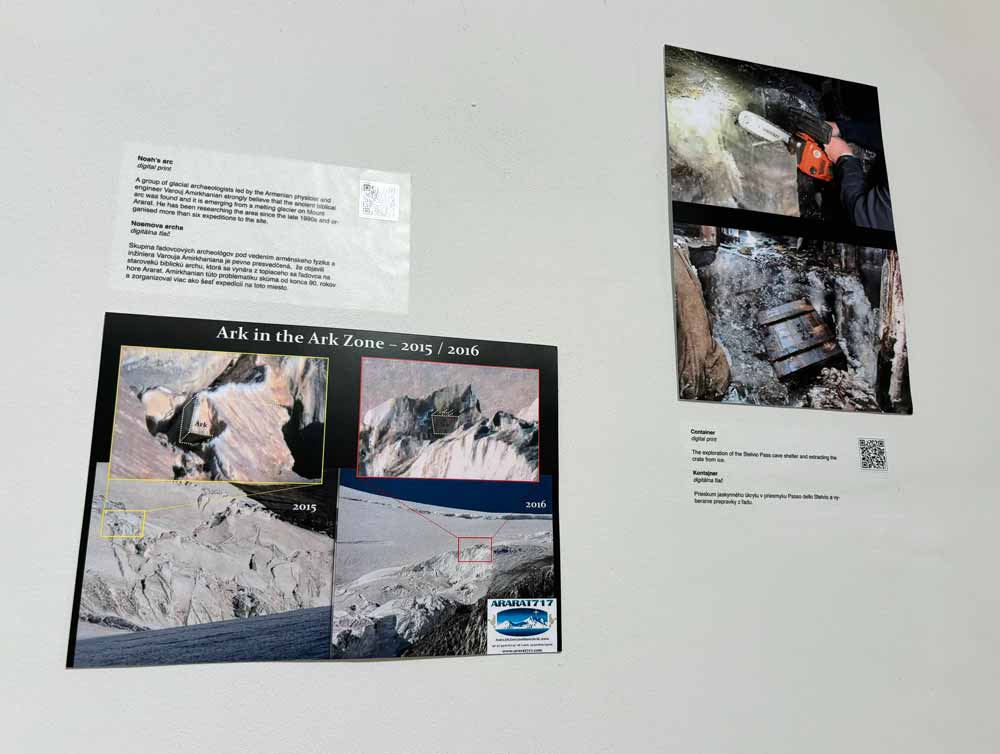
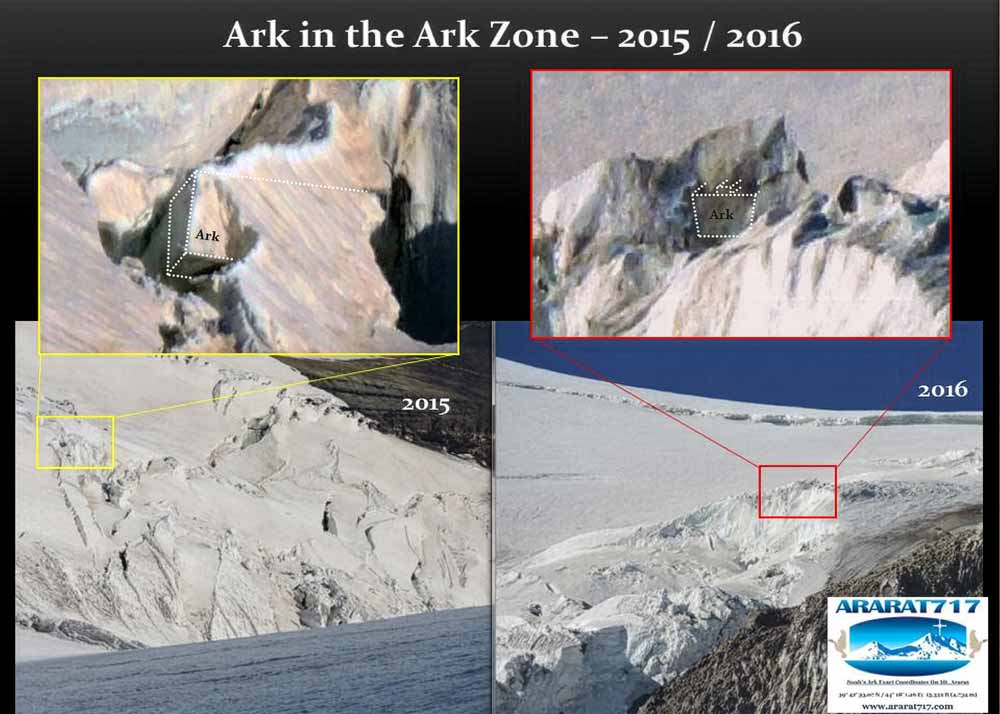
Noah’s arc
digital print, 21 x 30 cm
A group of glacial archaeologists led by the Armenian physicist and engineer Varouj Amirkhanian strongly believe that the ancient biblical arc was found and it is emerging from a melting glacier on Mount Ararat. He has been researching the area since the late 1990s and organised more than six expeditions to the site. There were various earlier searches and expeditions between 1959-1990 that were aiming at finding the arc, all of them failed the scientific consistency tests.
OpenAI. (2026). ChatGPT (GPT-5.6) [Large language model]. See prompts at the end
Noah’s Ark Searches and Expeditions, 1959–1990
A source-critical chronology of exploration, belief and contested evidence
Scope: Modern Ark searches on Mount Ararat and at Durupinar; expedition chronology; material claims; the evidentiary status of Varouj / Varoujan Amirkhanian; and the report’s relation to the installation’s movement from panoramic observation toward ideological action.
Abstract
Between 1959 and 1990, modern searches for Noah’s Ark combined mountaineering, aerial photography, drilling, filming and geophysical interpretation on Mount Ararat and at the separate Durupinar formation. The academically documented expeditions repeatedly generated compelling images and material claims, but none produced a vessel or artefact accepted by archaeology or geology. Alleged Ark wood recovered in 1969 was radiocarbon-dated to the historical period, while the Durupinar feature was explained as a natural geological structure. No peer-reviewed source located for this revision documents a Varouj or Varoujan Amirkhanian expedition within the 1959–1990 period. For The Sunshine Find, this chronology is significant less as a history of discovery than as a history of looking: prior belief, expeditionary technology and media circulation organise ambiguous ice and rock into apparent evidence. Read beside the Mount Scorluzzo shelter, it clarifies the project’s distinction between verified glacial archaeology and narratives that seek confirmation in the landscape.
Project links and cross-references: Project website · Exhibition pages · Supporting archive
Contents
1. Expedition chronology, 1959–1990
2. Varouj / Varoujan Amirkhanian: evidentiary status
3. Interpretive synthesis: ice, faith and evidentiary desire
4. Numbered academic reference list
Appendix: User prompts
1. Expedition chronology, 1959–1990
1. 1959-1960 – Identification and first ground investigation of the Durupinar formation
Organiser(s) | Turkish aerial-mapping personnel; subsequent Archaeological Research Foundation (ARF) party |
Location | Durupinar formation near Dogubayazit, eastern Turkey; separate from Mount Ararat |
Search mode | Aerial-photograph interpretation followed by field inspection |
What happened | A boat-shaped feature became known through Turkish aerial photographs in the late 1950s. An ARF party examined the formation in 1960. The academic historical account reports that the expedition judged it to be a natural clay uplift within volcanic terrain. |
Outcome / significance | The investigation opened a separate Durupinar line of Ark searching, but did not establish an archaeological vessel. Later peer-reviewed geological work identified the feature as a common natural geological structure. |
Academic source links: Oxford University Press volume | Peer-reviewed geological assessment
References: [3], 439-444; [4], 255-256.
2. 1960-1966 – Archaeological Research Foundation expeditions on Mount Ararat
Organiser(s) | Archaeological Research Foundation (ARF), associated with Eryl Cummings, Clifford Burdick, Lawrence Hewitt, and George Vandeman |
Location | Mount Ararat, eastern Turkey |
Search mode | Mountain reconnaissance, photography, and topographic charting |
What happened | Several ARF expeditions travelled to Ararat between 1960 and 1966. Their work photographed and charted extensive parts of the mountain while pursuing reported Ark locations. |
Outcome / significance | The expeditions did not claim to have found any trace of the Ark. Their main documented contribution was reconnaissance and mapping rather than archaeological discovery. |
Academic source links: Oxford University Press volume
References: [4], 251.
3. 1969 – SEARCH Foundation expedition led by Fernand Navarra
Organiser(s) | Scientific Exploration and Archaeological Research Foundation (SEARCH); expedition led by Fernand Navarra |
Location | Glaciated areas of Mount Ararat |
Search mode | Hand drilling in glacier ice and recovery of wood fragments from a meltwater pond |
What happened | SEARCH sponsored a Navarra-led expedition in the summer of 1969. Initial drilling produced only ice. After Navarra indicated another location, the group recovered five pieces of apparently worked wood from a small glacial meltwater pond. |
Outcome / significance | The wood generated substantial publicity, but subsequent scholarly radiocarbon analysis dated the material to the historical period rather than to the era claimed for the biblical Flood. It therefore did not authenticate an ancient Ark. |
Academic source links: Oxford University Press volume | Bailey peer-reviewed analysis | Radiocarbon study in Antiquity
References: [2], 137-146; [4], 253-254; [5], 34-36.
4. 1970 – ‘International Expedition 70’ and John Warwick Montgomery’s ascent
Organiser(s) | Eryl Cummings and collaborators; John Warwick Montgomery undertook a separate permitted ascent after arriving late |
Location | Mount Ararat |
Search mode | Ground ascent and visual reconnaissance |
What happened | The planned international expedition was reduced by withdrawals and delays. Cummings, a Turkish guide, and Mark Albrecht began climbing but were ordered off the mountain by Turkish authorities. Montgomery later obtained permission to climb by the approved tourist route with a certified guide. |
Outcome / significance | The coordinated expedition collapsed for administrative and logistical reasons, and Montgomery’s ascent produced no reported Ark discovery. |
Academic source links: Oxford University Press volume
References: [4], 251-253.
5. 1972 – Institute for Creation Research expedition led by John D. Morris
Organiser(s) | Institute for Creation Research (ICR); five-person party led by John D. Morris |
Location | Mount Ararat, including the Ahora Gorge area |
Search mode | High-altitude climbing and visual search |
What happened | Morris led a five-person party during the summer of 1972. The expedition encountered rockfall, a blizzard, and lightning; several members were injured or temporarily incapacitated. |
Outcome / significance | The party found no Ark remains. The episode later became influential in popular evangelical Ark-search literature, but yielded no archaeological evidence. |
Academic source links: Oxford University Press volume
References: [4], 244-245.
6. 1974 – Bart LaRue / Janus Productions ascent attempt
Organiser(s) | Bart LaRue and Janus Productions |
Location | Mount Ararat |
Search mode | Unauthorised climbing and filming |
What happened | LaRue undertook an unauthorised attempt to climb Ararat in the summer of 1974. Footage from the attempt was later incorporated into the film The Ark of Noah together with material connected to Navarra and the 1969 SEARCH expedition. |
Outcome / significance | The attempt produced film material rather than verifiable archaeological evidence. |
Academic source links: Oxford University Press volume
References: [4], 254.
7. 1982 – James Irwin and Eryl Cummings expedition
Organiser(s) | James B. Irwin with Eryl Cummings and collaborators |
Location | Mount Ararat |
Search mode | Ground ascent, extensive photography, and assessment of proposed locations |
What happened | Former astronaut James Irwin made his first Ararat ascent with Cummings in 1982. The group took hundreds of photographs and excluded several proposed locations. The expedition ended after Irwin fell approximately 100 feet on a glacier and suffered serious injuries. |
Outcome / significance | No Ark remains were found; the expedition eliminated some claimed sites from further consideration. |
Academic source links: Oxford University Press volume
References: [4], 255.
8. 1983 – James Irwin helicopter survey
Organiser(s) | James B. Irwin and associates, operating with special Turkish permission |
Location | Mount Ararat region |
Search mode | Aerial filming and photographic reconnaissance by helicopter |
What happened | Irwin returned in 1983 and obtained permission to film the mountain from a helicopter. The survey was intended to inspect terrain that was difficult to reach safely on foot. |
Outcome / significance | The aerial survey found no trace of the Ark. |
Academic source links: Oxford University Press volume
References: [4], 255.
9. 1983, 1984, 1986, and 1988 – Charles Willis expedition series
Organiser(s) | Charles Willis and successive teams |
Location | Several areas of Mount Ararat, including the eastern plateau |
Search mode | Mapping, surveying, ice trenches, radar equipment, and a solar-powered drill |
What happened | Willis led four expeditions under names including the Apostle Thomas Expedition and the Snow Tiger Team. The teams mapped and surveyed candidate areas, cut probe trenches into ice, and applied geophysical and drilling equipment. |
Outcome / significance | The expedition series concluded that the eastern plateau contained ice rather than a buried wooden structure. |
Academic source links: Oxford University Press volume
References: [4], 254-255.
10. 1985 – James Irwin return expedition
Organiser(s) | James B. Irwin and collaborators |
Location | Mount Ararat |
Search mode | Ground expedition under restricted border-security conditions |
What happened | Irwin returned in 1985 for another search. Turkish security concerns connected to military activity across the Soviet border sharply limited the operation. |
Outcome / significance | Authorities required the expedition to leave the mountain after two days; no archaeological evidence was recovered. |
Academic source links: Oxford University Press volume
References: [4], 255.
11. Mid-1980s – Ron Wyatt and David Fasold investigation of Durupinar
Organiser(s) | Ron Wyatt, David Fasold, and associates |
Location | Durupinar formation, south of Mount Ararat |
Search mode | Surface survey, metal detection, and claimed geophysical pattern recognition |
What happened | Wyatt and Fasold promoted the Durupinar formation as a buried ship and interpreted detected linear patterns and nearby stones as structural or nautical evidence. The methods and interpretations were disputed even within creationist circles. |
Outcome / significance | Peer-reviewed geological analysis concluded that the formation, its supposed internal structures, and the alleged artefacts were products of natural geological processes. The site is not accepted as an archaeological vessel. |
Academic source links: Oxford University Press volume | Peer-reviewed geological assessment
References: [3], 439-444; [4], 255-256.
12. 1989 – Chuck Aaron and Robert Garbe aerial observation and November reassessment
Organiser(s) | September: Chuck Aaron and Robert Garbe; November follow-up: Aaron, John D. Morris, and geologist Grant Richards |
Location | Mount Ararat |
Search mode | Helicopter photography and repeat aerial inspection |
What happened | In September 1989 Aaron and Garbe photographed what they described as an Ark-sized object. Aaron returned in November with Morris and Richards to inspect the feature again when it was less obscured by snow. |
Outcome / significance | Richards judged the object probably volcanic, and Morris expressed doubt that it was the Ark. The follow-up therefore weakened rather than confirmed the original interpretation. |
Academic source links: Oxford University Press volume
References: [4], 255-256.
13. 1990 – Carl Baugh follow-up expedition
Organiser(s) | Carl Baugh and the Creation Evidences Museum |
Location | Mount Ararat |
Search mode | Follow-up investigation of candidate features |
What happened | A 1990 expedition led by Baugh revisited the late-1980s claims and candidate areas discussed by Ark searchers. |
Outcome / significance | The expedition echoed the negative assessment of the 1989 object and produced no academically accepted Ark evidence. |
Academic source links: Oxford University Press volume
References: [4], 256.
2. Varouj / Varoujan Amirkhanian: evidentiary status
Question examined | Whether a Varouj or Varoujan Amirkhanian research programme or organised expedition can be placed within the 1959-1990 chronology. |
Academic-source result | No peer-reviewed journal article, scholarly university-press book, or academic book chapter located for this revision documents an Amirkhanian-organised Noah’s Ark expedition during 1959-1990. |
Editorial decision | No Amirkhanian expedition has been inserted into the chronology. Earlier references based on the Ararat717 project website or conference-presentation material have been removed because they do not satisfy the academic-source rule. |
Research limitation | This statement does not prove that no field activity occurred; it means only that the claim could not be substantiated through the academically reliable literature used here. |
Academic assessment
Across the 1959-1990 period, the academic literature documents repeated reconnaissance, climbing, drilling, filming, and geophysical interpretation, but no expedition produced an artefact or structure accepted by archaeology or geology as Noah’s Ark. Two often-cited material claims were specifically undermined by academic analysis: wood attributed to Ararat was dated to the historical period, and the Durupinar formation was explained as natural geology.
3. Interpretive synthesis: ice, faith and evidentiary desire
Within The Sunshine Find, the Ark-search chronology is not used to validate a biblical vessel. It shows how a mountain, a glacier and ambiguous material traces become an image-making and belief-producing apparatus. Aerial photographs, drilled wood, mapped anomalies and repeated ascents translate the mountain into a field of signs whose interpretation is organised in advance by religious expectation. The expeditions therefore sit between exploration, tourism, media spectacle and contested knowledge.
This report should be read beside the Mount Scorluzzo shelter report. Scorluzzo preserves an archaeologically coherent, historically dated assemblage; the Ark searches repeatedly sought to turn uncertain forms into confirmation of an inherited narrative. The contrast supplies a methodological hinge for the archive: melting ice can expose evidence, but it can also intensify the desire to see what a prior story has already prepared the observer to find.
Numbered academic reference list
Chicago bibliography style. The numbered list contains only peer-reviewed journal articles and scholarly books or chapters issued by academic publishers.
1. Bailey, Lloyd R. Noah: The Person and the Story in History and Tradition. Columbia: University of South Carolina Press, 1989. Persistent link
2. Bailey, Lloyd R. “Wood from ‘Mount Ararat’: Noah’s Ark?” The Biblical Archaeologist 40, no. 4 (December 1977): 137–146. https://doi.org/10.2307/3209528. Persistent link
3. Collins, Lorence Gene, and David Franklin Fasold. “Bogus ‘Noah’s Ark’ from Turkey Exposed as a Common Geologic Structure.” Journal of Geoscience Education 44, no. 4 (September 1996): 439–444. https://doi.org/10.5408/1089-9995-44.4.439. Persistent link
4. Eskridge, Larry. “A Sign for an Unbelieving Age: Evangelicals and the Search for Noah’s Ark.” In Evangelicals and Science in Historical Perspective, edited by David N. Livingstone, D. G. Hart, and Mark A. Noll, 244–266. New York: Oxford University Press, 1999. Persistent link
5. Taylor, R. E., and Rainer Berger. “The Date of ‘Noah’s Ark’.” Antiquity 54, no. 210 (March 1980): 34–36. https://doi.org/10.1017/S0003598X00042836. Persistent link
Appendix: User prompts related to this report
Prompts are reproduced as a research-process record. Minor typographic normalisation has been limited to quotation marks and line breaks; wording and instructions are otherwise retained.
1. When Varouj Amirkhanian started researching on the possible Noah’s ark, and when he organised their first expedition to the site?
2. 1. Map all the early Ark expeditions (1959–1990)
2. include to ones organised by Amirkhanian
3. compile a numbered list into a word document format, add to each exhibition links and references
4. send the document, there is no need to post your answer in the chat
3. Thank you!
1. regenerate the document by adding a numbered reference list at the end
2. resend the document
4. Keep the structure of this document, and add a numbered reference list at the end <<File name=”noahs_ark_expeditions_1959_1990.docx”>>
5. Repeat the task
1. Complete the reference list with their exact bibliographical data in Chicago style
6. Please review the references enlisted at the end of the document you sent, since seemingly no book titled Noah’s Ark and the Zoroastrian Flood Myth (London: Routledge, 1969) was written by Henry Corbin for instance.
7. Do it properly!
8. rework the material, use only reliable academic sources!M
9. reformat all the the links in the document, so they would open in a new tab
10. General remarks and new request:
1. I have been asking you to create individual reports on different topics, in this case the train service and model of Glacier Express.
2. Nonetheless these materials should converge into a unity which is the archive itself and the supporting physical installation. This convergence should be based on a synthesys of all of my other topics, questions and criteria raised in all of the other chat sessions, which are all part of the same project the main scope of which is an art installation and a supporting archive that grows by time. The archive is meant for both professional and nonprofessional use, it should be informative within its artistic and pedagogical scope as well.
3. the main line of thoughts of the project departs from panoptic tourism and concludes to ecoterrorism in a narrative line. Therefore all the reports should follow this general direction in their approach and references.
4. The reports we are working on now will all serve as a background research material published on the project website for the set of objects that will be on display, Each object will have its own page (see: https://glacial-archaeology.net/category/exhibition/). See: Szabolcs KissPál – The sunshine find_for translation. I am also adding the brief description of the project’s general concept, see: Szabolcs KissPál – The sunshine find. The website will have a separate but interconnected section for both the exhibition and the supporting archive. https://glacial-archaeology.net/an-archive-of-narratives-on-global-warming-copy/ Inspect the site while note that it doesn’t have its final structure yet!
5. the scope with the reports is to produce a set of background research material for each object in part that should refer to each other, and should be unified in their narrative and typographic structure, tone, and scope. Pay attention to snychronise the focus points of different partial research tasks when possible with cross references!
6. I am attaching two of your previous reports (noahs_ark_expeditions_1959_1990_academic_sources_new_tab_links.docx, Container_Mount_Scorluzzo_WWI_Shelter_Research_Report). Please develop and and apply to these reports a uniform structure both content wise and in formal aspects while mostly keeping their original content.
7. Main further formal criteria:
– you should always start with an abstract summarizing your finds in a text no longer than 200 words.
– you should always enlist at the very end of the document all my prompts related to that topic
– the external links should always open in a different tab
– you should be using only valid, peer reviewed academic sources listed and numbered at the end of the documents
– you should apply a somewhat unified narrative structured and a unified formatting (including typeface styles, subtitles structure, etc.
8. – note and memorise the above in your cross-chat memory for rurther tasks
– return the three reports keeping their main content but slightly modified (!) according to the above