Rape and Assault
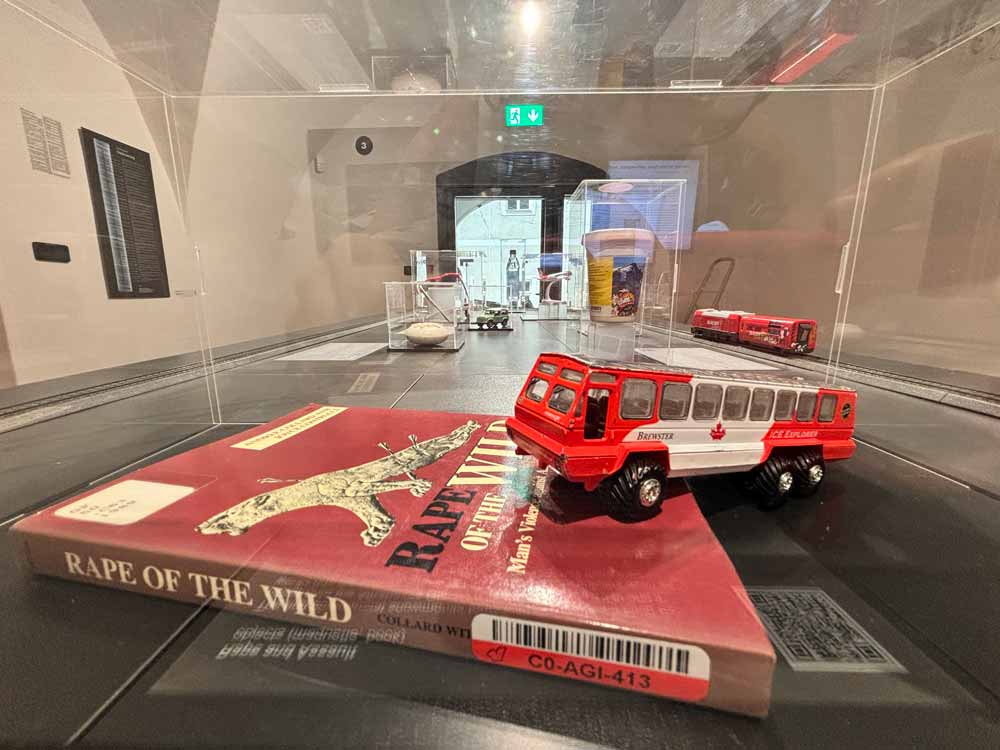
objects,
maquette 18 x 5 x 5 cm, book 14 x 21 cm,
The first commercial snowmobile tours with Columbia Ice Field Explorer onto the Athabasca Glacier (Canada) began in 1939 and it would ride the visitors directly on the surface of the glaciers even as the road was being finished already. The service has more than 400,000 visitors during the summer season.
Global tourism is responsible for 8% of the world’s carbon emission.
Andree Collard and Joyce Contrucci: The Rape of the Wild, Indiana University Press, 1989
The eco-feminist book argues that the domination of women, animals, and nature stems from the same patriarchal logic of control, objectification, and exploitation. It frames environmental destruction—especially industrial agriculture, hunting, and resource extraction—as a form of systemic violence analogous to sexual violation, calling for an ethical shift toward empathy, interdependence, and non-hierarchical relationships with the natural world.
OpenAI. (2026). ChatGPT (GPT-5.6) [Large language model]. See prompts at the end
Motorised glacier tourism, ecofeminist critique and the industrial conquest of mountain landscapes
Scope: The paired exhibition objects – a 1:64 Columbia Icefield Ice Explorer maquette and Andrée Collard with Joyce Contrucci’s The Rape of the Wild (1989) – are examined through the history of mountain transport, scenic tourism, extractivism, ecofeminism and environmental direct action. The report concentrates on the European Alps and the Canadian Rockies from the nineteenth century to the present, with selected reference to the Earth Liberation Front (ELF). It does not attempt a complete corporate history of every railway, road or vehicle manufacturer.
Abstract
The Columbia Icefield vehicle and The Rape of the Wild condense two opposed accounts of modernity. From the nineteenth-century railway to the Alpine automobile road and the purpose-built glacier coach, transport technologies converted mountains from difficult terrain into accessible, saleable views. The Athabasca Glacier tours, begun in 1939 with a half-tracked Model A Ford, exemplify the passage from scenic access to direct motorised occupation of ice. Collard and Contrucci interpret such command through an ecofeminist analogy: patriarchal cultures naturalise the domination of women, animals and land by defining them as passive matter available for use. Later ecofeminists refined this insight through analyses of dualism, capitalism, colonialism and species hierarchy, while materialist and intersectional critics warned that universal claims about “women” can obscure class, race, caste, colonial history and unequal access to resources. Read together, the objects identify tourism not as a harmless gaze but as an extractive system of mobility, infrastructure, labour, fuel and image production. The 1998 ELF arson at Vail marks a violent counter-movement in which tourist infrastructure itself became a political target.
Project links and cross-references
Contents
1. The paired objects and their conceptual collision
2. From sublime prospect to transport system
3. Railways and the panoramic reorganisation of the Alps
4. Automobility and the Grossglockner High Alpine Road
5. The Columbia Icefield: driving directly onto glacier ice
6. Historical turning points in “conquering the glaciers”
7. Ecofeminism: principal authors and arguments
8. Class, race, colonial and essentialist critiques
9. Tourism as extractivism and panoptic consumption
10. ELF actions against tourist infrastructure
11. Interpretive synthesis: from locomotive vision to ecological violation
12. Primary and institutional evidence
13. Numbered academic reference list
Appendix: User prompts related to this report
1. The paired objects and their conceptual collision
The maquette miniaturises a machine designed to carry tourists over a glacier; the book supplies a vocabulary for interpreting the same operation as part of a larger regime of domination. Their conjunction is deliberately asymmetrical. The Ice Explorer is a commodity-image of access, safety and technical capability. The book insists that apparently neutral acts of entering, surveying, naming, enclosing and using the non-human world are culturally gendered and politically organised.
The item’s title “Rape and Assault” should therefore not be read as a claim that every tourist is individually violent, nor as an uncomplicated equivalence between sexual violence and environmental damage. It identifies a historically recurring metaphor – the penetration, conquest and possession of feminised land – and places it under critical pressure. The report preserves the force of Collard and Contrucci’s argument while also noting scholarly objections to universalising both “woman” and “nature”.
Field | Documented information |
Object 1 | Columbia Icefield Ice Explorer 1:64 souvenir maquette, representing purpose-built glacier-tour vehicles used on the Athabasca Glacier in Jasper National Park, Canada. |
Object 2 | Andrée Collard with Joyce Contrucci, The Rape of the Wild: Man’s Violence against Animals and the Earth (The Women’s Press, 1988; Indiana University Press, 1989). |
Shared problem | How modern mobility transforms mountains and glaciers into visible, reachable, managed and profitable environments. |
Critical tension | Technological access is presented commercially as encounter and education, but can also intensify fossil-fuel use, habitat disturbance, enclosure, unequal consumption and the symbolic subordination of non-human nature. |
Academic source links: Lori Gruen’s Hypatia review | Tourism’s global carbon footprint
References: [7], 198-206; [13], 522-528.
2. From sublime prospect to transport system
Before industrial transport, European mountain travel was constrained by cost, season, bodily endurance and local knowledge. Eighteenth-century aesthetics recoded mountains once feared as disorderly or useless into sites of the sublime. Nineteenth-century mountaineering then shifted the desired position from beholding summits to occupying them. The language of first ascent, virgin peak and conquest converted bodily achievement into territorial and masculine mastery.
The Industrial Revolution altered both who could approach mountains and how landscapes were perceived. Steam railways compressed travel time, regularised itineraries and joined remote valleys to urban markets. Hotels, guide services, funiculars, rack railways and viewing platforms followed. This did not simply reveal a pre-existing landscape: it produced destinations, selected viewpoints and disciplined movement through timetables, windows and routes.
Academic source links: Mountains of sublimity, mountains of fatigue | Alpine Modern | The Tourist Gaze
References: [6], 341-369; [4], 850-890; [19], 1-15, 49-76.
3. Railways and the panoramic reorganisation of the Alps
Railways made mountain tourism scalable. They brought urban visitors, food, coal, building materials and capital into Alpine regions while exporting labour, images and branded experiences. The carriage window organised landscape as a sequence of framed scenes: close terrain blurred, distant mountains appeared stable, and the traveller acquired a mobile overview without reciprocal contact with the places crossed. Wolfgang Schivelbusch’s account of the railway journey describes this perceptual reorganisation as “panoramic” vision.
The Glacier Express, inaugurated in 1930 after metre-gauge connections permitted through travel between Zermatt and St Moritz, is a mature form of this logic. Its value lies less in speed than in scenic duration. Later panoramic carriages enlarged the window into the central apparatus of the journey, integrating difficult Alpine engineering, luxury hospitality and branded glacier imagery. The train’s name converts the glacier into a route-wide sign even though modern operation is physically separated from the Rhone Glacier after the Furka Base Tunnel opened in 1982.
Rail transport can be substantially less carbon-intensive than private cars or aviation, but the report’s argument is not that railway and automobile are environmentally identical. Rather, both belong to an industrial infrastructure that turns remoteness into organised consumption. The Glacier Express is the comparatively collective and corridor-bound version; the automobile and snowcoach extend access into increasingly dispersed and fragile terrain.
Academic source links: The Railway Journey | Going Places: Recent Histories of European Tourism | Tourist Landscapes and Regional Identities
References: [17], 51-69; [21], 289-304; [16], 589-621.
Primary / institutional evidence links: Glacier Express company history | Swiss tourism description of panoramic windows
4. Automobility and the Grossglockner High Alpine Road
The automobile loosened mountain tourism from railway stations and fixed timetables. Between the world wars, motor roads became instruments of economic modernisation, national prestige and tourist development. They produced a new landscape of petrol stations, tolls, car parks, lookout points, restaurants, repair services and promotional races. Mountain scenery became both destination and demonstration ground for automotive reliability.
The Grossglockner High Alpine Road crystallises this alliance. Engineer Franz Wallack developed plans in the 1920s; construction began in 1930 during severe economic crisis and the road opened in 1935. It was designed not merely as a crossing but as a scenic attraction whose curves, stops and sightlines staged the High Tauern for drivers. The project created employment and toll income, while simultaneously binding the Pasterze Glacier to automobile consumption.
The official exhibition at Kaiser-Franz-Josefs-Höhe makes this relationship explicit. Its first three floors are devoted to Austria’s highest automobile and motorcycle exhibition, including vehicles, racing machines and model cars. Here the machine that enabled mass arrival becomes a heritage object inside the glacier-viewing complex. The road, the vehicle collection, the souvenir shop and the shrinking glacier form a single apparatus: mobility industry, national engineering memory and climate spectacle.
Field | Documented information |
Planning and construction | Plans commissioned in the 1920s; construction commenced in 1930; official public opening on 3 August 1935. |
Economic function | A state-backed employment and tourism project during interwar crisis, financed through infrastructure investment and subsequently toll use. |
Scenic design | The road was conceived as a carefully staged nature experience rather than only a utilitarian crossing. |
Automobile culture | The Kaiser-Franz-Josefs-Höhe complex now contains Austria’s highest automobile and motorcycle exhibition, including around 200 model cars. |
Project relation | Cross-reference to Ignite and Edelweiss 2: the same site sells combustive and botanical souvenirs while presenting the retreating Pasterze as an attraction. |
Academic source links: Automobiles and tourism as indicators of development | Alpine Modern
References: [23], 301-327; [4], 850-890.
Primary / institutional evidence links: Grossglockner road history | Grossglockner automobile and motorcycle exhibition | UNESCO tentative-list description
5. The Columbia Icefield: driving directly onto glacier ice
The Athabasca Glacier service represents a further threshold: rather than carrying visitors to a viewpoint, it transports them onto the glacier itself. The preliminary research identifies the first commercial tours in summer 1939, when Banff entrepreneur Alex Watt used a Model A Ford fitted with half-tracks and carried slightly more than one hundred passengers to the glacier toe. Six-passenger Bombardier vehicles followed in the 1950s; Brewster Transport Company assumed the concession in 1969; and large Foremost “Snowcoaches”, later marketed as Ice Explorers, industrialised the excursion.
Current promotional materials describe a guided journey onto the Athabasca Glacier, while historical institutional material reports more than 400,000 summer visitors. That figure should be treated as a promotional or institutional annual claim, not an audited universal constant. No consolidated annual series, cumulative passenger total since 1939, attraction-specific lifetime revenue, or reliable total production and sales figure for the 1:64 souvenir model was located.
The service is pedagogically ambiguous. It can make glacial recession sensorially immediate and supports interpretation by guides; at the same time, it turns ice into a driveable surface and climate vulnerability into a premium experience. The maquette repeats this process at another scale: a machine for consuming the glacier becomes a collectible commodity detached from the environmental costs and regulatory apparatus that make the full-sized excursion possible.
Field | Documented information |
1939 | Alex Watt operated a half-tracked Model A Ford and transported just over 100 visitors onto the glacier toe. |
1950s | Early improvised vehicles were replaced by six-passenger Bombardier oversnow vehicles. |
1969 | The snowmobile concession passed to Brewster Transport Company. |
Later development | Foremost built large-capacity Snocoaches; present vehicles are branded Ice Explorers. |
Visitor claim | Institutional histories report more than 400,000 visitors during the short summer season; no independent audited time series was located. |
Evidence gaps | No verified cumulative revenue, lifetime ridership, or total diecast unit-sales figure is publicly available in the reviewed sources. |
Academic source links: Tourism’s global carbon footprint | Tourism and recreation conservation threats
References: [13], 522-528; [15], 283-302.
Primary / institutional evidence links: Icefields Parkway historical account | Columbia Icefield Adventure | Pursuit annual reporting
6. Historical turning points in “conquering the glaciers”
Field | Documented information |
c. 1750-1850: aesthetic discovery | European elites increasingly recoded mountains from feared obstacles into sublime scenery and objects of scientific description. |
1850s-1900: railway access | Main-line and mountain railways shortened journeys, expanded hotels and organised the panoramic carriage-window gaze. |
1860s-1914: heroic alpinism | First-ascent culture and national mountaineering institutions popularised a masculine vocabulary of conquest, virginity and possession. |
1900-1939: skiing and mechanical ascent | Funiculars, cableways, ski lifts and sporting media transformed winter mountains into modern leisure systems. |
1920s-1930s: scenic motoring | Purpose-built roads, automobile clubs, races and manufacturers turned the Alps into proving grounds and mobile spectacles. |
1930: Glacier Express | A through railway service packaged Alpine engineering and glacier imagery as a continuous panoramic commodity. |
1935: Grossglockner road | A national scenic road fused employment policy, toll revenue, motor culture and controlled glacier viewing. |
1939 onward: motorised glacier occupation | The Columbia Icefield service moved tourism from observing ice to driving directly over it. |
Post-1945: mass tourism | Rising incomes, paid leave, private car ownership and package tourism greatly expanded mountain visitation and construction. |
1980s-present: climate spectacle | Retreating glaciers became both evidence of planetary warming and marketable sites of “last chance” tourism. |
1998: Vail arson | ELF activists attacked ski-resort infrastructure, reframing mountain tourism as habitat destruction and capitalist expansion. |
Academic source links: Alpine Modern | Mountains of sublimity, mountains of fatigue | The carbon footprint of global tourism
References: [4], 850-890; [6], 341-369; [13], 522-528.
7. Ecofeminism: principal authors and arguments
Ecofeminism is not a single doctrine. It emerged from feminist peace, anti-nuclear, animal-liberation, anti-colonial and environmental movements, arguing that ecological destruction is inseparable from social structures of domination. Collard and Contrucci’s distinctive contribution is to place animals at the centre of the analysis and to connect domestication, hunting, vivisection, militarism, reproductive control and environmental exploitation through a masculinised culture of violence.
Carolyn Merchant’s The Death of Nature traced how early modern science and capitalism displaced organic conceptions of a living earth with a mechanistic nature imagined as inert matter. Vandana Shiva and Maria Mies linked ecological crisis to colonial development, capitalist accumulation and the devaluation of subsistence labour. Karen Warren formulated a “logic of domination” in which hierarchical dualisms – man/woman, culture/nature, reason/emotion, human/animal – become premises for subordination. Val Plumwood analysed the “master model” of Western reason, stressing backgrounding, radical exclusion and instrumentalisation. Greta Gaard and Carol J. Adams expanded ecofeminist work on species, embodiment and animal exploitation.
These approaches illuminate motorised mountain tourism by asking not only how much fuel a vehicle consumes but what social imaginary makes the glacier available to penetration, traversal, measurement and sale. The point is structural: mechanical access becomes desirable because a culture of mastery treats distance, resistance and non-human autonomy as technical problems awaiting defeat.
Academic source links: Feminism and the Mastery of Nature | The Death of Nature
References: [14], 1-41, 97-121; [10], 1-26; [5], 1-12; [11], 1-13; [20], 1-32; [1], 1-15; [12], 1-20.
8. Class, race, colonial and essentialist critiques
The most important criticism of early ecofeminism is that claims about women’s natural affinity with the earth can reproduce the very dualism they seek to oppose. When femininity is identified with care, reproduction, emotion and nature, women may again be confined to an allegedly timeless biological role. Social constructionist and materialist ecofeminists therefore distinguish an imposed historical association from an innate essence.
Bina Agarwal’s feminist environmentalism argues from differentiated material relations to resources. Rural women’s environmental knowledge and vulnerability are shaped by gendered divisions of labour, property rights, class, caste and state policy, not by a universal female consciousness. Postcolonial critics have likewise challenged accounts that romanticise “Third World women”, erase colonial histories, or use Indigenous and peasant struggles as evidence for a Western theory without attending to political difference.
Race and class also qualify the tourism narrative. The capacity to enjoy distant landscapes has historically belonged disproportionately to affluent, mobile subjects, while construction workers, guides, local residents and racialised or Indigenous communities bear uneven labour, land and ecological costs. Lenzen and colleagues found that tourism’s carbon footprint is driven primarily by high-income countries. A critical account of panoptic tourism must therefore identify not only a gendered gaze but the classed and colonial distribution of mobility, visibility and environmental harm.
Academic source links: The Gender and Environment Debate | Intersectionality and the Changing Face of Ecofeminism | Development, Gender, and the Environment | The carbon footprint of global tourism
References: [2], 119-158; [9], 63-87; [22], 929-947; [13], 522-528.
9. Tourism as extractivism and panoptic consumption
Extractivism conventionally describes the large-scale removal of minerals, fuels, timber or biological resources for distant markets. Tourism does not always remove matter in the same direct sense, but it can operate extractively by appropriating landscape value, concentrating land ownership, importing energy and labour, externalising waste and converting local environments into revenue-producing images and experiences. The glacier is extracted visually, symbolically and economically even when the ice remains physically in place.
Panoptic tourism names the organisation of this extraction through vision. Rail windows, roads, car parks, cable cars, viewing decks and oversized coach windows establish privileged positions from which visitors see without being seen and traverse without dwelling. The environment appears comprehensive and available because infrastructures suppress friction, danger and local complexity. The Ice Explorer radicalises the arrangement: the viewing apparatus moves onto the viewed body.
The 8 per cent figure in the exhibition label derives from a 2018 multi-regional input-output analysis estimating that tourism produced about 4.5 gigatonnes CO2-equivalent in 2013, approximately 8 per cent of global greenhouse-gas emissions. It is not a timeless constant, and later estimates use different years and methods. Its project significance is systemic: the footprint includes transport, food, shopping, accommodation and supply chains, revealing that the scenic encounter is materially sustained by a much larger industrial metabolism.
Academic source links: The Tourist Gaze 3.0 | The Railway Journey | The carbon footprint of global tourism | Colonial Baggage: An Introduction
References: [19], 1-15, 49-76; [17], 51-69; [13], 522-528; [8], 1-17.
10. ELF actions against tourist infrastructure
The clearest ELF action directly targeting mountain tourism was the coordinated arson at Vail Ski Resort, Colorado, on 19 October 1998. Fires destroyed or damaged lifts, a restaurant, a picnic facility, a utility building and associated structures. The claim of responsibility framed the resort’s expansion as destruction of lynx habitat through roads and clear-cutting. Federal sources initially placed losses above US$12 million.
Vail matters to this report because the target was not an abstract symbol of consumption but the material apparatus that makes high-altitude leisure possible: lifts, buildings, roads and commercial expansion. The action translated a critique of mountain tourism into clandestine economic sabotage. It also helped consolidate the institutional category of “eco-terrorism”, through which property destruction was placed within post-Cold War and later post-9/11 security frameworks.
The connection must be stated precisely. Collard and Contrucci did not provide a programme for ELF arson, and ecofeminism is not synonymous with sabotage. Both, however, reject the neutrality of domination. The book exposes the cultural logic by which violence against non-human nature is normalised; the ELF attempted to interrupt selected infrastructures materially. The project’s narrative moves between these registers – theory, object, clandestine action and state classification – without collapsing their ethical and political differences.
Field | Documented information |
Date and place | 19 October 1998, Vail Ski Resort, Colorado, United States. |
Target | Ski lifts and resort buildings associated with a major expansion. |
Stated rationale | Opposition to roads, clear-cuts and perceived destruction of Canada lynx habitat. |
Damage | Federal testimony reported damage exceeding US$12 million; later accounts vary. |
Human harm | No death was caused by the Vail fires, but arson inherently created serious risk and was prosecuted as a major federal crime. |
Project relation | Cross-reference to ELF Timeline, Sunshine, No Sprawl and the Green Scare research: infrastructure critique becomes sabotage, then a security narrative. |
Academic source links: Leaderless resistance and ideological inclusion | Eco-terrorism and environmental movements
References: [3], 1565-1581; [18], 1-28, 95-125.
Primary / institutional evidence links: FBI testimony: The Threat of Eco-Terrorism | Congressional Record on the Vail arson
11. Interpretive synthesis: from locomotive vision to ecological violation
The paired objects form a compact genealogy of industrial vision. The locomotive turn did not merely transport tourists toward mountains; it reorganised time, perception and capital so that remote terrain could be consumed in regular sequences. Roads extended this regime from corridors to flexible networks, while snowmobiles and glacier coaches carried it onto surfaces previously defined by climatic and bodily limits. In each stage, overcoming resistance is celebrated as progress.
Within The Sunshine Find, the Ice Explorer is therefore not only a vehicle. It is an emblem of a modern promise: that every distance can be shortened, every obstacle engineered away and every landscape converted into an experience. The maquette adds a second commodification, shrinking the infrastructure of access into a purchasable memory. It belongs with the Glacier Express model, Grossglockner lighter, SUV and glacier cosmetics as an object in which landscape, machine and brand become inseparable.
The Rape of the Wild names the violence concealed by this promise. Its metaphor is powerful because histories of exploration, extraction and tourism repeatedly feminised land as virgin territory to be penetrated, conquered and possessed. Yet the report also qualifies that metaphor through intersectional critique: there is no universal category of “woman” standing outside technology, and environmental harm is distributed through race, class, caste, colonialism and property.
The overall project position can thus be stated as a critical presumption rather than a monocausal fact: industrial transport supplied the material and perceptual conditions for extractive mountain tourism; panoptic systems translated ecological otherness into controlled vision; motorised glacier travel made the transformation literal by placing the vehicle on the ice. Ecofeminism reveals the gendered and hierarchical logic of this mastery. ELF sabotage represents one historically specific, ethically contested attempt to reverse the direction of force by attacking the infrastructure rather than accepting its claim to neutrality.
12. Primary and institutional evidence
1. Columbia Icefield / Icefields Parkway historical account
2. Columbia Icefield Adventure – current operator page
4. Glacier Express – company history
5. Grossglockner High Alpine Road – history
7. UNESCO tentative-list entry for the Grossglockner road
8. FBI testimony: The Threat of Eco-Terrorism
9. Congressional Record concerning the 1998 Vail fires
13. Numbered academic reference list
1. Adams, Carol J. The Sexual Politics of Meat: A Feminist-Vegetarian Critical Theory. New York: Continuum, 1990.
2. Agarwal, Bina. “The Gender and Environment Debate: Lessons from India.” Feminist Studies 18, no. 1 (1992): 119-158. DOI / stable link
3. Beck, Colin J. “The Contribution of Social Movement Theory to Understanding Terrorism.” Sociology Compass 2, no. 5 (2008): 1565-1581. DOI / stable link
4. Denning, Andrew. “Alpine Modern: Central European Skiing and the Vernacularization of Cultural Modernism, 1900-1939.” Central European History 46, no. 4 (2013): 850-890. DOI / stable link
5. Gaard, Greta. “Living Interconnections with Animals and Nature.” In Ecofeminism: Women, Animals, Nature, edited by Greta Gaard, 1-12. Philadelphia: Temple University Press, 1993.
6. Felsch, Philipp. “Mountains of Sublimity, Mountains of Fatigue: Towards a History of Speechlessness in the Alps.” Science in Context 22, no. 3 (2009): 341-369. DOI / stable link
7. Gruen, Lori. “Rape of the Wild. By Andrée Collard with Joyce Contrucci.” Hypatia 6, no. 1 (1991): 198-206. DOI / stable link
8. Greiner, Andreas, et al. “Colonial Baggage: An Introduction.” Itinerario 48, no. 1 (2024): 1-17. DOI / stable link
9. Kings, A. E. “Intersectionality and the Changing Face of Ecofeminism.” Ethics and the Environment 22, no. 1 (2017): 63-87. DOI / stable link
10. Merchant, Carolyn. The Death of Nature: Women, Ecology, and the Scientific Revolution. San Francisco: Harper & Row, 1980.
11. Mies, Maria, and Vandana Shiva. Ecofeminism. London: Zed Books, 1993.
12. Collard, Andrée, with Joyce Contrucci. The Rape of the Wild: Man’s Violence against Animals and the Earth. Bloomington: Indiana University Press, 1989.
13. Lenzen, Manfred, Ya-Yen Sun, Futu Faturay, Yuan-Peng Ting, Arne Geschke, and Arunima Malik. “The Carbon Footprint of Global Tourism.” Nature Climate Change 8 (2018): 522-528. DOI / stable link
14. Plumwood, Val. Feminism and the Mastery of Nature. London: Routledge, 1993.
15. Gössling, Stefan. “Global Environmental Consequences of Tourism.” Global Environmental Change 12, no. 4 (2002): 283-302. DOI / stable link
16. Murdock, Caitlin E. “Tourist Landscapes and Regional Identities in Saxony, 1878-1938.” Central European History 40, no. 4 (2007): 589-621. DOI / stable link
17. Schivelbusch, Wolfgang. The Railway Journey: The Industrialization of Time and Space in the Nineteenth Century. Oakland: University of California Press, 2014 [1977].
18. Scarce, Rik. Eco-Warriors: Understanding the Radical Environmental Movement. 2nd ed. Walnut Creek, CA: Left Coast Press, 2006.
19. Urry, John, and Jonas Larsen. The Tourist Gaze 3.0. London: SAGE, 2011.
20. Warren, Karen J. Ecofeminist Philosophy: A Western Perspective on What It Is and Why It Matters. Lanham, MD: Rowman & Littlefield, 2000.
21. Williams, Tom. “Going Places: Recent Histories of European Tourism.” Contemporary European History 23, no. 2 (2014): 289-304. DOI / stable link
22. Zein-Elabdin, Eiman. “Development, Gender, and the Environment: Theoretical or Contextual Link? Toward an Institutional Analysis of Gender.” Journal of Economic Issues 30, no. 4 (1996): 929-947. DOI / stable link
23. Vilar-Rodríguez, Margarita, and Elvira Lindoso-Tato. “Automobiles and Tourism as Indicators of Development in Spain, 1918-1939.” The Historical Journal 65, no. 2 (2022): 301-327. DOI / stable link
Appendix: User prompts related to this report
Prompts are reproduced chronologically as a research-process record. Typographic normalisation is limited to obvious spelling and punctuation corrections where needed for legibility.
1. Two of the objects will be displayed together, with the descriptive text:
objects (maquette, book)
The first commercial snowmobile tours with Columbia Ice Field Explorer onto the Athabasca Glacier (Canada) began in 1939 and it would ride the visitors directly on the surface of the glaciers even as the road was being finished already. The service has more than 400,000 visitors during the summer season.
Global tourism is responsible for 8% of the world’s carbon emission.
Andree Collard and Joyce Contrucci: The Rape of the Wild, Indiana University Press, 1989
The eco-feminist book argues that the domination of women, animals, and nature stems from the same patriarchal logic of control, objectification, and exploitation. It frames environmental destruction—especially industrial agriculture, hunting, and resource extraction—as a form of systemic violence analogous to sexual violation, calling for an ethical shift toward empathy, interdependence, and non-hierarchical relationships with the natural world.
Review the preliminary research on Columbia Icefield Explorer (attached).
Create a unified analysis on both the snowmobile and the book on the following topics and questions:
– how mountain tourism developed as a result of the development of transportation means; here refer to the direct actions of ELF targeting tourism establishments;
– how this development relates to ecofeminist critics, who the main authors are, and their principal arguments; reference criticism of the class and race positions of ecofeminism;
– how the locomotive and automobile industry took over mountain tourism (the building of the Grossglockner highway, sponsors, economic interests, Glacier Express);
– the historical turning points in this development (“conquering the glaciers”);
– how this development can be critically situated in the context of extractivism and panoptic tourism;
– the overall position should be based on the presumption that the locomotive turn rooted in the Industrial Revolution led to the extractivist rape of nature, of which panoptic tourism and vehicles such as the snowmobile are prominent examples.
Compile and send back the report according to the project guidelines: project-aware argumentation and cross-referentiality, peer-reviewed sources, formatting, and related requirements.