Sunshine
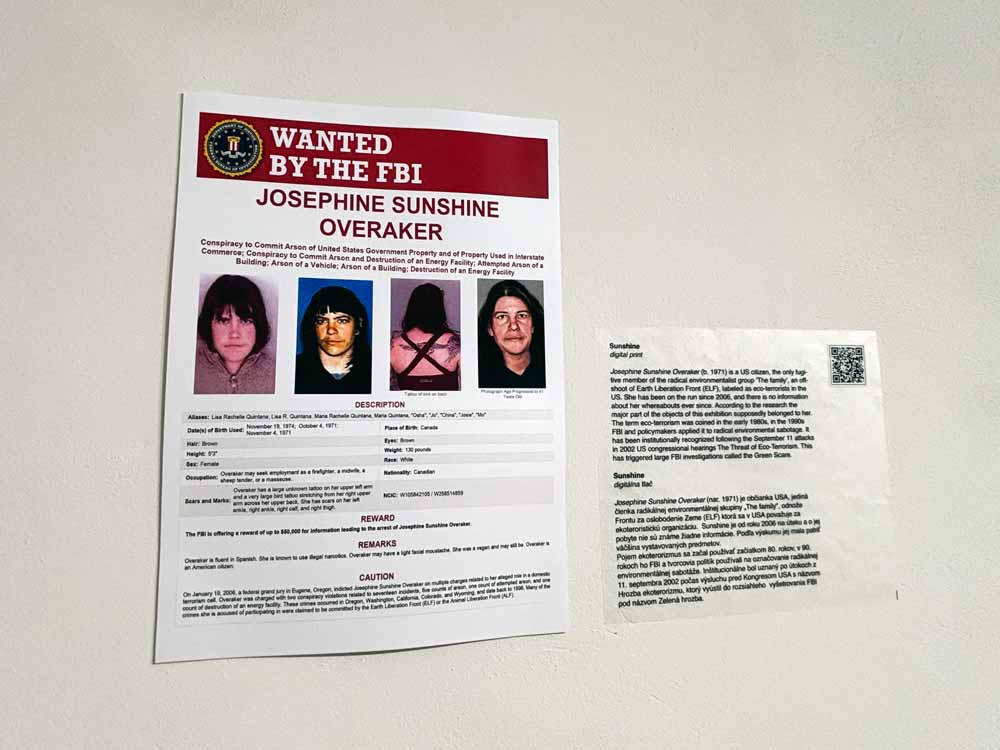
digital print, 21 x 30 cm
Josephine Sunshine Overaker (b. 1971) is a US citizen, the only fugitive member of the radical environmentalist group ‘The family’, an offshoot of Earth Liberation Front (ELF), labeled as eco-terrorists in the US. She has been on the run since 2006, and there is no information about her whereabouts ever since.
According to the research the major part of the objects of this exhibition supposedly belonged to her.
The term eco-terrorism was coined in the early 1980s, in the 1990s FBI and policymakers applied it to radical environmental sabotage. It has been institutionally recognized following the September 11 attacks in 2002 US congressional hearings The Threat of Eco-Terrorism.
This has triggered large FBI investigations called the Green Scare.
OpenAI. (2026). ChatGPT (GPT-5.6) [Large language model]. See prompts at the end
Josephine Sunshine Overaker
Biography, alleged ELF/ALF activity, Operation Backfire, fugitive status and the contested construction of “eco-terrorism”
Scope: Publicly documented biographical information; alleged participation in the Pacific Northwest cell known as the Family; federal indictments and Operation Backfire; FBI fugitive status through 27 July 2026; and the distinction between verified evidence and the installation’s parafictional attribution of objects to “Sunshine”. The report excludes speculation about her current residence, private life or unverified actions.
Abstract
Josephine Sunshine Overaker is a Canada-born fugitive whom the FBI identifies as an American citizen, while its wanted notice also lists Canadian nationality and three dates of birth in 1971 and 1974. Publicly verifiable biographical information is sparse. Federal authorities allege that she participated in the Family, a Pacific Northwest affinity cell whose property attacks were carried out or claimed under Earth Liberation Front (ELF) and Animal Liberation Front (ALF) names. She was indicted in 2006 on conspiracy, arson, attempted-arson and energy-facility charges; a separate Colorado indictment charged her in eight counts arising from the 1998 Vail ski-resort fires. These are allegations, not convictions. The Department of Justice states that she fled to Europe in late 2001. Following Joseph Dibee’s 2018 apprehension, she became the only remaining Operation Backfire fugitive. As of 27 July 2026, the FBI profile remains active, offers up to $50,000 for information leading to her arrest, and provides no verified current location. Within The Sunshine Find, Overaker is a documentary hinge between environmental direct action and the Green Scare; the claim that the installation’s objects belonged to her remains explicitly parafictional.
Contents
1. Identity and evidentiary limits
2. ELF, ALF, the Family and Overaker’s alleged role
3. Chronology: alleged campaign, flight and Operation Backfire
4. FBI wanted notice and present status
5. “Eco-terrorism”, post-9/11 security and the Green Scare
6. Parafiction boundary and interpretive synthesis
7. Primary and institutional evidence links
8. Numbered academic reference list
Appendix: User prompts
1. Identity and evidentiary limits
Overaker’s public identity is unusually unstable because the principal biographical record is a fugitive notice designed for identification rather than a conventional life history. The FBI lists three dates of birth, multiple aliases and a combination of Canadian and American identifiers. This makes the commonly repeated formulation “born in 1971” too certain. The most accurate description is that she was born in Canada, that the FBI states she is an American citizen, and that the agency records dates of birth in both 1971 and 1974.
Field | Documented information |
Public name | Josephine Sunshine Overaker |
Dates of birth used | 19 November 1974; 4 October 1971; 4 November 1971 |
Place of birth | Canada |
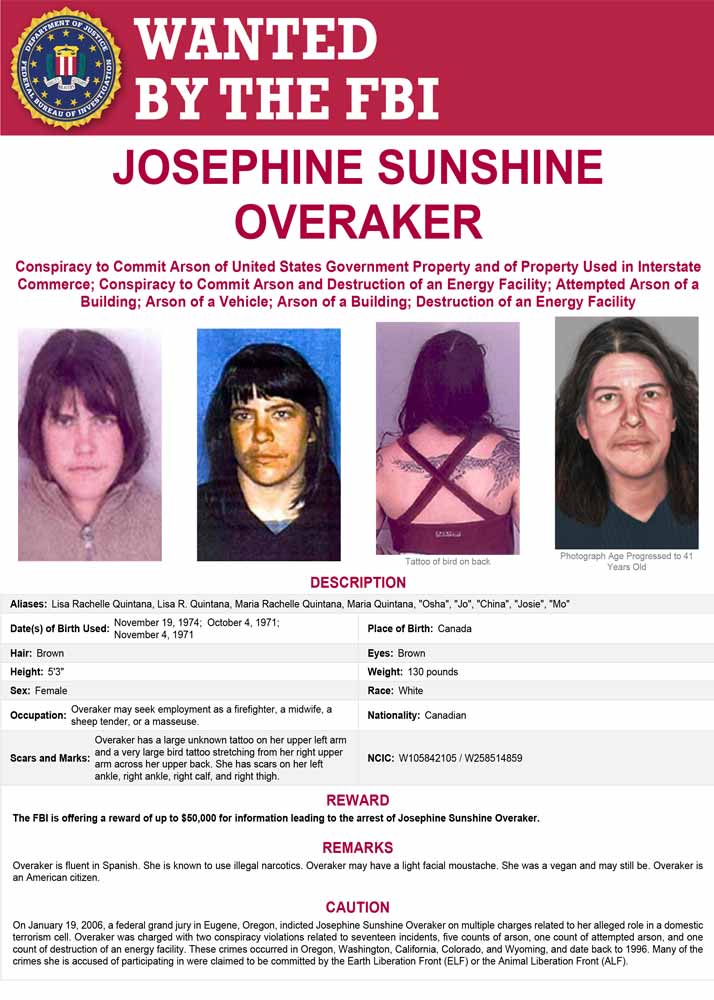
Citizenship / nationality record | The FBI profile lists “Nationality: Canadian” and separately states in its remarks that Overaker is an American citizen. The public record therefore should not be simplified into a single unqualified nationality claim. |
Aliases and nicknames | Lisa Rachelle Quintana; Lisa R. Quintana; Maria Rachelle Quintana; Maria Quintana; “Osha”; “Jo”; “China”; “Josie”; “Mo” |
Language | Fluent Spanish, according to the FBI |
Occupational skills in wanted notice | The FBI states that she may seek work as a firefighter, midwife, sheep tender or masseuse. |
Verified public-life limitation | No reliable public source located for this report establishes a complete family history, education, present occupation or current residence. |
Primary / institutional evidence links: FBI current wanted profile | FBI wanted poster
1.1 What can be called a life history
A source-critical life history must therefore remain asymmetrical. The official record says considerably more about how Overaker is being sought than about her childhood, education or everyday social world. Her public biography becomes legible mainly through allegations attached to the Pacific Northwest radical environmental milieu of the 1990s, through her reported departure from the United States in 2001, and through the later persistence of her wanted image. This is not evidence that no fuller biography exists; it is a statement about the limits of the verifiable record available to the public.
The alias Lisa Quintana is especially important inside the installation because Citizenship places that name in an Antarctica World Passport. Historically, the alias is verified by the FBI. The possession and use of the project’s passport, however, are not. That distinction allows the artwork to move from a documentary identifier into a speculative narrative without presenting the speculation as police or biographical evidence.
2. ELF, ALF, the Family and Overaker’s alleged role
The Earth Liberation Front is better understood as a decentralised action framework or banner than as a conventional organisation with membership rolls, officers and a command chain. Scholarship describes its “leaderless resistance” model: autonomous individuals or small cells act without central direction, then use shared ideological language and anonymous communiqués to connect local property attacks to a wider movement. This structure complicates the language of membership. A person can act “in the name of ELF” without joining a formal body in the ordinary organisational sense.
The Family should likewise not be described simply as an “offshoot” of ELF. Federal records and recent scholarship present it as a Pacific Northwest affinity cell, or network of approximately twenty participants, associated with both ELF and ALF banners. The cell is alleged to have conducted or supported more than forty acts ranging from vandalism to arson between 1995 and 2001. Its targets included forestry and government facilities, animal-processing sites, energy infrastructure and the Vail ski resort. The shared tactic was economic and material damage intended to obstruct activities perceived as environmentally or ethically destructive.
Overaker’s alleged role is documented through indictments, not through a completed trial. The current FBI profile charges her with two conspiracy violations tied to seventeen incidents, five arson counts, one attempted-arson count and one count involving destruction of an energy facility. A Colorado grand jury separately named her in eight arson counts for the 19 October 1998 Vail fires. These documents establish the content of the accusations; they do not establish guilt.
Academic source links: The Earth Liberation Front and Environmental Terrorism | Leaderless Resistance and Ideological Inclusion | Elves, Environmentalism, and “Eco-Terror” | Kaczynski’s Shadow and the Rise of the Earth Liberation Front
References: [1], 37–58; [2], 351–368; [3], 75–93; [7], 60–85.
Primary / institutional evidence links: DOJ: Eleven Defendants Indicted | Colorado Vail indictment | FBI: Operation Backfire
2.1 The Vail arson as a symbolic and legal centre
The Vail action became the most visible event associated with the Family because it joined environmental conflict to a globally recognisable tourism infrastructure. The attack targeted buildings and lift facilities at a ski resort whose expansion was contested on habitat grounds. Federal estimates placed the damage at approximately $26 million. In the project’s broader narrative, this is an evidence-based connection between panoramic mountain tourism and militant intervention: the resort packages the high-altitude landscape as a commodity, while the arson recoded that infrastructure as an ecological target.
The connection must not erase the legal and material risk. Arson directed at apparently unoccupied property can still endanger workers, residents and emergency responders. The Department of Justice later stated that no innocent lives were taken in the Family’s campaign, while emphasising the risk to firefighters. The absence of recorded fatalities is therefore not equivalent to an absence of danger.
3. Chronology: alleged campaign, flight and Operation Backfire
Date | Milestone | Source-critical significance |
1995–1996 | Formation of the Family milieu; alleged campaign begins | Federal and FBI accounts place the cell’s activities between 1995/1996 and 2001. The Oregon indictment begins its site chronology in October 1996. |
19 Oct 1998 | Vail ski-resort fires | A later Colorado indictment charged Overaker and three others in eight counts concerning buildings and lift facilities. The charge remains untried as to Overaker. |
Late 2001 | Reported departure for Europe | DOJ records state that Overaker fled to Europe in late 2001. This corrects the recurrent claim that she began hiding only after the 2006 indictments. |
2004 | Investigations consolidated | The FBI states that multiple environmental-extremism investigations were combined under the name Operation Backfire. |
7 Dec 2005 | Coordinated arrests | Federal agents began the multi-state takedown that preceded the main Oregon indictment. |
19 Jan 2006 | Oregon grand-jury indictment | Overaker was named in the 65-count case with alleged conduct across five western states. The DOJ announcement was issued on 20 January. |
18 May 2006 | Colorado Vail indictment | Eight separate arson counts named Overaker in relation to the 1998 resort fires. |
19 Nov 2008 | Reward and fugitive campaign expanded | The FBI publicised a reward of up to $50,000 and circulated updated fugitive information. |
Dec 2012 | Rebecca Rubin surrenders | The number of remaining Family fugitives fell to two: Joseph Dibee and Overaker. |
10 Aug 2018 | Joseph Dibee apprehended | Overaker became the only remaining fugitive associated with Operation Backfire. |
22 Apr 2022 | Dibee guilty plea | The DOJ again stated that Overaker remained at large, faced nineteen felony charges and was believed to have left for Europe in 2001. |
27 Jul 2026 | Current status check | The FBI wanted profile remains active. No reliable public source located for this report confirms an arrest, death or verified present location. |
Academic source links: Repression and Operation Backfire | Total Liberation
References: [6], especially the discussion of state repression and radical environmental networks; [8], 86–101.
Primary / institutional evidence links: FBI: Operation Backfire — Ten Years Later | FBI: Update — Operation Backfire | FBI: Eco-Terrorist Surrenders | DOJ: Dibee apprehended | DOJ: Dibee guilty plea
3.1 Operation Backfire and the evidentiary asymmetry of a fugitive case
Operation Backfire was the official FBI name for the consolidation and prosecution of several investigations. “Green Scare” is not its official subtitle. It is an activist and scholarly counter-term that compares post-9/11 surveillance, grand-jury pressure, terrorism enhancements, long sentences and movement disruption with earlier political scares. The two names therefore describe the same historical field from opposed institutional positions: one presents a successful counterterrorism investigation; the other foregrounds the political effects of repression.
Overaker’s continued absence creates an enduring evidentiary imbalance. The government’s case is repeatedly summarised in official releases, while there is no defence testimony, cross-examination or judgment in her own case. A responsible report can map charges, institutional language and the outcomes of co-defendants, but cannot transfer their admissions or convictions automatically to her.
4. FBI wanted notice and present status
Field | Documented information |
Status checked | Active FBI Domestic Terrorism wanted profile, checked 27 July 2026 |
Current reward | Up to US$50,000 for information leading to arrest |
Charge summary on FBI page | Two conspiracy violations related to seventeen incidents; five counts of arson; one count of attempted arson; one count of destruction of an energy facility |
Total felony charges stated by DOJ | Nineteen charges across the District of Oregon, Western District of Washington and District of Colorado |
Flight chronology | DOJ: believed to have fled to Europe in late 2001 |
Remaining-fugitive status | Only remaining fugitive associated with Operation Backfire after Joseph Dibee’s 2018 apprehension |
Present whereabouts | No verified public location is provided by the FBI or established by reliable sources located for this revision. |
Legal status | Indicted and wanted; not convicted on the outstanding charges. An indictment is an accusation, and the presumption of innocence remains applicable. |
Older official and media materials speculated that Overaker might have lived in Spain or elsewhere in Europe, while later local reporting also mentioned Mexico. None of these suggestions should be converted into a present-tense location. The current FBI page does not identify a country of residence. The safest formulation is therefore “whereabouts publicly unknown”.
Likewise, “there has been no information about her since 2006” is too broad. Authorities have repeatedly updated the reward campaign and age-progressed imagery, and the DOJ has restated the case. What remains absent is verified public evidence of her location or activities after her departure.
Primary / institutional evidence links: FBI current wanted profile | DOJ fugitive-status statement, updated 2025
5. “Eco-terrorism”, post-9/11 security and the Green Scare
The term “eco-terrorism” did not originate with Operation Backfire. David N. Pellow traces its influential American formulation to anti-environmental activist Ron Arnold in 1983 and argues that the term became a contested terrain of political power. Its central ambiguity lies in whether politically motivated damage to property, undertaken while attempting to avoid injury, should be classified as terrorism, ecotage, sabotage or another form of political crime.
The post-11 September 2001 security environment greatly increased the institutional force of the category. On 12 February 2002, a House subcommittee held an oversight hearing titled Eco-Terrorism and Lawlessness on the National Forests. In May 2005, a Senate hearing specifically examined ELF and ALF. These proceedings did not invent the term, but they helped formalise a federal discourse in which radical environmental property crime was treated through counterterrorism institutions and vocabulary.
Scholars disagree over the classification. Leader and Probst adopt a security-oriented analysis of ELF as environmental terrorism. Vanderheiden argues that extending terrorism language to ecotage risks collapsing important distinctions between attacks on civilians and sabotage of property. Joosse shows how leaderless organisation and news framing amplify one another: anonymity, communiqués and spectacular damage make the movement media-visible, while the “eco-terror” label supplies a simplified narrative of threat. Pellow places that discourse within wider struggles over state and corporate power.
TERMINOLOGICAL DECISION FOR THIS REPORT |
Academic source links: Eco-terrorism or Justified Resistance? | Elves, Environmentalism, and “Eco-Terror” | Ecoterrorism — Keywords for Environmental Studies | Repression and Operation Backfire
References: [3], 75–93; [4], 425–447; [5], 82–85; [8], 86–101.
Primary / institutional evidence links: 2002 House hearing: Eco-Terrorism and Lawlessness on the National Forests | 2005 Senate hearing on ELF and ALF
5.1 The Green Scare as historical interpretation
The Green Scare names more than a prosecution. It describes the atmosphere produced by informants, grand juries, surveillance, terrorism sentencing arguments, media narratives and uncertainty within activist scenes. Recent scholarship treats Operation Backfire as a decisive factor in weakening the militant Pacific Northwest networks that had sustained clandestine action. The term is politically committed, but it is also analytically useful when clearly attributed: it directs attention to how state pressure changes movements, not only to whether individual criminal charges are proved.
For The Sunshine Find, this dual framing is essential. Overaker appears simultaneously as an accused participant in destructive actions and as an absent figure produced by wanted posters, age progression, aliases and state archives. The image does not merely represent a person; it materialises the visual regime through which a fugitive is made continuously present despite physical absence.
6. Parafiction boundary and interpretive synthesis
Field | Documented information |
Verified documentary layer | The FBI identity record and aliases; federal indictments; the alleged Family/ELF/ALF context; reported flight to Europe in late 2001; active wanted status and reward; present location not publicly verified. |
Interpretive archival layer | Overaker’s wanted image as a technology of absence and presence; Operation Backfire and the Green Scare as competing institutional narratives; the shift from environmental grievance to sabotage and counterterrorism. |
Parafictional installation layer | The Scorluzzo crate; ownership of most exhibition objects; visits to the Glacier Express, Grossglockner or other sites; the Antarctica World Passport; notebook texts and drawings; collected debris; future targets; and any claim that the installation reconstructs her actual itinerary. |
Editorial rule | Object labels and web reports should signal the transition with formulations such as “the installation proposes”, “supposedly”, “within the project’s narrative” or “parafictionally attributed”. |
Overaker’s place in the archive is not that of a heroic protagonist or a solved criminal biography. She is a point of collision among environmental emergency, clandestine action, property, risk, law enforcement and representation. The lack of a trial and the lack of a verified present location mean that her image is dominated by institutional documents. The project can make that domination visible without pretending to fill the biographical gaps.
Read backwards through the installation, Sunshine transforms the Alpine and glacial objects already encountered. The Glacier Express, panorama infrastructure and glacier-branded commodities no longer appear only as scenes of organised consumption; they become possible objects of critique or intervention. Read forwards, Sunshine leads into ELF Timeline, No Sprawl, Sabotage, Spiking and Future, where environmental politics is recoded through property damage, criminal investigation and the disputed language of terrorism.
The project’s tactical use of parafiction should therefore remain double: it may imagine that an archive of climate narratives belonged to a fugitive, but its scholarly background must also show precisely where the record stops. That boundary is not a limitation on the artwork. It is the mechanism through which the installation can examine how belief, evidence, state classification and narrative desire produce one another.
7. Primary and institutional evidence links
The following records support identity, charge, chronology and current-status claims. They are not included in the numbered academic bibliography.
1. Federal Bureau of Investigation. “Josephine Sunshine Overaker.” Current wanted profile.
2. Federal Bureau of Investigation. Josephine Sunshine Overaker wanted poster.
5. Federal Bureau of Investigation. “Update — Operation Backfire.” 19 November 2008.
6. Federal Bureau of Investigation. “Eco-Terrorist Surrenders.” 10 December 2012.
8. Numbered academic reference list
Chicago bibliography style. This numbered list contains only verified scholarly publications.
Appendix: User prompts related to this report
The original Hungarian-language instruction is reproduced below as a faithful English editorial rendering and consolidated into a formal directed-research brief. It records the requested subject, evidentiary emphases, exhibition relation and production criteria.
1. Prepare an English-language research description of Josephine Sunshine Overaker. Examine her documented life course, her alleged roles and activities in relation to the Earth Liberation Front and the Pacific Northwest cell known as the Family, the history of the relevant actions and prosecutions, her FBI fugitive notice, and her present status. Treat “Sunshine” as the related exhibition object, a digital print. Critically review and correct the supplied working description: Josephine Sunshine Overaker has been presented as a U.S. citizen born in 1971, the sole fugitive member of the Family, and a figure associated with the ELF and the U.S. construction of “eco-terrorism”. Address the early-1980s emergence of the term, its application by the FBI and policymakers to radical environmental sabotage, the post-11 September 2001 congressional and security context, Operation Backfire, and the activist/scholarly concept of the Green Scare. Clearly distinguish verified biography and legal history from the installation’s parafictional proposition that most of the exhibited objects belonged to her. Follow the project’s established report criteria: begin with an abstract of no more than 200 words; use a unified narrative and typographic structure; include only valid scholarly sources in a numbered Chicago-style academic reference list; label official and institutional records separately; maintain descriptive external hyperlinks.
2. General remarks:
1. I have been asking you to create individual reports on different topics.
2. Nonetheless these materials should converge into a unity which is the archive itself and the supporting physical installation. This convergence should be based on a synthesys of all of my other topics, questions and criteria raised in all of the other chat sessions, which are all part of the same project the main scope of which is an art installation and a supporting archive that grows by time. The archive is meant for both professional and nonprofessional use, it should be informative within its artistic and pedagogical scope as well.
3. the main line of thoughts of the project departs from panoptic tourism and concludes to ecoterrorism in a narrative line. Therefore all the reports should follow this general direction in their approach and references.
4. The reports we are working on now will all serve as a background research material published on the project website for the set of objects that will be on display, Each object will have its own page (see: https://glacial-archaeology.net/category/exhibition/). See: Szabolcs KissPál – The sunshine find_for translation. I am also adding the brief description of the project’s general concept, see: Szabolcs KissPál – The sunshine find. The website will have a separate but interconnected section for both the exhibition and the supporting archive. https://glacial-archaeology.net/an-archive-of-narratives-on-global-warming-copy/ Inspect the site while note that it doesn’t have its final structure yet!
5. the scope with the reports is to produce a set of background research material for each object in part that should refer to each other, and should be unified in their narrative and typographic structure, tone, and scope. Pay attention to snychronise the focus points of different partial research tasks when possible with cross references!
6. I am attaching two of your previous reports (noahs_ark_expeditions_1959_1990_academic_sources_new_tab_links.docx, Container_Mount_Scorluzzo_WWI_Shelter_Research_Report). Please develop and and apply to these reports a uniform structure both content wise and in formal aspects while mostly keeping their original content.
7. Main further formal criteria:
– you should always start with an abstract summarizing your finds in a text no longer than 200 words.
– you should always enlist at the very end of the document all my prompts related to that topic
– the external links should always open in a different tab
– you should be using only valid, peer reviewed academic sources listed and numbered at the end of the documents
– you should apply a somewhat unified narrative structured and a unified formatting (including typeface styles, subtitles structure, etc.
8. – note and memorise the above in your cross-chat memory for rurther tasks