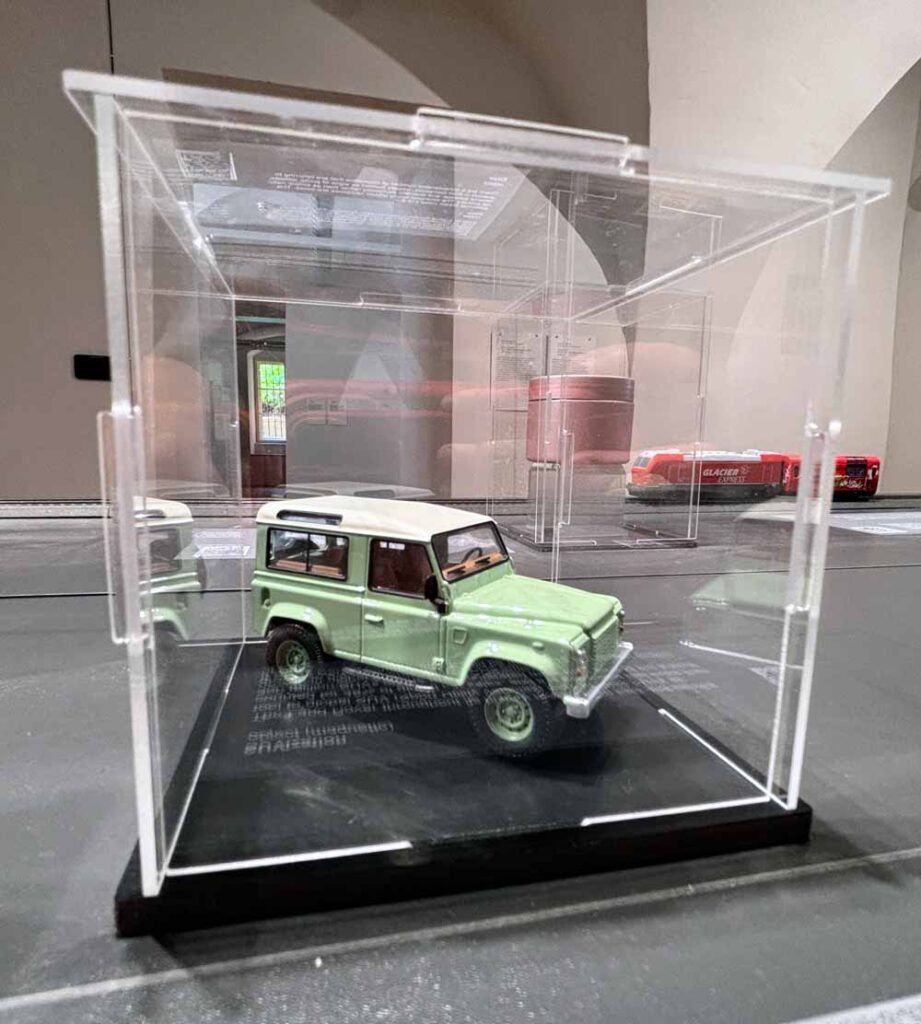
SUVization
object, maquette 1/43
The Land Rover throughout its history moved from field-and-service tool to global SUV (Sport Utility Vehicles) icon.
In 2023 SUVs accounted for 48% of global car sales, and it is estimated that more than 360 million SUVs on the road generated more than 20% of the annual growth in global energy-related CO2 emissions.
If SUVs were a country, they would be the world’s fifth largest emitter of CO2.
OpenAI. (2026). ChatGPT (GPT-5.6) [Large language model]. See prompts at the end
Land Rover, Defender and the SUV Turn
Military mobility, colonial afterlives, environmental violence and the Norev miniature
Scope: Land Rover history from 1947 to 2026, with emphasis on the Series vehicles, Range Rover, Discovery and Defender; military and colonial deployment; the semantic and political work of the name “Defender”; SUVisation and its relation to ATVs, UTVs, dirt bikes and quads; environmental impacts and controversies; global circulation; and the Norev Land Rover Defender 1995 Jet-Car 1:43 maquette. Exact production, sales, legal and model specifications are drawn from clearly identified institutional evidence where scholarship is unavailable.
Abstract
Land Rover began as a post-war agricultural and export vehicle but was rapidly absorbed into British military logistics at the moment of imperial retreat and Cold War counter-insurgency. Series Land Rovers and later Defenders became mobile infrastructure for armies, police, settlers, aid organisations and commercial exploration, while Range Rover and Discovery translated the same visual language of territorial access into domestic comfort, prestige and suburban security. The 1990 name “Defender” distinguished the traditional utility line from Discovery, yet also condensed a political promise: a vehicle imagined as protecting occupants, property, nation and mobility against rough terrain and an externalised “wild”. SUVs subsequently converged with ATVs, UTVs, dirt bikes and quads in an off-road mobility culture that converts landscapes into traversable surfaces. This report links that culture to the archive’s Rape and Assault material, whose ecofeminist account of domination helps interpret the vehicle without equating metaphor with documented violence. The Norev 1:43 model miniaturises this history as licensed play, nostalgia and commodity. Land Rover’s trajectory therefore joins colonial mobility, automobility, extraction, climate emissions and environmental protest within The Sunshine Find.
Project links and cross-references
The displayed Norev Defender forms the archive object SUVization. It should be read beside Rape and Assault, where the Athabasca Glacier tour vehicle and Andrée Collard and Joyce Contrucci’s The Rape of the Wild frame motorised access as a gendered language of possession; Gaze and Glacier Express, which organise remote terrain for controlled viewing; Ignite and Drill baby, drill!, which connect motor tourism to combustion and oil; and No Sprawl, Sabotage and “Stop the war!”, where SUVs become targets within radical environmental narratives. The project’s installation document explicitly places SUVization between glacier tourism and extractive commodity objects, then returns to SUVs in the direct-action room. This report treats those curatorial links as interpretation, not as proof that the vehicle itself possesses a single political meaning.
Contents
1. Post-war utility and the military intersection
2. Land Rover in colonial and postcolonial conflict
3. From utility vehicle to domestic SUV
4. “Defender”: name, etymology and political promise
5. SUVs, ATVs, UTVs, dirt bikes and quads
6. Environmental impacts and corporate controversies
7. Global distribution and political economy
8. Norev Defender 1995 and the miniature afterlife
9. Maquettes and post-agricultural modes of production
10. Interpretive synthesis: defence, access and assault
11. Numbered Academic Reference List
Appendix: User prompts related to this report
1. Post-war utility and the military intersection
The first Land Rover was developed in 1947–48 amid material shortage, export pressure and agricultural reconstruction. Aluminium body panels answered steel rationing and drew on wartime aircraft-production capacity. The Amsterdam launch in April 1948 presented a civil “go-anywhere” work platform, but military procurement followed in 1949. Its ladder frame, four-wheel drive, simple body panels and capacity for field conversion made it useful as transport, radio vehicle, ambulance, weapons carrier and patrol platform.
Field | Documented information |
1947–48 | Prototype and launch as a farm, industrial and export utility vehicle. |
1949 | Early British Army orders institutionalise the platform. |
1950s–70s | Series I, II and III circulate through Commonwealth forces, colonial police, development projects and civilian markets. |
1983–90 | Coil-sprung One Ten and Ninety modernise the utility line; the Defender name is introduced in 1990. |
1990s–2010s | Defender remains a military and humanitarian platform while increasingly becoming a heritage and lifestyle icon. |
Academic source links: Warfare State: Britain, 1920–1970 | The British Way in Counter-Insurgency
References: [5], passim; [8], introduction.
Primary / institutional evidence links: Land Rover Defender heritage story | British Motor Museum Land Rover collection
2. Land Rover in colonial and postcolonial conflict
The Land Rover’s military career coincided with Britain’s withdrawal from formal empire. This timing is essential. The vehicle did not cause colonial warfare, but it became part of the mobile apparatus through which soldiers, police, administrators and supplies traversed contested rural territory. Scholarly histories of Malaya, Kenya, Cyprus and Aden describe counter-insurgency systems built around roads, patrols, checkpoints, forced resettlement, intelligence and rapid movement. Land Rovers appear within this wider infrastructure as light vehicles capable of moving between metalled roads and rough tracks.
Field | Documented information |
Malayan Emergency, 1948–60 | Series Land Rovers entered service during a campaign that combined jungle patrol, population control, resettlement and road-based security. The broader “hearts and minds” legend has been critically reassessed as a system also dependent on coercion. |
Kenya Emergency / Mau Mau war, 1952–60 | Land Rovers served security and administrative mobility within a colonial campaign marked by detention, villagisation and extensive violence. The vehicle should be interpreted as logistical infrastructure, not as a sufficient explanation of the violence. |
Cyprus Emergency, 1955–59 | British forces and colonial police used light vehicles in patrol and counter-insurgency operations against EOKA; mobility joined curfews, searches and intelligence. |
Aden Emergency and Radfan, 1963–67 | Land Rovers operated in a late-colonial theatre where urban patrol, mountain warfare and emergency rule accompanied Britain’s withdrawal. |
Northern Ireland, late 1960s–2007 | Military Land Rovers, including armoured variants, became highly visible symbols of patrol, surveillance and contested sovereignty. Northern Ireland is not simply classed as an overseas colony, but its security practices carried imperial and counter-insurgency inheritances. |
Falklands/Malvinas, 1982 | Land Rovers supported British expeditionary logistics in a war over sovereignty in the South Atlantic, linking the marque to the continuing territorial afterlife of empire. |
Iraq and Afghanistan, 2000s–2020s | Defender-based and specialised military vehicles persisted in expeditionary warfare, although protection requirements increasingly favoured heavier armoured platforms. These wars are better described as postcolonial interventions than as formal colonial conflicts. |
Academic source links: The British Way in Counter-Insurgency, 1945–1967 | Fighting the Mau Mau | The Malayan Emergency
References: [8], passim; [3], passim; [9], passim.
Primary / institutional evidence links: Imperial War Museums: post-war conflicts | Royal Logistic Corps Museum collections
Research caution. Vehicle-specific deployment records are uneven and often survive as photographs, regimental histories or museum catalogues rather than peer-reviewed studies. The defensible conclusion is therefore not that “Land Rover was the vehicle of empire” in an exclusive sense, but that it became an unusually durable and recognisable component of late-imperial and post-imperial mobility.
3. From utility vehicle to domestic SUV
The move from military-capable utility to domestic SUV was neither a simple demilitarisation nor a sudden change of audience. The Range Rover of 1970 translated four-wheel-drive capability into comfort, motorway performance and design prestige. Discovery, launched in 1989, broadened family and leisure appeal. In this portfolio, the old utility line could be renamed Defender and marketed as authentic, elemental and durable while the marque’s profits increasingly depended on comfortable, high-margin SUVs.
Field | Documented information |
1948 Station Wagon | An early attempt to combine utility with passenger accommodation. |
1970 Range Rover | Off-road engineering joined comfort and status; a foundational moment in the luxury-SUV category. |
1989 Discovery | A family-oriented vehicle positioned between Defender and Range Rover. |
1990 Defender | The utility lineage becomes a named heritage product inside a differentiated SUV portfolio. |
1994–2008 ownership changes | BMW, Ford and then Tata ownership tie the marque to transnational capital, platform sharing and global luxury strategy. |
2020 new Defender | The name returns on a technically sophisticated premium SUV that cites the old vehicle visually while serving a different market and regulatory environment. |
Academic source links: Mobilities | Introduction: Impossibilities of Automobility | Car Cultures
References: [17], 109–145; [4], 3–16; [13], passim.
Primary / institutional evidence links: Range Rover history | Defining the Defender
4. “Defender”: name, etymology and political promise
Etymologically, defender derives through Middle English and Anglo-French from Latin defendere: to ward off, protect or repel. The word is relational. A defender protects someone or something against an anticipated threat. The commercial name therefore invites questions absent from a neutral wheelbase designation: what is being defended, and from whom or what?
Field | Documented information |
Verified naming reason | Land Rover introduced “Defender” in September 1990 to distinguish the traditional Ninety/One Ten lineage from the expanding marque after Discovery’s launch. |
Manufacturer’s semantic framing | Current heritage language associates the name with trust, dependability, ruggedness and reliability. |
Occupant and property | In domestic SUV culture, “defence” can signify bodily safety, family enclosure, cargo protection and the elevated visibility of a large vehicle. |
Nation and institution | Military service, royal association and British design heritage allow the name to resonate with national defence even when a vehicle is sold for leisure. |
Terrain and “the wild” | Advertising commonly stages mud, rock, water and remoteness as obstacles to be overcome. Terrain becomes an adversary, while technological enclosure promises mastery. |
Critical interpretation | The Defender can be read as defending privileged mobility and access: the ability to enter landscapes without surrendering comfort, property or control. This is an interpretation, not a documented statement of corporate intent. |
Academic source links: Feminism and the Mastery of Nature | Landscape and Power | The Tourist Gaze 3.0
References: [15], 41–68; [12], 1–34; [19], 1–26.
Primary / institutional evidence links: Oxford English Dictionary: defend | Land Rover: The Defender Story
“Defending what from whom?” has no single historical answer. In military use the answer may be troops, territory, communications or state authority against an enemy. In suburban marketing it may be family, status and autonomy against risk, congestion or imagined vulnerability. In off-road imagery it is the vehicle and its occupants against a landscape coded as hostile. The name’s power lies precisely in allowing these layers to overlap without naming the threat.
5. SUVs, ATVs, UTVs, dirt bikes and quads
SUVs belong to a larger family of off-highway and all-terrain machines. Their boundaries are technical but also cultural: all promise access beyond ordinary roads, and all move between work, military, sport, recreation and consumption. The Defender is road-legal, enclosed and car-like; ATVs and dirt bikes expose the rider; UTVs restore a cabin, steering wheel and cargo function at a smaller scale. “Quad” generally names a four-wheeled ATV, while “dirt bike” identifies a lightweight off-road motorcycle.
Field | Documented information |
SUV / 4×4 | Enclosed passenger vehicle, generally road legal, with car controls and increasing emphasis on comfort, safety and status. Contemporary crossovers may have limited true off-road capacity. |
ATV / quad | Straddle-seat, handlebar-steered machine on low-pressure tyres; compact, manoeuvrable and used in agriculture, forestry, policing, recreation and sport. |
UTV / side-by-side | Larger task vehicle with side-by-side seating, steering wheel, roll structure and cargo bed; closer to a miniature utility truck. |
Dirt bike | Light motorcycle designed for unsealed terrain, racing or trail riding; minimal enclosure and high bodily exposure. |
Shared genealogy | Military reconnaissance, farm labour, frontier access and resource work overlap with leisure, adventure tourism and motorsport. |
Shared environmental issue | All can extend motorised access into sensitive landscapes, generating noise, soil compaction, erosion, habitat fragmentation, wildlife disturbance and combustion emissions; impacts vary strongly by vehicle, place and regulation. |
Academic source links: Recreation Ecology | A Review of the Effects of Off-Road Vehicles on Ecosystems | Mobilities
References: [10], passim; [14], 1–11; [17], 109–145.
Primary / institutional evidence links: US Consumer Product Safety Commission: ATVs | US Forest Service: off-highway vehicles
The historical connection is therefore not that SUVs simply evolved from quads or dirt bikes. Rather, these machines form a differentiated mobility system. Agricultural utility provided legitimacy; military and frontier use supplied toughness; sport and tourism supplied adventure; consumer marketing transferred the promise of all-terrain sovereignty into everyday ownership. The new Defender sits at the most protected and luxurious end of that spectrum, while the rider of a dirt bike occupies the most exposed end.
6. Environmental impacts and corporate controversies
Land Rover’s environmental history must be assessed at vehicle, system and cultural levels. A durable old vehicle may distribute its manufacturing impact across a long life, yet fuel use, local pollutants and maintenance remain significant. New premium SUVs can improve tailpipe efficiency or become electric while retaining high mass, large batteries, material demand and road-space effects. At system level, the decisive issue is SUV normalisation: efficiency gains are partly cancelled when vehicles become larger and heavier.
Field | Documented information |
Operational carbon | The IEA counted more than 360 million SUVs in 2023 and attributed roughly 1 billion tonnes of combustion-related CO₂ to them. |
Vehicle mass and materials | Large bodies, powerful drivetrains, aluminium structures and—where electric—large batteries increase embodied material and energy demand. |
Air pollution | Diesel NOx and particulate emissions have generated regulatory and legal scrutiny. UK and Scottish group proceedings concern allegations involving JLR diesel engines; liability is a legal question and should not be presumed. |
Land and habitat | Off-road use can damage soils, vegetation and wildlife habitat when access is unmanaged; effects are especially serious in arid, alpine and wetland environments. |
Cultural rebound | Marketing safety, capability and prestige can increase demand for larger vehicles and displace smaller cars, counteracting technical efficiency. |
Corporate transition | JLR reports electrification, recycled materials and net-zero commitments. These are institutional claims that require independent verification over time. |
Academic source links: The Rebound Effect in Road Transport | Global carbon inequality over 1990–2019 | Introduction: Impossibilities of Automobility
References: [18], 10–17; [2], 931–938; [4], 3–16.
Primary / institutional evidence links: IEA: SUVs and emissions | JLR Annual Report 2025 | UK group litigation orders
Controversy has also taken the form of direct action. Greenpeace stopped Range Rover production at Solihull in 2005, while later anti-SUV campaigns targeted dealerships and tyres. Within The Sunshine Find, No Sprawl, Sabotage and “Stop the war!” place these protests beside ELF narratives. The report should not collapse legal protest, property damage and “eco-terrorism” into one category; their tactics, targets, risks and institutional labels differ.
7. Global distribution and political economy
Land Rover globalised first through imperial and Commonwealth circuits, including exports and local assembly from completely knocked-down kits. Later ownership by BMW, Ford and Tata Motors embedded the marque in transnational finance, platform strategy and global luxury demand. The geography changed from a British export workhorse with African, Australasian and Middle Eastern significance to a portfolio whose key markets include North America, China, Europe and the United Kingdom.
Field | Documented information |
Early export logic | Post-war Britain needed export earnings; utility vehicles were suited to agricultural, infrastructure and state markets across the Commonwealth and beyond. |
Local assembly | Assembly operations and kits reduced tariffs and adapted vehicles to regional markets. Exact plant dates vary and are better documented institutionally than academically. |
Late twentieth century | Japanese 4×4 competition challenged Land Rover in many former imperial markets while Range Rover and Discovery grew in affluent consumer markets. |
Tata ownership since 2008 | British branding and engineering operate within an Indian-owned multinational group. |
FY2024/25 | JLR reported 428,854 retail sales, with North America strengthening and China facing intense competition and retailer stress. |
Political exposure | Tariffs, sanctions, Brexit, exchange rates, semiconductor shortages, conflict and emissions regulation directly shape sales and production. |
Academic source links: The Global Automotive Industry | Global Production Networks | Warfare State
References: [16], passim; [6], 1–32; [5], passim.
Primary / institutional evidence links: JLR Annual Report 2025 | Tata Motors history
8. Norev Defender 1995 and the miniature afterlife
The exhibition object is a miniature rather than a vehicle. Norev lists the Land Rover Defender 1995 Jet-Car at 1:43 scale in multiple colours. Reference 845107 identifies the blue-and-white version noted in the earlier report; the current product language presents the Defender as a faithful replica associated with adventure, reliability and imaginative exploration. The object translates a working and military platform into a hand-held, purchasable image.
Field | Documented information |
Manufacturer | Norev, founded near Lyon in 1946 by the Véron family; the company name reverses “Véron”. |
Model | Land Rover Defender 1995, Jet-Car series, 1:43 scale. |
Reference | 845107 for the blue-and-white version documented in the earlier report. |
Material lineage | Norev’s early 1:43 cars used Rhodialite plastic; later ranges adopted zamak die-casting and mixed materials. |
Represented year | 1995: after the Defender name had stabilised but before the original line’s 2016 production end. |
Cultural operation | Miniaturisation separates the vehicle from fuel, terrain, labour and violence while preserving recognisable form, livery and brand mythology. |
Academic source links: Toys as Culture | The System of Objects | Material Culture and Mass Consumption
References: [20], passim; [1], 83–105; [11], 124–152.
Primary / institutional evidence links: Norev: company history | Norev Defender 1995 Jet-Car
9. Maquettes and post-agricultural modes of production
“Post-agricultural” is used here as a curatorial and historical description, not as a claim that agriculture disappeared. The original Land Rover addressed farming and reconstruction, but its miniature belongs to a mature industrial-consumer regime in which value is generated by design rights, petrochemical and metal materials, global subcontracting, logistics, retail and memory. The maquette reproduces not the vehicle’s labour but its sign.
Standardised scale is crucial. At 1:43, vehicles from different places and periods become commensurable, collectable and displayable. The miniature turns territorial power into domestic arrangement: the collector can possess, classify and visually command a fleet. This echoes the archive’s larger interest in panoptic tourism, where the world is reorganised as a sequence of views and objects.
The model’s smallness also produces an ethical distance. Exhaust, road death, military patrol, colonial policing and habitat damage vanish from the toy’s immediate sensory field. What remains is a clean emblem of capability. Yet the maquette can also reactivate suppressed histories when placed in an exhibition that restores its connections to oil, war, climate and protest.
Academic source links: Material Culture and Mass Consumption | Toys as Culture | The System of Objects
References: [11], 124–152; [20], passim; [1], 83–105.
10. Interpretive synthesis: defence, access and assault
The Land Rover story begins with a machine designed to cross fields and repair a post-war economy. It becomes military and administrative infrastructure during imperial retreat. Its technical capacity is then aestheticised: Range Rover and Discovery turn rough-terrain access into comfort, elevated vision and status. Defender retrospectively names the older form as something authentic that protects and endures. Finally, Norev reduces this history to a miniature whose apparent innocence makes it available for renewed interpretation.
The connection to Rape and Assault should be precise. Collard and Contrucci analyse the linked domination of women, animals and earth within patriarchal culture; Plumwood more broadly criticises the dualisms that position reason, culture and mastery above feminised nature. Read through that literature, SUV advertising can be examined for recurrent motifs of penetration, conquest, possession and immunity. The Athabasca Glacier tour vehicle in Rape and Assault literalises motorised entry onto vulnerable ice. The Defender similarly promises access without exposure.
The Defender also links panoramic tourism to direct action. Its raised cabin and all-terrain promise organise the landscape as available surface, while its fuel and material demands connect it to Drill baby, drill! and Ignite. Its military history reaches “Stop the war!”, where fossil-fuel mobility and armed conflict converge. Its status as a large luxury SUV reaches Sabotage, where radical activists target the category as a conspicuous form of emissions and urban domination. The same object can therefore be a farm tool, colonial vehicle, family enclosure, collectible icon and political target. The archive’s task is not to choose one essence, but to expose the narratives that make each meaning operational.
Academic source links: Rape of the Wild | Feminism and the Mastery of Nature | Introduction: Impossibilities of Automobility
References: [7], passim; [15], 41–68; [4], 3–16.
11. Numbered Academic Reference List
Chicago bibliography style. This numbered list contains scholarly books and peer-reviewed journal articles only. Corporate, legal, museum and statistical records are linked in the relevant sections as primary or institutional evidence.
1. Baudrillard, Jean. The System of Objects. Translated by James Benedict. London: Verso, 1996.
5. Edgerton, David. Warfare State: Britain, 1920–1970. Cambridge: Cambridge University Press, 2006.
11. Miller, Daniel. Material Culture and Mass Consumption. Oxford: Basil Blackwell, 1987.
12. Mitchell, W. J. T., ed. Landscape and Power. 2nd ed. Chicago: University of Chicago Press, 2002.
13. Miller, Daniel, ed. Car Cultures. Oxford: Berg, 2001.
15. Plumwood, Val. Feminism and the Mastery of Nature. London: Routledge, 1993.
17. Urry, John. Mobilities. Cambridge: Polity, 2007.
19. Urry, John, and Jonas Larsen. The Tourist Gaze 3.0. London: Sage, 2011.
20. Sutton-Smith, Brian. Toys as Culture. New York: Gardner Press, 1986.
Appendix: User prompts related to this report
Prompts are reproduced chronologically as a research-process record. Spelling and punctuation are preserved except for minor typographic normalisation.
1. 1. make an internet search on the history Land Rover with a focus on
– how from the military usage shifted to domestic use of SUVs
– what kind of environmental impact it’s been having throughout its history
– the global distribution of these models
– environmental controversies surrounding the production company
2. pay attention especially to the model Norev Land Rover Defender
3. contextualise historically the development phases in relation to global political developments
4. add a section on the production of maquettes, elaborating on how the production of these connected to the changes in the modes of production in the post agricultural era
5. compile your findings into a structured word document
6. you don’t need to post your answer in the chatline
2. 1. Review the attached report according to the general guidelines and criteria.
2. Connect the argumentation with references to other objects from the archive and to the material Rape and assault report.
3. research on the etymological references of the brand: ‘defender’ (defending what from whom?)
4. develop the connection of SUVs with ATVs, UTVs, Dirt Bikes and quads
5. At the military usage section look for references in its colonial conflicts in past and present
6. compile your report according to the standards and criteria shared with you earlier