Tag!
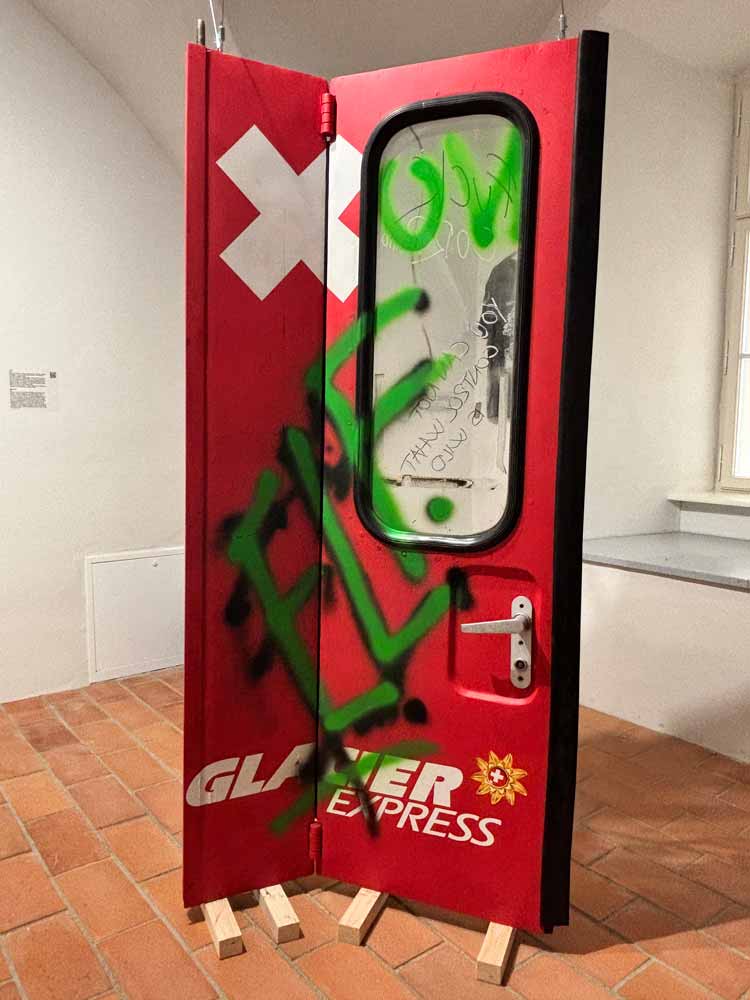
object, metal, 185 x 80 x 30 cm
A train door of the Glacial Express that has been recovered by researchers from the Swiss scrapyard Kurz Altmetalle AG (Bern) in the summer of 2025.
Some fragments of graffiti can be seen on it.
OpenAI. (2026). ChatGPT (GPT-5.6) [Large language model]. See prompts at the end
Tag!
Correcting a false vandalism attribution and tracing train tagging from mobile monikers to contentious urban media
Scope: The train door’s stated recovery and railway provenance; the evidentiary status of a photograph made at Oberalppass on 26 February 2019; and a concise history of train, subway and freight-car tagging in relation to activism. The report excludes forensic attribution of the physical door because no vehicle number, maker’s plate, paint stratigraphy, acquisition photograph, transfer record or scrapyard receipt has been supplied.
Abstract
The attached report labels a photograph dated 26 February 2019 as evidence of vandalism on a Matterhorn Gotthard Bahn train linked to the Glacier Express. Rechecking the image metadata and a contemporaneous 2018/19 railway publication changes that conclusion. Wikimedia Commons identifies a regional MGB service entering Oberalppass, not the branded Glacier Express; the date records the photograph, not an offence. A VIADI article shows that the conspicuous “graffiti” was the commissioned livery of an Après-Ski bar made from retired Glacier Express panorama coaches. No police, operator or press record located for this revision documents a vandalism incident that day. The 2019 entry should therefore be withdrawn as incident evidence. The physical door’s provenance remains unresolved without rolling-stock and transfer documentation. The timeline situates train marking from hobo and railway-worker monikers through New York subway writing, the Clean Train regime, freight-car revival and digital train-graffiti videos. Scholarship supports a cautious political reading: graffiti can be contentious participation when message or context is political, but tagging is not automatically activism.
Project links and cross-references: Project website · Exhibition pages · Related reports: Glacier Express; Gaze; Sabotage; ELF timeline; Future
Contents
1. Object claim, terminology and provenance
2. The 26 February 2019 photograph: source audit
3. Corrected finding and verification requirements
4. Short timeline: train tagging and activism
5. When does tagging become activism?
6. Primary and institutional evidence
7. Numbered academic reference list
Appendix: User prompts
1. Object claim, terminology and provenance
The installation presents a metal railway door bearing a fragment of painted lettering. Three separate propositions must be kept apart: the object’s physical identity; its asserted recovery from a scrapyard in summer 2025; and the meaning or authorship of the remaining paint. None is established by the 2019 Oberalppass photograph.
Field | Source-critical finding |
Displayed object | A detached metal train door with a surviving painted fragment; no identifying photograph or technical markings were included with the present request. |
Service name | The official Swiss service is Glacier Express. “Glacial Express” may function as project language, but it should not be used as the factual railway name. |
Claimed recovery | The object text places recovery at Kurz Altmetalle AG in “Bern” in summer 2025. The company’s public website and register listing identify its seat and address in Zürich; no Bern branch or transaction record was located for this revision. |
Evidence gap | No carriage number, door serial, manufacturer’s plate, paint-layer examination, recovery photograph, purchase receipt, witness statement or railway disposal record links the door to Glacier Express rolling stock. |
Editorial status | Treat the scrapyard and Glacier Express provenance as an installation claim or parafictional layer unless supporting records are added to the archive. |
Primary / institutional evidence links: Kurz Altmetalle AG company site | Swiss commercial-register summary
2. The 26 February 2019 photograph: source audit
The attached report describes the file as “Graffiti/vandalism on train exterior (photo evidence)”. That wording moves from visible style to an alleged event without evidentiary support. A source audit produces the following sequence.
Evidence unit | Documented result |
Claim in the attached report | A photograph dated 26 February 2019 is presented as a trace of graffiti or vandalism affecting MGB rolling stock on the Glacier Express network. |
What the Commons record establishes | The camera metadata dates the exposure to 26 February 2019 at 14:00. The caption identifies an MGB regional train entering Oberalppass on the Andermatt–Disentis/Mustér route. It does not identify a vandalism event, perpetrator, complaint or repair. |
What the train actually carried | A contemporaneous VIADI feature describes two retired Glacier Express panorama coaches converted into MGB Après-Ski bar cars, redesigned for the SkiArena Andermatt–Sedrun. Its photograph shows the same conspicuous yellow-and-black lettering and portrait imagery. |
Why “graffiti” is misleading here | The VIADI text itself calls the design graffiti and says the coach was brightly spray-painted, but it also explains that the cars were deliberately redesigned. “Graffiti” here names an authorised commercial aesthetic, not unauthorised damage. |
Finding | 26 February 2019 is the date of the photograph. The cited image is evidence of a themed bar-car livery on a regional MGB service, not evidence of a vandalism incident on the Glacier Express. |
Technical note | The direct-image URL printed in the attached report does not resolve reliably; the Commons file page remains the stable record. |
Primary / institutional evidence links: Wikimedia Commons: MGB train at Oberalppass, 26 February 2019 | VIADI 2/2018–2019: “Mit Viktor und Rebecca unterwegs im Barwagen” | Wikimedia Commons: Après-Ski train, 21 April 2017
3. Corrected finding and verification requirements
Correction to the earlier report. Delete the 26 February 2019 row from any table of verified vandalism incidents. Replace it with a source note stating that the photograph was misidentified and depicts authorised Après-Ski bar-car livery on an MGB regional train. The sentence “the perpetrator was never revealed” should not be retained as factual history: the cited evidence establishes no offence and therefore no unidentified perpetrator.
The correction does not prove that no Glacier Express or operator-network vehicle was vandalised in 2019. It establishes only that the specific photograph relied upon by the report cannot support that claim. A separate event could be added only after locating an operator notice, police record, court file, insurance or cleaning record, dated press report, or independently verified image sequence.
Verification step | Required evidence |
1. Identify the door | Record both sides, dimensions, hinge and locking system, welds, window shape, paint scheme, serial numbers and maker’s marks. |
2. Establish the carriage | Match the door to a documented rolling-stock type and vehicle number; distinguish a former Glacier Express panorama coach from a regional MGB or RhB vehicle. |
3. Establish disposal | Obtain railway decommissioning and sale records, scrapyard intake records, purchase documentation and dated recovery photographs. |
4. Examine the paint | Use oblique light, microscopy and non-destructive layer analysis to distinguish factory paint, commissioned livery, later tagging and post-recovery intervention. |
5. Document authorship cautiously | A letter fragment rarely identifies a writer or political message. Record style and material before assigning activist intent. |
4. Short timeline: train tagging and activism
Train tagging has more than one genealogy. Railway-worker and hobo monikers preceded aerosol subway writing; New York subway culture transformed the train into a moving field of fame and style; freight writing later used continental logistics as a distribution network; and digital video added a second circulation system. The political meaning changes across these contexts.
Period | Turning point in train writing | Relation to activism and public space |
c. 1870s–1930s | Railway workers, itinerant labourers and illegal riders inscribe monikers, dates, routes and symbols on freight cars and railway structures. The mark travels with the wagon and records a mobile subculture. | A politics of precarious mobility and self-documentation may be inferred from the social setting, but most monikers are names, reputational signs or practical communication rather than organised protest. |
Late 1960s–early 1970s | Name-based writing expands in Philadelphia and New York; repeated signatures move from neighbourhood walls onto buses and subway trains, allowing citywide visibility. | The act challenges unequal access to public visibility and advertising space. It is rebellious and spatially assertive, yet the writer’s name usually remains the primary message. |
1972–mid-1970s | Tags develop into larger pieces, crew productions and whole-car compositions. Trains operate as moving exhibitions while early gallery and performance projects begin to translate writing into the art world. | The subway surface becomes contested public media: youth-produced names interrupt municipal and commercial visual order. Institutional recognition also begins a long process of commodification. |
Late 1970s–1984 | New York authorities increasingly frame subway graffiti as an emblem of fiscal crisis, danger and loss of control; cleaning and policing become central transit policies. | The “war on graffiti” constructs writing as a public-order crisis. Persistence can function as cultural resistance, but the politics also lies in the state’s classification, surveillance and removal practices. |
1984–1989 | The Clean Car Program isolates and rapidly cleans painted rolling stock; by 1989 New York declares the regular subway fleet graffiti-free. | Erasure becomes a technology of metropolitan image management. Writers move towards walls, legal spaces, freight cars and other cities; removal helps globalise the culture rather than simply ending it. |
1980s–1990s | Hip-hop recordings, films, books, magazines, exhibitions and travel spread New York-derived writing internationally. European metros and railways become prominent sites with local styles and rules. | Graffiti overlaps with punk, anarchist and anti-authoritarian milieus, but scholarship warns against treating every stylistic train piece as a political declaration. |
1990s–2000s | Freight-train graffiti expands in North America. Pieces circulate for months or years across a logistics network beyond the writer’s home city. | The freight car offers unauthorised access to industrial distribution. Mobility amplifies the mark, although most works continue to address subcultural audiences rather than a campaign constituency. |
2000s–2020s | Mobile phones, online platforms and specialised videos create a digital afterlife for ephemeral train pieces and document entrances, painting, escape and encounters with security. | Documentation can reverse surveillance, but Hannerz finds that train-graffiti videos often stage competence, emotion and subcultural identity more than explicit resistance. |
Contemporary overlap | Style writing coexists with political slogans, banners, train occupations, blockades and climate or labour actions directed at railway infrastructure. | Classify the act by message, organiser, target, intended audience and tactic. Activist use of a train surface is adjacent to tagging, not proof that tagging as a whole is activism. |
Academic source links: Hobo graffiti chapter | Freight-train graffiti chapter | New York, 1969–1990 chapter | Taking the Train | Getting Up | The Graffiti Subculture | Train-graffiti videos article
References: [1], 27–35; [2], 36–47; [3], 223–233; [4], passim; [5], passim; [6], passim; [9], 438–454.
5. When does tagging become activism?
The category “activism” should be assigned by evidence rather than by the illegality of a mark. Three levels are useful for the archive.
Analytical category | How to interpret it |
Explicit political communication | A slogan, symbol or image communicates a demand, names a conflict, supports a movement or contests an institution. Here graffiti can be a form of contentious political participation. |
Infrastructural or spatial politics | Even name-writing can disrupt the authorised visual economy of a station or carriage and assert access to a regulated surface. This is political as a struggle over visibility and property, although the writer may not describe it as activism. |
Subcultural practice | Many tags and train pieces primarily pursue reputation, style, risk, belonging and recognition among writers. Illegality or confrontation with security does not by itself make the act an activist campaign. |
Sabotage boundary | Painting may cause cleaning costs and service disruption, but it is analytically different from attacks intended to disable vehicles, destroy property or impose economic damage. The archive should not collapse tagging into ELF-style sabotage. |
Evidence test | Ask: What does the mark say? Who claims it? Is there a movement connection? What audience is addressed? Is the goal communication, fame, territoriality, disruption, material damage, or a combination? |
Academic source links: Crimes of Style | Graffiti as Contentious Political Participation | Playing in the Yard
References: [7], passim; [8], 377–389; [9], 438–454.
5.1 Swiss railway context: removal, safety and image control
A 2025 SRF report describes Rhätische Bahn policy as consistent removal across its network, costing several hundred thousand Swiss francs per year. RhB staff stated that trains themselves are sprayed relatively rarely and that coated vehicle surfaces can be cleaned quickly; infrastructure cleaning near tracks and in tunnels carries greater safety risks. This evidence demonstrates that unauthorised graffiti exists on one Glacier Express operator’s network, but it does not retroactively validate the 2019 Oberalppass claim.
Primary / institutional evidence links: SRF: RhB graffiti removal at Landquart, 29 October 2025
6. Primary and institutional evidence
3. Wikimedia Commons. “File:Après-Ski Zug.jpg.” Photograph made 21 April 2017.
4. Schweizer Radio und Fernsehen. “Graffiti entfernen: teuer und nicht ungefährlich.” 29 October 2025.
5. Kurz Altmetalle AG. Company website, Zürich.
6. Moneyhouse / SHAB-derived company record. “Kurz Altmetalle AG,” Zürich.
7. Numbered academic reference list
Chicago bibliography style. This numbered list contains only scholarly books, academic chapters and a peer-reviewed journal article.
5. Castleman, Craig. Getting Up: Subway Graffiti in New York. Cambridge, MA: MIT Press, 1982.
Appendix: User prompts related to this report
Prompts are reproduced chronologically as a research-process record. Minor typographic normalisation is limited to quotation marks, capitalisation of the official service name in editorial discussion, and line breaks; the original prompt is reproduced below.
1. Next object is a train door with the text:
A train door from the Glacial Express that has been recovered by researchers from the Swiss scrapyard Kurz Altmetalle AG (Bern) in the summer of 2025.
A fragment of graffiti can be seen on it.
1. Inspect the attached report and research for the vandalism incidend that happen on 26 February 2019
2. make a research on the history of train tagging, compile a short timeline with the important turning points, in the context of activism
2. General remarks and new request:
1. I have been asking you to create individual reports on different topics, in this case the train service and model of Glacier Express.
2. Nonetheless these materials should converge into a unity which is the archive itself and the supporting physical installation. This convergence should be based on a synthesys of all of my other topics, questions and criteria raised in all of the other chat sessions, which are all part of the same project the main scope of which is an art installation and a supporting archive that grows by time. The archive is meant for both professional and nonprofessional use, it should be informative within its artistic and pedagogical scope as well.
3. the main line of thoughts of the project departs from panoptic tourism and concludes to ecoterrorism in a narrative line. Therefore all the reports should follow this general direction in their approach and references.
4. The reports we are working on now will all serve as a background research material published on the project website for the set of objects that will be on display, Each object will have its own page (see: https://glacial-archaeology.net/category/exhibition/). See: Szabolcs KissPál – The sunshine find_for translation. I am also adding the brief description of the project’s general concept, see: Szabolcs KissPál – The sunshine find. The website will have a separate but interconnected section for both the exhibition and the supporting archive. https://glacial-archaeology.net/an-archive-of-narratives-on-global-warming-copy/ Inspect the site while note that it doesn’t have its final structure yet!
5. the scope with the reports is to produce a set of background research material for each object in part that should refer to each other, and should be unified in their narrative and typographic structure, tone, and scope. Pay attention to snychronise the focus points of different partial research tasks when possible with cross references!
6. I am attaching two of your previous reports (noahs_ark_expeditions_1959_1990_academic_sources_new_tab_links.docx, Container_Mount_Scorluzzo_WWI_Shelter_Research_Report). Please develop and and apply to these reports a uniform structure both content wise and in formal aspects while mostly keeping their original content.
7. Main further formal criteria:
– you should always start with an abstract summarizing your finds in a text no longer than 200 words.
– you should always enlist at the very end of the document all my prompts related to that topic
– the external links should always open in a different tab
– you should be using only valid, peer reviewed academic sources listed and numbered at the end of the documents
– you should apply a somewhat unified narrative structured and a unified formatting (including typeface styles, subtitles structure, etc.
8. – note and memorise the above in your cross-chat memory for rurther tasks
– return the three reports keeping their main content but slightly modified (!) according to the above