You cannot control what is wild!
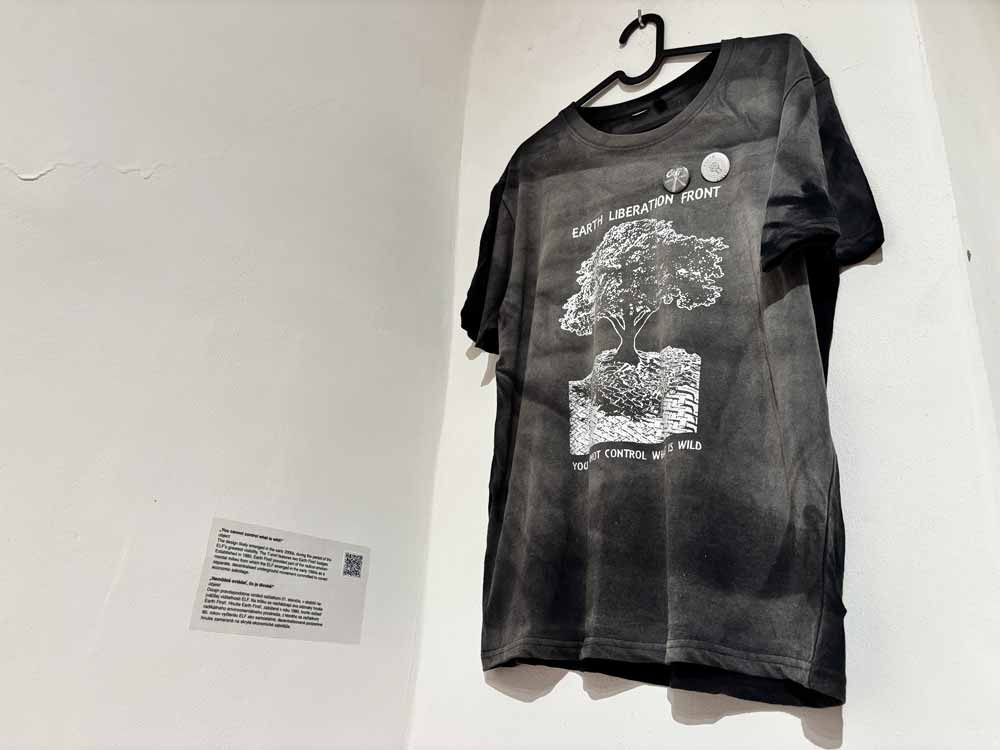
object, T-shirt, 50 x 65 cm
The design likely emerged in the early 2000s, during the period of the ELF’s greatest visibility. The T-shirt features two Earth First! badges. Established in 1980, Earth First! provided part of the radical environmental milieu from which the ELF emerged in the early 1990s as a separate, decentralised underground movement committed to covert economic sabotage.
OpenAI. (2026). ChatGPT (GPT-5.6) [Large language model]. See prompts at the end
Earth First!, Its internal currents, and the afterlives of radical environmental merchandise
Movement history, Earth First!-ELF relations, T-shirts, badges and the commodification of dissent
Scope: Earth First! in the United States and Britain from 1980 to the present; internal ideological and tactical currents; the relationship between Earth First! and the Earth Liberation Front (ELF); the history, design and circulation of T-shirts, badges and related activist objects; and the contradictory role of commerce in neutralising, financing and preserving radical environmental memory. The report does not provide operational guidance for sabotage and does not offer a separate catalogue description of the displayed object.
Abstract
Earth First! emerged in 1980 as a deliberately uncompromising alternative to professionalised conservation. The requested distinction between a radical and a moderate branch is historically useful only with qualification. By the late 1980s, the US movement had divided between a wilderness-centred biocentric current and a social-justice current associated with labour, feminism, coalition-building and mass direct action. Both remained radical relative to mainstream environmental organisations; they differed over the meaning of radicalism, acceptable risk and whether ecological defence could be separated from human inequality. In Britain, a clearer tactical differentiation appeared in 1992: Earth First! continued public direct action while the ELF name was adopted for covert property sabotage. T-shirts and related merchandise were already part of Earth First!’s movement economy by 1982, serving communication, identity and fundraising before later entering commercial, print-on-demand and collectors’ markets. The earliest verified appearance located for the slogan ‘You cannot control what is wild’ is the May 2001 ELF action at Jefferson Poplar Farms; the date and authorship of the later T-shirt design remain unverified. Commodification can reduce dissent to purchasable identity, yet the same objects can fund movements, preserve contested histories and keep ecological conflict publicly legible.
Contents
1. Foundation and early movement form, 1980-1986
2. Internal currents: biocentrism, social justice and competing radicalisms
3. From Earth First! to the Earth Liberation Front
4. T-shirts, badges and the material culture of radical environmentalism
5. “You cannot control what is wild”: slogan, evidence and design lineage
6. Commerce, commodification and capitalist integration
7. Memory, collecting and the political afterlife of objects
8. Primary and archival evidence links
9. Numbered academic reference list
Appendix: User prompts related to this report
1. Foundation and early movement form, 1980-1986
Earth First! was founded in 1980 by Dave Foreman and a small circle of conservationists who believed that the established US environmental organisations had become too professionalised, legalistic and willing to compromise. The movement placed wilderness and biological diversity before short-term human convenience, articulated a biocentric ethic, and adopted the slogan ‘No compromise in defence of Mother Earth’. It was conceived less as a membership organisation than as a decentralised movement connected by a newspaper, gatherings, personal networks and a shared repertoire of symbolic protest, civil disobedience and, controversially, monkeywrenching or ecotage.
This organisational looseness was both strategic and cultural. It allowed people to act locally without waiting for authorisation, encouraged humour and theatricality, and made Earth First! difficult to reduce to a single programme. It also produced recurrent disputes over who could speak for the movement, which tactics were legitimate and what its symbols meant. The newspaper functioned simultaneously as an ideological forum, an organising infrastructure, a marketplace and an archive of the movement’s evolving identity.
Date | Development | Historical significance |
1980 | Earth First! founded in the United States. | A no-compromise, biocentric challenge to established conservation organisations takes movement form. |
1981 | The exclamation-point logo and high-profile symbolic actions circulate. | A recognisable visual identity helps connect a decentralised network. |
1982 | The newsletter becomes Earth First!; T-shirt designs are solicited and shirts offered for sale. | Communication, identity and commodity circulation are integrated very early. |
1983-1984 | T-shirts, calendars, bumper stickers and “Trinkets and Snake Oil” are promoted as income sources. | Merchandise becomes part of movement self-financing, not simply later external appropriation. |
1985 | Ecodefense and movement merchandise expand alongside public direct action. | The movement combines print culture, practical repertoire, spectacle and fundraising. |
1986 | Disputes over strategically indiscriminate damage and public relations intensify. | The category of monkeywrenching is internally policed rather than uniformly accepted. |
Academic source links: Earth First!: Environmental Apocalypse | The Impact of Environmental Factors on Factionalism and Schism
References: [1], 33-103; [2], 199-228.
Primary / archival evidence links: Introducing Earth First! – Radical Environmentalism’s Print History | Earth First! 2, no. 7 – T-shirt design solicitation | Earth First! 2, no. 8 – early T-shirt advertisement
1.1 “Non-organisation” and the politics of decentralisation
Earth First!’s early self-description as a movement or ‘non-organisation’ rejected the bureaucratic model associated with national environmental NGOs. This stance enabled rapid experimentation and protected a sense of autonomy, but it did not abolish power. Editorial control, access to mailing lists, management of income, public visibility and ownership of movement infrastructure all created informal centres. The later history of the journal and its merchandise demonstrates that decentralisation does not eliminate institutional questions; it relocates them into networks, reputations and control over communicative resources.
Academic source links: Earth First!: Environmental Apocalypse | Leaderless Resistance and Ideological Inclusion
References: [1], 52-103; [7], 351-368.
2. Internal currents: biocentrism, social justice and competing radicalisms
A simple division between a radical wing and a moderate wing obscures the actual conflict. By 1986-1987, two broad currents had crystallised in the US movement. Martha F. Lee describes one as a biocentric or wilderness-centred faction, closely associated with Foreman’s old guard, and the other as a social-justice faction associated with organisers such as Mike Roselle and, later, Judi Bari. The first prioritised the intrinsic value of wilderness and biodiversity; the second argued that ecological destruction was inseparable from class power, racism, patriarchy, labour exploitation and industrial capitalism.
Neither current was simply moderate. The wilderness-centred current could be tactically and rhetorically uncompromising, yet politically narrower in its focus on land and species. The social-justice current could be more restrictive about tactics that endangered workers, while advocating a broader transformation of social and economic relations. Judi Bari’s renunciation of tree spiking in 1990 is exemplary: it was a tactical de-escalation around worker safety, but it served a radical attempt to build alliances between timber workers and environmentalists against corporate control.
Current / position | Primary emphasis | Typical repertoire and political logic | Why “radical” or “moderate” is unstable |
Wilderness-centred biocentrism | Intrinsic value of wilderness, species and ecological integrity. | No-compromise preservation; decentralised action; openness to strategic monkeywrenching; suspicion of anthropocentric politics. | More uncompromising toward property and development, but often less expansive on labour, race, gender and social transformation. |
Social-justice direct action | Ecology linked to labour, feminism, anti-racism, community and anti-capitalism. | Mass civil disobedience, coalition-building, protest camps, media work and selective sabotage debates. | More cautious about tactics that expose workers to harm, but often more radical in its critique of the whole social order. |
Mainstream environmental organisations | Legislation, litigation, professional advocacy and negotiated policy. | Institutional campaigns, lobbying, research and fundraising. | More moderate in repertoire; not an internal branch of Earth First!, but the comparative field against which Earth First! defined itself. |
ELF covert cells | Economic sabotage against activities defined as ecologically destructive. | Clandestine property damage by autonomous cells, with a stated norm of avoiding harm to life. | More radical in illegality and secrecy; organisationally separate from Earth First! rather than simply its “hard wing”. |
Academic source links: Earth First!: Environmental Apocalypse | The Impact of Environmental Factors on Factionalism and Schism | Covert Repertoires: Ecotage in the UK
References: [1], 104-135; [2], 199-228; [5], 199-219.
2.1 The 1987-1990 schism
Factional disagreement became difficult to contain after the 1987 Round River Rendezvous. Disputes concerned social justice, population rhetoric, gender, labour, the role of the journal, the use of movement income and the relationship between public organising and covert action. By 1990 Foreman had withdrawn from the movement and the social-justice current retained the journal. The result was not a clean corporate division into two formally bounded organisations. It was a dispersal of people, styles and infrastructures: some continued under the Earth First! name, some moved into conservation biology or other organisations, and some pursued covert action independently.
For the present report, the most important point is that material culture was implicated in the conflict. By 1988 the journal’s budget exceeded US$200,000, while Ned Ludd Books and the ‘Trinkets and Snake Oil’ operation had expanded substantially. Lee records internal concern about control and the destination of profits. Merchandise was therefore not a peripheral souvenir economy. It was one of the resources through which authority, autonomy and the meaning of the movement were negotiated.
Academic source links: Earth First!: Environmental Apocalypse | The Impact of Environmental Factors on Factionalism and Schism
References: [1], 122-135; [2], 199-228.
3. From Earth First! to the Earth Liberation Front
The ELF should be placed within Earth First!’s milieu without being represented as a simple renamed branch. In Britain, Earth First! developed in the early 1990s through anti-road, anti-development and direct-action networks. Scholarship on British ecotage identifies a 1992 tactical differentiation: public Earth First! organising continued through visible mass action, while the ELF name provided a separate identity for covert sabotage. This separation allowed above-ground organisers to maintain open campaigns while clandestine actors claimed anonymous actions without a membership list or central command.
The ELF identity subsequently travelled across borders and was adopted in the United States during the mid-1990s. Its organisational principle was ‘leaderless resistance’: independent individuals or cells could act in the name of the ELF if they accepted a minimal ideological framework. This structure enlarged tactical participation and made the name reproducible, but it also meant that no central organisation could reliably authorise, police or comprehensively document every action attributed to it.
The relation is therefore genealogical and cultural rather than administrative. Earth First! contributed slogans, ecological urgency, anti-corporate analysis, decentralised practice and a repertoire of direct action. The ELF intensified secrecy and economic sabotage. A garment that combines an ELF slogan with Earth First! badges can truthfully evoke this shared history, but it cannot by itself establish that Earth First! designed, commissioned or endorsed the garment or the action from which the slogan came.
Dimension | Earth First! | Earth Liberation Front |
Public form | Open movement, journal, gatherings, campaigns and above-ground direct action. | Anonymous name used by autonomous cells or individuals. |
Typical visibility | Demonstrations, blockades, tree-sits, protest camps, publications and symbolic actions. | Covert property sabotage, communiques and post-action claims. |
Organisational continuity | Persistent movement identity with changing regional networks. | No central membership, leadership or formal chain of command. |
Relationship | Part of the political and cultural milieu from which the ELF emerged. | Separate clandestine repertoire; not a formal Earth First! department. |
Evidentiary caution | Published material can often be attributed to editors or regional groups. | A claim of responsibility may identify a political frame without identifying perpetrators or proving central coordination. |
Academic source links: Earth First! and the Anti-Roads Movement | Covert Repertoires: Ecotage in the UK | Religion, Violence and Radical Environmentalism | Leaderless Resistance and Ideological Inclusion
References: [3], 1-42; [4], chaps. 3-8; [5], 199-219; [7], 351-368.
3.1 The contested category of eco-terrorism
After 11 September 2001, US law-enforcement and political discourse increasingly classified ELF and Animal Liberation Front property crimes within domestic terrorism. Scholarship remains divided over whether politically motivated damage to inanimate property should be called terrorism. Vanderheiden distinguishes ecotage from attacks on persons and examines moral constraints on sabotage, while Fleming’s recent comparative work argues that environmental activism is strikingly non-lethal and that ‘ecoterrorism’ often conflates property destruction with violence against human beings. This report therefore uses ‘eco-terrorism’ as a contested institutional category, not as a neutral description.
Academic source links: Eco-terrorism or Justified Resistance? | Searching for Ecoterrorism
References: [6], 425-447; [8], 1986-1999.
4. T-shirts, badges and the material culture of radical environmentalism
Wearable objects turn a movement’s language into a portable surface. A T-shirt can communicate at a demonstration, identify allies, raise money, produce photographs and continue circulating after an organisation, campaign or local network has changed. A badge performs a similar function at smaller scale: it is inexpensive, combinable with other affiliations, transferable between garments and easily collected. Because these objects move with bodies, they blur the boundary between personal style, political statement, fundraising and advertising.
Earth First! used this material repertoire early. In August 1982 the movement newspaper solicited original designs for an anti-Coors T-shirt; the September issue advertised an ‘Earth lover’s’ shirt. By November 1983, the sale of T-shirts, calendars and other ‘snake oil and trinkets’ was described as a major source of income. A 1984 notice justified a price rise by pointing to improved shirt quality. Later catalogues offered multiple designs, colours, caps, stickers, publications and music. The evidence establishes a continuous movement commodity practice, although it does not establish the provenance of every surviving garment.
Object type | Movement function | Design characteristics | Commercial / archival afterlife |
T-shirt | Fundraising, message display, group recognition, photographic visibility. | High-contrast slogan and emblem; screen-print or transfer; reproducible sizes and colours. | Movement shop, artist cooperative, print-on-demand seller, vintage resale, museum or exhibition object. |
Pin badge | Compact declaration of affiliation; combinable political identity. | Circular field, emblem or short slogan; low-cost mass production. | Kept in personal collections, archives and issue-based museum collections; easily detached from original event. |
Patch / cap | Longer-term identity marker and adaptation to field clothing. | Durable embroidered or printed symbol; association with outdoor and countercultural dress. | Can become heritage streetwear or a nostalgic marker of activist authenticity. |
Bumper sticker | Extends movement communication onto vehicles and public space. | Brief slogan, logo and strong contrast designed for distance. | Often survives in archives as ephemera; may outlast the campaign but lose date and location. |
Journal / zine | Organising, debate, instruction, fundraising and record keeping. | DIY layout, illustration, satire, reports and order forms. | Becomes the principal source for dating designs, prices and internal disputes. |
Poster / digital file | Mobilisation and rapid symbolic reproduction. | Woodcut, linocut, stencil or vector aesthetics; easy adaptation. | Can circulate freely, be sold by cooperatives, or be captured by commercial platforms. |
Academic source links: Feminist Commodity Activism | Slogan T-shirts: Liberalism, abolition and commodity activism | Participation with Style | The Art of Protest
References: [9], 215-232; [10], 255-277; [11], article 55; [12].
Primary / archival evidence links: Earth First! 4, no. 1 – merchandise as income | Earth First! 5, no. 1 – quality and price notice | Earth First! records, 1971-2012 – archive finding aid
4.1 Design: reproducibility, anonymity and shared visual language
Radical environmental graphics commonly favour strong silhouettes, black-and-green contrasts, fists, trees, mountains, animals, tools and short imperative slogans. These choices are not merely stylistic. They reproduce clearly through inexpensive screen-printing, photocopying, stencil, badge-making and later digital transfer. Their roughness can also signify urgency, collective production and distance from corporate design polish.
The earliest documented Earth First! logo with an exclamation point dates to 1981, and movement catalogues subsequently advertised several graphic families rather than one fixed corporate identity. This plural visual field makes retrospective attribution difficult. Anonymous activist production is possible, but anonymity should not be assumed whenever attribution is missing: designs may also have been made by named artists, regional groups, printers, commercial sellers or later appropriators. Roger Peet’s 2009 Earth First! T-shirt, produced for a roadshow and documented through Justseeds, demonstrates that movement-related designs can have identifiable authors and circulate through an allied artist economy.
Academic source links: The Art of Protest | Participation with Style
References: [11], article 55; [12].
Primary / archival evidence links: Introducing Earth First! – first logo and merchandise | Roger Peet, Earth First! T-shirt, 2009
4.2 Badges as modular political identity
A badge differs from a T-shirt in one crucial respect: it is modular. Several badges can be worn together, allowing the wearer to assemble a temporary political constellation rather than submit to a single logo. Two Earth First! badges placed on or beside an ELF-related garment can therefore create a visual genealogy, but the combination may have been made by the wearer, a collector, a seller or a later curator. The badge’s portability strengthens memory while weakening provenance.
Institutional collections emphasise that political buttons and pins have been widely used since the mid-twentieth century to display support, participation and issue affiliation. Their cheapness and small scale facilitate mass circulation; their detachability encourages reuse. In an archive, the same qualities produce ambiguity: a badge may be genuine to a movement but not original to the garment on which it is later found.
Academic source links: Museums, Archives and Protest Memory | The Art of Protest
References: [12]; [14], 29-80, 113-138.
Primary / archival evidence links: Political Movements and Protest Pins since 1960 – Harvard Library | Buttons and Pins – Smithsonian | Politics and Protest Badge Collection – Museums Victoria
5. “You cannot control what is wild”: slogan, evidence and design lineage
The earliest securely dated occurrence located in this research is not a T-shirt but graffiti associated with the 21 May 2001 ELF arson at Jefferson Poplar Farms near Clatskanie, Oregon. An FBI review records that one building was marked ‘ELF’ and ‘You cannot control what is wild’. A June 2001 ELF communique referred back to the Clatskanie wording. This provides a firm terminus ante quem for the slogan: it existed by 21 May 2001.
The available evidence does not support the stronger claim that the phrase originated in late-1990s anarchist or anti-civilisation discourse, nor does it identify a first author. It may have circulated orally or in ephemeral print before the action, but no verified earlier source was located. Equally, the assumption that the T-shirt itself was produced between 2001 and 2005 is plausible because the slogan was then highly legible within ELF publicity, but remains unproven without a dated catalogue, label, purchase record, photograph or designer testimony.
Claim | Finding | Confidence / editorial treatment |
The slogan existed by May 2001. | Confirmed in official reporting of the Jefferson Poplar Farms action and echoed in an ELF communique. | High. Present as verified history. |
The slogan predates 2001 in anti-civilisation discourse. | No reliable dated source located for this revision. | Unverified. Do not repeat as fact. |
The T-shirt was designed in 2001-2005. | Chronologically possible, but no dated production evidence located. | Low to moderate. Present only as a hypothesis. |
The design was anonymously produced by activists. | Possible, but absence of attribution does not prove collective or anonymous authorship. | Unverified. Designer remains unknown. |
Earth First! badges prove Earth First! authorship or endorsement. | Badges establish visual association only and may have been added later. | Not supported. Treat as retrospective montage or assemblage. |
The tree motif belongs to radical environmental print culture. | Broadly plausible; the specific image was not supplied with a traceable source. | General lineage possible; specific derivation unverified. |
Academic source links: Religion, Violence and Radical Environmentalism | Leaderless Resistance and Ideological Inclusion
References: [3], 1-42; [7], 351-368.
Primary / archival evidence links: FBI, Terrorism 2000/2001 – Clatskanie incident | Earth Liberation Front communiques, 1997-2002
EVIDENTIARY BOUNDARY The combined visual field – an ELF slogan, a tree or wilderness image and two Earth First! badges – can be interpreted as a retrospective statement about shared radical environmental culture. It should not be presented as proof that Earth First! produced the shirt, that an ELF cell commissioned it, or that the badges were original to the garment. |
6. Commerce, commodification and capitalist integration
The political meaning of an activist T-shirt does not disappear when it becomes a commodity, but it is reorganised by the commodity form. A complex history is compressed into a surface that can be priced, sized, shipped, photographed and worn without participation in the movement that produced the slogan. The buyer may acquire an ethical or rebellious self-image; the seller may acquire revenue; a platform may extract fees; and the original conflict may be reduced to style. Repo’s concept of commodity activism is useful here because it identifies how political agency can be transferred from collective organising to companies, charities, entrepreneurs and consumers.
Earth First!’s own history prevents a simple story of pure resistance later corrupted by the market. The movement sold shirts and ephemera almost from the beginning. Merchandise financed the newspaper and movement infrastructure, helped regional organisers recognise one another and allowed people unable to attend an action to support it materially. The contradiction was internal from the start: anti-capitalist or anti-industrial messages circulated through cotton garments, printing, postal systems and money. Capitalist integration was therefore not only an external capture; it was also a practical condition of sustaining a decentralised movement within a market society.
Circuit of circulation | Economic form | Political gain | Political risk |
Movement-controlled fundraising | Journal or regional group commissions and sells merchandise. | Income supports printing, travel, organising and legal defence; context can be supplied with the object. | Control over money and design may centralise informal power; production still relies on commodity supply chains. |
Allied artist / cooperative economy | Named artists or collectives produce work for campaigns or benefit sales. | Authorship, solidarity and revenue destination can remain visible; aesthetic innovation strengthens movement culture. | The object can still become a niche lifestyle product and may reach mainly sympathetic consumers. |
Independent commercial reproduction | Third-party seller uses familiar slogans or imagery on demand. | Extends visibility beyond movement networks and may preserve otherwise unavailable designs. | Revenue may not reach activists; history, risk and political context can be stripped away. |
Vintage and collectors’ market | Scarcity, age and presumed authenticity generate resale value. | Objects survive and can enter archives, research collections and exhibitions. | Rarity may be fetishised; unverifiable stories and false dates can increase market value. |
Museum / art exhibition | The object is accessioned, displayed or incorporated into an artwork. | Recontextualisation can restore history, contradiction and public debate. | Institutional framing can aestheticise dissent, neutralise illegality or convert radical memory into cultural capital. |
Academic source links: Feminist Commodity Activism | Slogan T-shirts: Liberalism, abolition and commodity activism | The Conquest of Cool | Museums, Archives and Protest Memory
References: [9], 215-232; [10], 255-277; [13]; [14], 1-80, 113-154.
Primary / archival evidence links: Current Earth First-inspired marketplace listings
6.1 The garment as purchasable political subjectivity
A slogan shirt turns the body into a moving display and the consumer into both audience and medium. This can support collective identity, but it can also substitute display for participation. The phrase becomes a compact declaration whose ambiguity is useful commercially: it can signify environmental militancy, generalised wildness, outdoor lifestyle, anti-authoritarianism or simply graphic intensity. The less context supplied, the larger the possible market.
For the ELF slogan, decontextualisation is especially consequential. Detached from the 2001 arson, ‘You cannot control what is wild’ can read as a benign celebration of nature. Reattached to the event, it becomes a statement about experimental tree plantations, sabotage, scientific and corporate control, and the use of fire as political communication. Commercial circulation can therefore preserve the words while erasing the action, or preserve the action as notoriety while erasing the ecological dispute.
Academic source links: Feminist Commodity Activism | Participation with Style | The Conquest of Cool
References: [9], 215-232; [11], article 55; [13].
6.2 Material contradiction: environmental message, industrial garment
The environmental T-shirt also contains a material contradiction. Cotton cultivation, synthetic blends, dyes, printing, labour, packaging, online fulfilment and global transport place the object inside the same industrial systems that radical environmentalism criticises. Ethical fibres or local printing may reduce some impacts, but they do not abolish the commodity chain. The garment’s ecological politics therefore operate at two levels: what it says and how it was made. In most surviving or second-hand examples, production data are absent, making the slogan more legible than the material history.
This asymmetry is one mechanism of capitalist integration. Politics is concentrated on the visible front; extraction and labour recede into the blank shirt. Yet second-hand survival can also extend the useful life of the object and rescue it from disposal. The same commodity may be simultaneously compromised, durable and historically valuable.
Academic source links: Slogan T-shirts: Liberalism, abolition and commodity activism | Feminist Commodity Activism
References: [9], 215-232; [10], 255-277.
7. Memory, collecting and the political afterlife of objects
Activist objects often outlive the networks that made or wore them. Their afterlife is not passive. Archives, private collections, resale platforms, museums and art projects select which slogans remain visible and which disappear. Chidgey and Garde-Hansen describe protest memory as something continually reactivated, managed and contested. A T-shirt can become evidence of participation, a family keepsake, a collectible, a costume, a marketable vintage object or a curatorial device. Each setting produces a different past.
Commercial survival is therefore politically ambivalent. Resale can detach an object from its maker, but it can also preserve ephemera that movements lacked the resources to archive. Searchability on a platform may make a forgotten slogan discoverable, even as the platform monetises that discovery. A buyer motivated by aesthetics may later encounter the movement’s history; a researcher may recover a rare design through the same market. Capitalist circulation can function unintentionally as a preservation mechanism, but it does not guarantee accurate provenance.
The memory of the ELF is particularly dependent on such dispersed traces because the movement’s clandestine form produced few conventional organisational records. Communiques, press photographs, court files, graffiti descriptions, shirts, badges, music and later documentaries form a fragmented archive. Preserving these traces keeps both the movement and the environmental problems it addressed available for scrutiny. It should not, however, turn sabotage into an uncritical heroic style. A responsible archive retains the targets, consequences, tactical debates, state response and uncertainty around attribution.
Academic source links: Museums, Archives and Protest Memory | The Art of Protest | Elves, environmentalism, and “eco-terror”
References: [12]; [14], 1-80, 113-154; [15], 75-93.
7.1 Authenticity, provenance and the collector’s problem
A movement object can be authentic in several different senses: it may be physically old, produced by a movement office, sold at a gathering, worn by an activist, depict an authentic slogan, or simply reproduce an historically accurate design. These categories should not be collapsed. A newly printed shirt may faithfully transmit a 1980s symbol; an old shirt may have no direct connection to a campaign; genuine badges may have been added to a later garment.
For this reason, the project should record the object itself – fabric, label, printing technique, wear, repairs, badge fastenings and any acquisition history – separately from the history of the images and words it carries. Material examination may narrow a date range, but it cannot independently prove political use. The correct archival description is layered: verified material facts, verified movement history, plausible interpretation and parafictional relation.
Academic source links: Museums, Archives and Protest Memory
References: [14], 29-80, 113-154.
Primary / archival evidence links: Earth First! records – ephemera including T-shirts and bumper stickers
8. Primary and archival evidence links
The following records support exact dates, movement self-description, merchandise history, slogan documentation and the present commercial afterlife. They are primary, institutional or commercial evidence and are not included in the numbered academic bibliography.
Environment & Society Portal, Earth First! Movement Writings – Archive of journals, pamphlets and related ephemera.
Introducing Earth First! – Radical Environmentalism’s Print History – Institutional exhibition page documenting the 1981 logo and early merchandise.
Earth First! 2, no. 7 (1 August 1982) – Solicits original designs for an anti-Coors T-shirt.
Earth First! 2, no. 8 (21 September 1982) – Advertises an early Earth First! T-shirt and price.
Earth First! 4, no. 1 (1 November 1983) – Describes T-shirts, calendars and other merchandise as a major income source.
Earth First! 5, no. 1 (1 November 1984) – Links a price increase to improved T-shirt quality.
Earth First! records, 1971-2012 – Archive finding aid listing publications and ephemera, including T-shirts and bumper stickers.
FBI, Terrorism 2000/2001 – Official incident summary recording the Clatskanie slogan and ELF claim.
Earth Liberation Front communiques, 1997-2002 – Activist compilation including a June 2001 reference to the Clatskanie slogan.
Roger Peet, Earth First! T-shirt, 2009 – Documented named-artist example produced for an Earth First! roadshow.
9. Numbered academic reference list
Chicago bibliography style. The numbered list contains only peer-reviewed journal articles and scholarly books issued by academic presses.
1. Lee, Martha F. Earth First!: Environmental Apocalypse. Syracuse, NY: Syracuse University Press, 1995. Publisher record
2. Balser, Deborah B. “The Impact of Environmental Factors on Factionalism and Schism in Social Movement Organizations.” Social Forces 76, no. 1 (September 1997): 199-228. DOI / stable link
3. Taylor, Bron. “Religion, Violence and Radical Environmentalism: From Earth First! to the Unabomber to the Earth Liberation Front.” Terrorism and Political Violence 10, no. 4 (1998): 1-42. DOI / stable link
4. Wall, Derek. Earth First! and the Anti-Roads Movement: Radical Environmentalism and Comparative Social Movements. London: Routledge, 1999. Publisher record
5. Plows, Alexandra, Derek Wall, and Brian Doherty. “Covert Repertoires: Ecotage in the UK.” Social Movement Studies 3, no. 2 (2004): 199-219. DOI / stable link
6. Vanderheiden, Steve. “Eco-terrorism or Justified Resistance? Radical Environmentalism and the ‘War on Terror’.” Politics & Society 33, no. 3 (2005): 425-447. DOI / stable link
7. Joosse, Paul. “Leaderless Resistance and Ideological Inclusion: The Case of the Earth Liberation Front.” Terrorism and Political Violence 19, no. 3 (2007): 351-368. DOI / stable link
8. Fleming, Sean. “Searching for Ecoterrorism: The Crucial Case of the Unabomber.” American Political Science Review 118, no. 4 (2024): 1986-1999. DOI / stable link
9. Repo, Jemima. “Feminist Commodity Activism: The New Political Economy of Feminist Protest.” International Political Sociology 14, no. 2 (June 2020): 215-232. DOI / stable link
10. Gebhart, Nancy, and Kelly L. Reddy-Best. “Slogan T-shirts: Liberalism, Abolition and Commodity Activism in the Midwestern United States.” Critical Studies in Fashion & Beauty 13, no. 2 (2022): 255-277. DOI / stable link
11. Genova, Carlo. “Participation with Style: Clothing among Young Activists in Political Groups.” Societies 10, no. 3 (2020): article 55. DOI / stable link
12. Reed, T. V. The Art of Protest: Culture and Activism from the Civil Rights Movement to the Present. 2nd ed. Minneapolis: University of Minnesota Press, 2019. Publisher record
13. Frank, Thomas. The Conquest of Cool: Business Culture, Counterculture, and the Rise of Hip Consumerism. Chicago: University of Chicago Press, 1997. Publisher record
14. Chidgey, Red, and Joanne Garde-Hansen. Museums, Archives and Protest Memory. Cham: Palgrave Macmillan, 2024. DOI / stable link
15. Joosse, Paul. “Elves, Environmentalism, and ‘Eco-terror’: Leaderless Resistance and Media Coverage of the Earth Liberation Front.” Crime, Media, Culture 8, no. 1 (2012): 75-93. DOI / stable link
Appendix: User prompts related to this report
The prompt below is an English translation and editorial normalisation of the original Hungarian instruction. It is reproduced as a structured research-process record; no new research requests have been invented.
1. Prepare an English-language, source-critical report on the history of Earth First!, distinguishing its more radical and more moderate tendencies while explaining the limits of that binary. Examine the historical relationship between Earth First! and the Earth Liberation Front, including the emergence of the ELF from the wider radical environmental milieu.
2. Include a separate material-culture analysis of movement T-shirts, badges and comparable objects. Research their design languages, origins, manufacture, distribution, trade and historical appearance. Do not create a separate catalogue description of the exhibition object; instead, use the associated wording and visual elements as a case through which the wider history can be analysed.
3. Place particular emphasis on commodification and capitalist integration. Analyse how movements, environmental problems and oppositional symbols become merchandise, consumer identity and marketable style. At the same time, examine how these commodities can preserve the memory of Earth First!, the ELF and related movements, and thereby maintain the public visibility of the ecological conflicts to which they responded.
4. The associated exhibition object is titled ‘You cannot control what is wild!’. The working hypothesis states that the design may have emerged in the early 2000s, during the period of greatest ELF visibility, and that the garment incorporates two Earth First! badges. Test these propositions rather than assuming them. State clearly what can and cannot be verified about the slogan, design, authorship, date and relationship between the organisations.
5. Follow the current standards of The Sunshine Find / Glacial Archaeology project. Begin with an abstract of no more than 200 words; maintain the approved unified narrative and typographic structure; distinguish verified history, interpretation and parafiction; use British English; include evidence-based cross-references to related project objects and reports; and conclude with a numbered Chicago-style academic bibliography containing only valid peer-reviewed or scholarly sources. Place all relevant user prompts at the very end of the document.
2. General remarks and new request:
1. I have been asking you to create individual reports on different topics, in this case the train service and model of Glacier Express.
2. Nonetheless these materials should converge into a unity which is the archive itself and the supporting physical installation. This convergence should be based on a synthesys of all of my other topics, questions and criteria raised in all of the other chat sessions, which are all part of the same project the main scope of which is an art installation and a supporting archive that grows by time. The archive is meant for both professional and nonprofessional use, it should be informative within its artistic and pedagogical scope as well.
3. the main line of thoughts of the project departs from panoptic tourism and concludes to ecoterrorism in a narrative line. Therefore all the reports should follow this general direction in their approach and references.
4. The reports we are working on now will all serve as a background research material published on the project website for the set of objects that will be on display, Each object will have its own page (see: https://glacial-archaeology.net/category/exhibition/). See: Szabolcs KissPál – The sunshine find_for translation. I am also adding the brief description of the project’s general concept, see: Szabolcs KissPál – The sunshine find. The website will have a separate but interconnected section for both the exhibition and the supporting archive. https://glacial-archaeology.net/an-archive-of-narratives-on-global-warming-copy/ Inspect the site while note that it doesn’t have its final structure yet!
5. the scope with the reports is to produce a set of background research material for each object in part that should refer to each other, and should be unified in their narrative and typographic structure, tone, and scope. Pay attention to snychronise the focus points of different partial research tasks when possible with cross references!
6. I am attaching two of your previous reports (noahs_ark_expeditions_1959_1990_academic_sources_new_tab_links.docx, Container_Mount_Scorluzzo_WWI_Shelter_Research_Report). Please develop and and apply to these reports a uniform structure both content wise and in formal aspects while mostly keeping their original content.
7. Main further formal criteria:
– you should always start with an abstract summarizing your finds in a text no longer than 200 words.
– you should always enlist at the very end of the document all my prompts related to that topic
– the external links should always open in a different tab
– you should be using only valid, peer reviewed academic sources listed and numbered at the end of the documents
– you should apply a somewhat unified narrative structured and a unified formatting (including typeface styles, subtitles structure, etc.
8. – note and memorise the above in your cross-chat memory for rurther tasks
– return the three reports keeping their main content but slightly modified (!) according to the above
2. General remarks and new request:
1. I have been asking you to create individual reports on different topics, in this case the train service and model of Glacier Express.
2. Nonetheless these materials should converge into a unity which is the archive itself and the supporting physical installation. This convergence should be based on a synthesys of all of my other topics, questions and criteria raised in all of the other chat sessions, which are all part of the same project the main scope of which is an art installation and a supporting archive that grows by time. The archive is meant for both professional and nonprofessional use, it should be informative within its artistic and pedagogical scope as well.
3. the main line of thoughts of the project departs from panoptic tourism and concludes to ecoterrorism in a narrative line. Therefore all the reports should follow this general direction in their approach and references.
4. The reports we are working on now will all serve as a background research material published on the project website for the set of objects that will be on display, Each object will have its own page (see: https://glacial-archaeology.net/category/exhibition/). See: Szabolcs KissPál – The sunshine find_for translation. I am also adding the brief description of the project’s general concept, see: Szabolcs KissPál – The sunshine find. The website will have a separate but interconnected section for both the exhibition and the supporting archive. https://glacial-archaeology.net/an-archive-of-narratives-on-global-warming-copy/ Inspect the site while note that it doesn’t have its final structure yet!
5. the scope with the reports is to produce a set of background research material for each object in part that should refer to each other, and should be unified in their narrative and typographic structure, tone, and scope. Pay attention to snychronise the focus points of different partial research tasks when possible with cross references!
6. I am attaching two of your previous reports (noahs_ark_expeditions_1959_1990_academic_sources_new_tab_links.docx, Container_Mount_Scorluzzo_WWI_Shelter_Research_Report). Please develop and and apply to these reports a uniform structure both content wise and in formal aspects while mostly keeping their original content.
7. Main further formal criteria:
– you should always start with an abstract summarizing your finds in a text no longer than 200 words.
– you should always enlist at the very end of the document all my prompts related to that topic
– the external links should always open in a different tab
– you should be using only valid, peer reviewed academic sources listed and numbered at the end of the documents
– you should apply a somewhat unified narrative structured and a unified formatting (including typeface styles, subtitles structure, etc.
8. – note and memorise the above in your cross-chat memory for rurther tasks
– return the three reports keeping their main content but slightly modified (!) according to the above