Edelweiss 3.
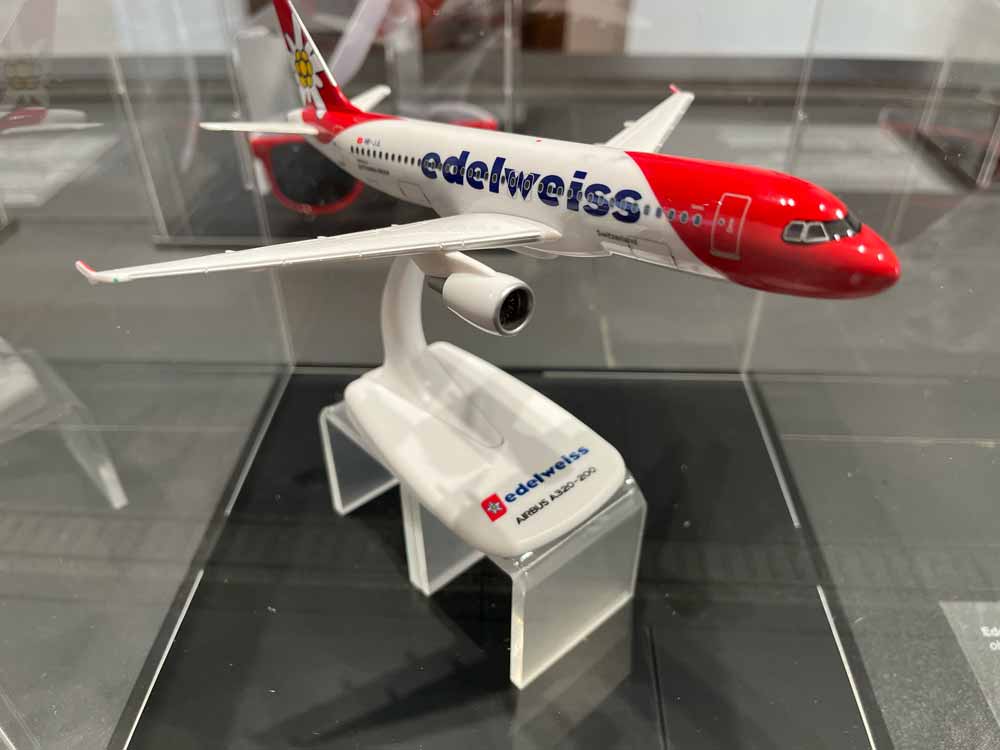
object (maquette), metal, plastic, 10 x 19 x 17,5
Swiss leisure airline carrying the alpine flower in its name and logo; the company frames edelweiss as a symbol of its homeland.
Aviation accounts for 2.5% of global CO₂ emissions. But it has contributed around 4% to global warming to date.
OpenAI. (2026). ChatGPT (GPT-5.6) [Large language model]. See prompts at the end
Edelweiss Air, national symbolism, branded uses and the climate impact of aviation
Scope: The Edelweiss Air maquette; the airline’s company history and homeland branding; the global climatic impact and unequal distribution of aviation; the edelweiss as a national, regional and institutional emblem; selected companies, brands and services using the plant; and ecological, political and economic narratives built around it. The report does not claim that every listed country recognises edelweiss as an official national flower, and it does not infer an airline-specific emissions total where no independently verified public inventory was located.
Abstract
Edelweiss Air was founded in 1995 by Kuoni Travel and Niklaus Grob, began commercial service in 1996, opened long-haul operations in 2000 and became a sister company of SWISS within the Lufthansa Group in 2008. Its name, aircraft livery, regional aircraft names and viewpoint benches extend a nineteenth-century symbolic system in which edelweiss condensed altitude, purity, courage, remoteness and Alpine authenticity into a portable tourism sign. The symbolism is strongest at national level in Switzerland and Austria; elsewhere it operates more specifically through mountain clubs, tourism organisations, currency, military traditions or regional identity. The same plant is used by firms selling aviation, climbing equipment, beer, cheese, cosmetics and financial services, where rarity and resilience become transferable brand values. Aviation produces roughly 2.5% of global carbon dioxide emissions, while its carbon dioxide and non-carbon-dioxide effects have contributed about 4% of warming to date. The object therefore joins a highly legible emblem of pristine mountain nature to a mobility sector whose climatic effects destabilise alpine ecosystems. This report documents that conjunction without treating branding alone as evidence of environmental performance.
Project links and cross-references: Edelweiss 1 and Edelweiss 2 document the plant as cosmetic ingredient and cultivated souvenir seed; Glacier Express and Gaze document other Swiss systems for scenic mobility and controlled Alpine viewing; Elixir and Thirst document the transfer of glacier and mountain imagery into luxury commodities. These are factual archive relations, not claims about the objects as artworks.
Contents
1. Alpine tourism symbolism extracted from the earlier report
2. Edelweiss Air: concise company history and homeland branding
3. Global aviation: carbon dioxide, non-carbon-dioxide effects and inequality
4. National, regional and institutional identity narratives
5. Companies, brands and services using edelweiss
6. Ecological, political and economic narratives
7. Research conclusions and limitations
Primary and institutional evidence links
Numbered Academic Reference List
Appendix: User prompts related to this report
1. Alpine tourism symbolism extracted from the earlier report
The earlier report’s strongest cultural finding is that edelweiss usually functions in tourism less as a botanical specimen than as a condensed and repeatable code. Its familiar white star evokes altitude, remoteness, purity, courage, endurance and a supposedly unspoilt Alpine world. Scheidegger’s cultural history shows that this vocabulary was built through nineteenth-century alpinism and was rapidly reused by tourism, advertising and souvenir production as railways, grand hotels and viewpoints reorganised the Alps for visitors.
1.1 From alpinist emblem to tourism infrastructure
• Alpine clubs helped stabilise edelweiss as an emblem of mountaineering, courage and fellowship. Their badges turned a locally growing plant into a mobile collective sign.
• Belle Époque railways, hotels, postcards and destination advertising transferred the emblem from specialist mountaineering culture into mass tourism. Edelweiss promised healthy air, brightness, altitude and access to a landscape represented as both remote and comfortably consumable.
• Contemporary tourism often turns the emblem into an experience rather than a static logo: named trails, aircraft christenings, viewpoint benches, souvenir pins and mountain retail sites locate the flower inside routes and services.
• The earlier report’s formulation “infrastructure of sentiment” is retained as a useful descriptive phrase for the repeated low-intensity circulation of the flower across logos, badges, seats, routes and souvenirs. It should be read as an editorial description, not as a separate historical claim.
Academic source links: Mythos Edelweiss: zur Kulturgeschichte eines alpinen Symbols
References: [1], 22–24, 38–52.
Primary / institutional evidence links: Edelweiss Air homeland programme | Edelweiss Air naming concept | Pizol Edelweiss Route | Edelweiss bench at Oberalp Pass
2. Edelweiss Air: concise company history and homeland branding
Date | Documented development | Relevance |
19 October 1995 | Edelweiss Air Ltd. founded by Kuoni Travel Ltd. and Niklaus Grob. | The leisure airline was established within the Swiss package-travel economy. |
February 1996 | Operating licence obtained; first commercial service from Zurich to Larnaca via Paphos. | Initial fleet comprised two McDonnell Douglas MD-83 aircraft. |
1999 | Fleet renewal began with Airbus A320 aircraft. | The airline associated growth with newer, more efficient equipment. |
November 2000 | First long-haul flight to the Maldives using an Airbus A330. | The company expanded the Swiss holiday-flight model beyond Europe. |
November 2008 | Edelweiss became a sister company of SWISS and part of the Lufthansa Group. | The Edelweiss name, management and holiday-airline identity were retained within a larger group structure. |
2016 | The “Where Edelweiss is at home” naming programme began with the aircraft Chäserrugg. | Aircraft were named after Swiss regions where the flower grows; related aircraft-seat benches were placed at viewpoints. |
2025 | Thirtieth anniversary and entry of the Airbus A350 into scheduled service. | The company presented the fleet change as improving efficiency and reducing fuel and carbon dioxide per aircraft relative to the A340; this is a relative efficiency claim, not a guarantee of absolute emissions decline. |
Primary / institutional evidence links: Official company history | Airbus A350 presentation
2.1 Homeland branding as a mobile tourism system
Edelweiss Air explicitly states that “Edelweiss is a symbol of our homeland” and that it carries the flower in its name and logo. The 2016 naming programme links individual aircraft to Swiss sites where edelweiss grows, while viewpoint benches shaped like aircraft seats connect aviation branding to ground-based scenic tourism. The emblem therefore travels in two directions: aircraft export an image of Switzerland to holiday destinations, and branded furniture and destination partnerships import the airline into Swiss landscapes. This is a direct continuation of the earlier tourism history in which a flower associated with inaccessible heights became an accessible sign attached to mobility infrastructure.
Primary / institutional evidence links: Responsibility for our homeland | Where Edelweiss is at home
3. Global aviation: carbon dioxide, non-carbon-dioxide effects and inequality
Indicator | Evidence-based summary | Qualification |
Carbon dioxide share | Aviation is commonly estimated to produce about 2.5% of annual global carbon dioxide emissions. | This figure counts direct carbon dioxide, not the full warming effect. |
Contribution to warming | Aviation has contributed approximately 4% of global warming to date in public syntheses based on the scientific literature. | The difference reflects non-carbon-dioxide effects as well as accumulated carbon dioxide. |
Non-carbon-dioxide effects | Nitrogen oxides, water vapour, soot, sulphate aerosols and contrail-induced cloudiness alter radiative forcing. Lee et al. found non-carbon-dioxide effects to constitute the majority of aviation’s net effective radiative forcing in 2018. | Contrail cirrus and nitrogen-oxide chemistry are especially important, but remain more uncertain than carbon dioxide. |
Distribution | The most frequent fliers – no more than about 1% of the world population – were estimated to cause more than half of passenger aviation carbon dioxide emissions in 2018. | Aviation climate responsibility is highly unequal rather than evenly distributed across humanity. |
Academic source links: Global aviation climate forcing, 2000–2018 | Global distribution and growth of aviation
References: [3]; [4].
Institutional / public synthesis link: Our World in Data: Where in the world do people have the highest CO₂ emissions from flying?
3.1 Decarbonisation pathways and limits
Efficiency improvements reduce fuel use per seat or flight, but they do not automatically reduce the sector’s absolute emissions when passenger demand, distance and capacity continue to grow. Scenario research identifies several interacting measures: slower demand growth or reduced flying, operational and aircraft efficiency, low-carbon fuels, and carbon dioxide removal for residual emissions and non-carbon-dioxide effects. Bergero and colleagues find that demand reduction and efficiency can make major contributions, while large-scale sustainable aviation fuel supply and carbon removal would still be required in ambitious net-zero pathways.
Taxation and demand-management proposals also raise questions of fairness. Because flights and flight emissions are concentrated among higher-income and frequent travellers, well-designed frequent-flyer levies can be more progressive than flat charges. This distributional evidence is particularly relevant to leisure aviation: a global sector is represented through universal holiday imagery even though participation and climatic responsibility are sharply unequal.
Academic source links: Pathways to net-zero emissions from aviation | How socially just are taxes on air travel and frequent-flyer levies?
References: [5], 404–414; [6], 62–84.
Airline-specific evidence gap: No independently audited, public, Edelweiss-only historical emissions inventory was located for this report. Group or fleet-efficiency statements should therefore not be converted into a precise company share of global aviation emissions. The object description is most defensibly anchored in the sector-wide 2.5% carbon-dioxide and approximately 4% warming estimates.
4. National, regional and institutional identity narratives
Edelweiss is often called a national flower, but the legal and cultural status differs by country. The table separates broad national symbolism from narrower mountain, currency, regional or institutional uses.
Country | Level of symbolism | Documented role | Qualification |
Switzerland | Broad national identity | Government cultural material describes edelweiss as a national symbol and emblem of Swiss identity. It appears on the five-franc coin, military rank insignia, tourism imagery, clothing and corporate logos. | Strong national-symbol case; not dependent on a single official designation. |
Austria | National and imperial-Alpine identity | The flower acquired major public visibility through Habsburg imagery, Alpine clubs, military traditions and popular culture. Austria places edelweiss on the national side of the 2-cent euro coin. | Strong national-symbol case; the coin explicitly links it to environmental duty. |
Germany | Alpine institutional and military identity | The German Alpine Club identifies edelweiss as the core of its brand, joining mountain love, freedom, respect and responsibility for nature. The emblem also has a mountain-troop history. | Important in German Alpine identity, but not a general state emblem. |
Bulgaria | National mountain-tourism and civic identity | The Bulgarian Tourist Union’s statutes define a white edelweiss as the central emblem on its flag, logo and seal, alongside the motto “Know the homeland in order to love it”. | Strong institutional link between the flower, domestic tourism and patriotic education; not the state’s official tourism logo. |
Romania | Carpathian nature and currency identity | Edelweiss (floarea-de-colț) has protected-species status and appears as a central floral element on the Aurel Vlaicu banknote design. | A national currency and conservation symbol rather than a formally declared national flower. |
Slovenia | Mountain culture and professional identity | Planika appears in mountain-guide and Alpine cultural contexts, while Triglav is the stronger state-wide mountain symbol. | Secondary national-mountain association; evidence is weaker for edelweiss as a general national emblem. |
Italy | Regional and military identity | The flower is prominent in South Tyrolean political and tourism imagery and in Alpine military traditions. | Predominantly regional or corps-based rather than a pan-Italian national symbol. |
Academic source links: Mythos Edelweiss
References: [1], especially 38–52.
Primary / institutional evidence links: Swiss identity account | Austrian national coin sides | German Alpine Club brand assets | Bulgarian Tourist Union statutes | Romanian banknote specification
5. Companies, brands and services using edelweiss
The following list is selective. It prioritises uses in which the plant’s symbolic function is explicit or historically documented, rather than businesses that merely happen to contain the word in a name.
Name | Sector / geography | Mode of use | Symbolic transfer | Evidence |
Edelweiss Air | Switzerland / aviation | Name, tail logo, red-and-white livery, aircraft naming and viewpoint benches. | Homeland, Swissness, tourism and mobile national identity. | |
Edelweiss Ropes | France / climbing equipment | Long-standing mountaineering brand; official history dates a major kernmantle-rope innovation to 1953. | Technical reliability, climbing heritage and Alpine expertise. | |
Edelweiss wheat beer | Austria / beverage | Brand built around Alpine origin and the flower’s rarity. | Purity, naturalness, passion, courage and “Alpine spirit”. | |
Edelweiss cheese company | Germany / dairy | Founder Karl Hoefelmayr registered the Alpine flower logo for speciality cheeses in 1893. | Regional quality, speciality and mountain provenance. | |
The Body Shop Edelweiss | International / skincare | Product range using edelweiss extract and marketing language about survival in extreme conditions. | Resilience, antioxidant “plant power” and stronger skin. | |
Edelweiss Financial Services | India / finance | Corporate flower symbol placed inside a protective letter “e”. | Protection, ideas, resilience and values transferred far beyond Alpine geography. | |
German Alpine Club (DAV) | Germany / membership and mountain services | Edelweiss is stated to be the core of the DAV brand. | Mountains, freedom, respect and nature-compatible sport. | |
Austrian Alpine Club (ÖAV) | Austria / membership, huts, routes and conservation | Edelweiss has served as a club badge since the nineteenth century. | Love of nature, mountains and Alpine life. | |
UIMLA | International / mountain-leader credential | The flower in the international mountain-leader association logo is identified as edelweiss. | Cross-border Alpine professionalism and guiding authority. | |
Switzerland Tourism and destination services | Switzerland / tourism promotion | Historic and current souvenir, route and promotional uses include pins, trails and Alpine attraction branding. | Swiss authenticity and accessible mountain experience. |
6. Ecological, political and economic narratives
6.1 From overcollection to climate vulnerability
Edelweiss became an early conservation symbol partly because tourism and mountaineering encouraged visitors to pick it as proof of ascent or as a souvenir. Protection laws and cultivation helped reverse some local pressures, but the species remains useful in climate narratives because its cultural identity is tied to cold, open high-mountain environments. The best species-specific demographic study located for this report found that climate change may have more negative effects on Romanian Carpathian populations than direct human disturbance alone. It does not establish glacier retreat as a single causal variable. The defensible formulation is broader: warming, changing snow and soil conditions, upward habitat shifts and altered plant competition can destabilise Alpine specialist populations.
Academic source links: Edelweiss demography and distribution modelling | Mythos Edelweiss
References: [2], 12322–12334; [1], 26–37.
6.2 Political ecology and public duty
The Austrian 2-cent coin gives the symbol an explicit environmental-political meaning: the floral series is said to represent duty to the environment and Austria’s part in European environmental policy. Alpine clubs similarly connect the emblem to responsible or nature-compatible mountain sport. In Bulgaria, the tourist union places the flower beside a homeland-learning motto, linking environmental experience, domestic mobility and civic education. In Romania, currency and protected-species narratives link technological national history, Carpathian nature and legal conservation.
Primary / institutional evidence links: Austrian National Bank: national coin sides | DAV: edelweiss and responsibility for nature | Bulgarian Tourist Union statutes | National Bank of Romania: 500,000 lei banknote — Aurel Vlaicu and edelweiss
6.3 Commercial nature narratives
Across aviation, beverages, dairy, cosmetics, climbing equipment and finance, the plant transfers a recurrent cluster of attributes: rarity, purity, high-altitude origin, endurance, protection and trust. Some products contain cultivated edelweiss material; others use only the name or graphic. These are different evidentiary categories. A botanical ingredient claim, a heritage claim and a sustainability claim should not be treated as interchangeable.
Environmental-communication scholarship provides a useful discipline for reading such branding. Nature imagery can be a genuine account of material sourcing or conservation, a general corporate identity, or a claim that encourages audiences to infer environmental performance. The presence of an edelweiss emblem is not itself evidence for low emissions, sustainable production or protection of wild populations. Verifiable environmental assessment requires boundaries, data, comparison methods and independent scrutiny. This report therefore describes the mismatch between an airline’s pristine Alpine symbol and aviation’s climatic effects as a documented conjunction, not as proof of deceptive intent.
Academic source links: The Drivers of Greenwashing | The Means and End of Greenwash
References: [7], 64–87; [8], 223–249.
7. Research conclusions and limitations
• The attached report’s account of Alpine tourism symbolism is well supported when grounded in the cultural history of alpinism, rail tourism, advertising and souvenir production.
• Edelweiss Air is not simply named after a flower: its livery, aircraft names, destination partnerships and scenic benches form a coordinated homeland-branding programme.
• The maquette connects a symbol of high-altitude purity to a sector responsible for about 2.5% of global carbon dioxide emissions and approximately 4% of warming to date once non-carbon-dioxide effects are considered.
• Switzerland and Austria provide the strongest broad national-symbol cases. Germany, Bulgaria, Romania, Slovenia and Italy should be described with narrower institutional, currency, mountain, military or regional qualifications.
• The plant’s commercial circulation is trans-sectoral and global. Its meanings remain unusually stable even when transferred from the Alps to Indian finance or international cosmetics: resilience, protection, rarity, authenticity and aspiration.
• No precise Edelweiss Air share of global aviation emissions should be stated without an independently verified company-level inventory. Relative aircraft-efficiency claims do not by themselves demonstrate absolute emissions reductions.
• No source located isolates glacier melt as a single driver of edelweiss decline. Climate effects should be described through broader high-mountain warming and habitat change.
Primary and institutional evidence links
1. Edelweiss Air, History of Edelweiss
2. Edelweiss Air, Responsibility for our homeland
3. Edelweiss Air, Naming concept
4. Swiss Federal Department of Foreign Affairs, The mystical and mythical edelweiss
5. Oesterreichische Nationalbank, The national sides
6. German Alpine Club, Logo, photos and videos
7. Austrian Alpine Club, Mythos Edelweiss
8. Bulgarian Tourist Union, Statutes
9. Romanian Legislative Portal, banknote design specification
13. Edelweiss dairy company, Our roots
14. The Body Shop, Edelweiss skincare
15. Edelweiss Financial Services, Brand identity
Numbered Academic Reference List
Chicago bibliography style. Only scholarly sources are included in this numbered list.
1. Scheidegger, Tobias. Mythos Edelweiss: Zur Kulturgeschichte eines alpinen Symbols. Eine Dokumentation. Zurich and Geneva: Botanical Gardens of the University of Zurich and the City of Geneva, 2008. DOI / stable link
2. Maghiar, Lăcrămioara M., Ilie A. Stoica, and Andrew J. Tanentzap. “Integrating Demography and Distribution Modeling for the Iconic Leontopodium alpinum Colm. in the Romanian Carpathians.” Ecology and Evolution 11, no. 18 (2021): 12322–12334. DOI / stable link
3. Lee, David S., David W. Fahey, Agnieszka Skowron, Myles R. Allen, Ulrike Burkhardt, Qing Chen, Sarah J. Doherty, et al. “The Contribution of Global Aviation to Anthropogenic Climate Forcing for 2000 to 2018.” Atmospheric Environment 244 (2021): 117834. DOI / stable link
4. Gössling, Stefan, and Andreas Humpe. “The Global Scale, Distribution and Growth of Aviation: Implications for Climate Change.” Global Environmental Change 65 (2020): 102194. DOI / stable link
5. Bergero, Candelaria, Greer Gosnell, Dolf Gielen, Seungwoo Kang, Morgan Bazilian, and Steven J. Davis. “Pathways to Net-Zero Emissions from Aviation.” Nature Sustainability 6, no. 4 (2023): 404–414. DOI / stable link
6. Büchs, Milena, and Giulio Mattioli. “How Socially Just Are Taxes on Air Travel and ‘Frequent Flyer Levies’?” Journal of Sustainable Tourism 32, no. 1 (2024): 62–84. DOI / stable link
7. Delmas, Magali A., and Vanessa Cuerel Burbano. “The Drivers of Greenwashing.” California Management Review 54, no. 1 (2011): 64–87. DOI / stable link
8. Lyon, Thomas P., and A. Wren Montgomery. “The Means and End of Greenwash.” Organization & Environment 28, no. 2 (2015): 223–249. DOI / stable link
Appendix: User prompts related to this report
Prompts are reproduced chronologically as a research-process record. Spelling and punctuation are preserved except for minor line-break normalisation.
1. The next object’s description:
Edelweiss 3.
object (maquette)
Swiss leisure airline carrying the alpine flower in its name and logo; the company frames edelweiss as a symbol of its homeland.
Aviation accounts for 2.5% of global CO₂ emissions. But it has contributed around 4% to global warming to date.
1. review the attached report and extract the parts on Alpine tourism symbolism.
2. compile a short history of Edelweiss airlines, connecti it to global impact of aviation industry
3. expand the research on national symbolics of the plant, enlist those nations, where it plays a role in defining the national identity narrative
4. enlist companies, brands, services that are using the plant as a symbol
5. search for ecological narratives (political, economic) that are referring to the plant in a symbolic way
2. General remarks:
1. I have been asking you to create individual reports on different topics.
2. Nonetheless these materials should converge into a unity which is the archive itself and the supporting physical installation. This convergence should be based on a synthesys of all of my other topics, questions and criteria raised in all of the other chat sessions, which are all part of the same project the main scope of which is an art installation and a supporting archive that grows by time. The archive is meant for both professional and nonprofessional use, it should be informative within its artistic and pedagogical scope as well.
3. the main line of thoughts of the project departs from panoptic tourism and concludes to ecoterrorism in a narrative line. Therefore all the reports should follow this general direction in their approach and references.
4. The reports we are working on now will all serve as a background research material published on the project website for the set of objects that will be on display, Each object will have its own page (see: https://glacial-archaeology.net/category/exhibition/). See: Szabolcs KissPál – The sunshine find_for translation. I am also adding the brief description of the project’s general concept, see: Szabolcs KissPál – The sunshine find. The website will have a separate but interconnected section for both the exhibition and the supporting archive. https://glacial-archaeology.net/an-archive-of-narratives-on-global-warming-copy/ Inspect the site while note that it doesn’t have its final structure yet!
5. the scope with the reports is to produce a set of background research material for each object in part that should refer to each other, and should be unified in their narrative and typographic structure, tone, and scope. Pay attention to snychronise the focus points of different partial research tasks when possible with cross references!
6. I am attaching two of your previous reports (noahs_ark_expeditions_1959_1990_academic_sources_new_tab_links.docx, Container_Mount_Scorluzzo_WWI_Shelter_Research_Report). Please develop and and apply to these reports a uniform structure both content wise and in formal aspects while mostly keeping their original content.
7. Main further formal criteria:
– you should always start with an abstract summarizing your finds in a text no longer than 200 words.
– you should always enlist at the very end of the document all my prompts related to that topic
– the external links should always open in a different tab
– you should be using only valid, peer reviewed academic sources listed and numbered at the end of the documents
– you should apply a somewhat unified narrative structured and a unified formatting (including typeface styles, subtitles structure, etc.
8. – note and memorise the above in your cross-chat memory for rurther tasks