Nations
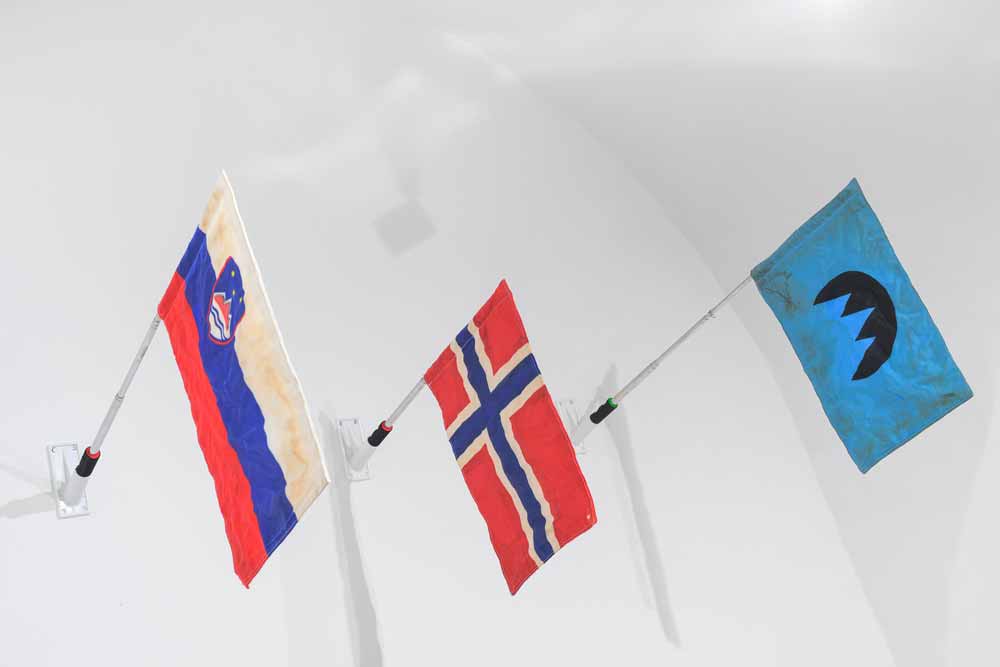
objects (flags), 40 x 25 cm each
digital print on dibond, 40 x 25 cm

Norway: Ingrid Christensen took part in several expeditions to Antarctica and she is considered the first woman to set foot in Antarctica. The Norwegian flag seen here has been thrown over the land area in East Antarctica from an airplane in 1937 as a gesture of positional claiming. The expedition was financed by a whaling magnate. Besides Norway six more countries have territorial claims on Antarctica (Argentina, Chile, UK, Australia, France, New Zealand).
Glacier Republic: The micronation was proclaimed by Greenpeace Chile in 2014, and is located in the Andes Mountains of Chile, covering 8,800 square miles of glaciated land that lack legal protection and acts as a symbolic entity, offering citizenship to supporters and issuing passports to protect 82% of South America’s glaciers.
Slovenia: The first nation to have lost all of its glaciers is Slovenia, where the Triglav Glacier has been declared gone in 2019. The mountain together with its glacier has been part of the national imagery, being depicted on the national flag of the country. The banner found in the crate mourns this loss with its new design.
OpenAI. (2026). ChatGPT (GPT-5.6) [Large language model]. See prompts at the end
Flags, women’s polar history, glacier sovereignty and the national meanings of disappearance
Scope: The three displayed flags and the photograph of Ingrid Christensen; Norwegian Antarctic expeditions and territorial symbolism in the 1930s; the Greenpeace “Glacier Republic” campaign from 2014; Triglav, Slovenian national imagery and disputed glacier-loss terminology; and comparative cases in which glaciers or glaciated mountains operate as national symbols. The report distinguishes physical ice loss, the technical reclassification of a glacier, and the cultural declaration that a nation has become “glacier-free”.
Abstract
The three objects and the photograph condense distinct ways in which nations attach meaning to ice: territorial acquisition, activist counter-sovereignty and mourning for climatic loss. Ingrid Christensen’s 1937 flight and mainland landing were embedded in Norwegian whaling capital, coastal mapping and the sovereignty programme that preceded Norway’s 1939 claim to Queen Maud Land. She is best described as the first documented woman to set foot on the Antarctic mainland; Caroline Mikkelsen had landed on an Antarctic island in 1935. A feminist history therefore treats “firsts” cautiously, examining exclusion, finance, marital access and erased labour as well as individual achievement. Greenpeace Chile proclaimed the Glacier Republic on 5 March 2014 as a symbolic campaign against weak and fragmented glacier protection, especially in a mining context; it was not a legally recognised state. Slovenia has not cleanly “lost all its glaciers” in a single 2019 event. Triglav’s residual ice is commonly described as a glacieret or glacier remnant, while official monitoring still records Triglav and Skuta glaciers. The Slovenian flag depicts Mount Triglav, not its glacier. Venezuela’s 2024 loss of glacier status offers the clearest recent national threshold, but even such declarations depend on definitions of area, thickness and flow.
Project links and cross-references: Nations object page · Citizenship / Antarctica World Passport · Expedition Artist / Anna Boberg · Container / glacial archaeology · Thirst / glacier-fed water · Future / climate-displaced nations
Contents
1. Evidentiary corrections to the object text
2. Norway: Ingrid Christensen, the flag and Antarctic possession
3. Women explorers and climbers: a feminist chronology
4. The Glacier Republic: counter-sovereignty in Chile
5. Slovenia: Triglav, glacieret and a disputed national loss
6. Countries at or near the glacier-free threshold
7. Glaciers and glaciated mountains in national symbolism
8. Synthesis: flags, sovereignty and vanishing ice
9. Numbered academic reference list
Appendix: User prompts related to this report
1. Evidentiary corrections to the object text
Several elements of the current label are substantially correct, but three central formulations require revision: Christensen’s priority depends on what counts as “Antarctica”; the 1937 flag drop was a symbolic act within a larger sovereignty programme rather than a self-sufficient legal claim; and Slovenia’s glacier-loss date and flag description are not supported by the best available evidence.
Object statement | Assessment | Recommended formulation |
A. “Ingrid Christensen … first woman to set foot in Antarctica.” | Qualified. Caroline Mikkelsen landed on the Tryne Islands in 1935. Later historical-geographical work located that landing on an island, not the mainland. Christensen’s 30 January 1937 landing at Scullin Monolith is therefore usually treated as the first documented landing by a woman on the Antarctic mainland. | Use “first documented woman to set foot on the Antarctic mainland”, and name Caroline Mikkelsen as the earlier island landing. |
A. “The flag … thrown over land in 1937 as a gesture of positional claiming.” | The flag drop is photographically documented. It belonged to an expedition that conducted aerial photography and coastal mapping in a whaling-financed Norwegian programme. Norway’s formal annexation of Queen Maud Land followed in January 1939. | Describe it as a symbolic assertion within a longer cartographic, commercial and diplomatic process; do not treat the drop alone as constituting legal possession. |
B. “8,800 square miles … lack legal protection … 82% of South America’s glaciers.” | These are Greenpeace’s 2014 campaign figures and legal rhetoric. Chile still lacks a single comprehensive glacier-protection law, but glaciers are not wholly outside law: environmental assessment, protected-area rules, water law and sectoral controls apply unevenly. The 2022 official inventory lists 26,180 glaciers covering 21,012 km², around 76% of the Southern Andes glacier area. | Present 23,000 km² and 82% as historical campaign claims. Pair them with the current official inventory and a qualified account of fragmented protection. |
C. “Slovenia … lost all of its glaciers … declared gone in 2019.” | Unsupported as a single official event. Triglav and Skuta retain perennial ice. Their small size and lack of clearly measurable flow make “glacier”, “glacieret” and “remnant ice” contested classifications. Slovenian official monitoring still refers to two glaciers. | Avoid “first nation” and “declared gone in 2019”. State that Slovenia’s two residual ice bodies have largely ceased to function as conventional flowing glaciers. |
C. “The mountain together with its glacier … depicted on the national flag.” | The coat of arms on the flag depicts Mount Triglav. The official description does not depict or name the glacier. | State that Triglav is the national mountain symbol; the glacier is culturally attached to that image but is not separately represented in the flag’s heraldry. |
C. “The banner found in the crate mourns this loss with its new design.” | This belongs to the installation’s parafictional layer. No official Slovenian flag redesign is implied. | Mark explicitly as the project’s commemorative or counterfactual redesign. |
Academic source links: Klarius Mikkelsen’s 1935 landing: some fiction and some facts | Glacier or not? Nuance in definitions of vanishing glaciers | Glacier protection laws
References: [5], 293–304; [15], 1–4; [10], 839–843.
Primary / institutional evidence links: Antarctic Treaty: claims and Article IV | Chile Public Glacier Inventory 2022 | Slovenian Environment Agency: changes in glacier extent | Slovenia: national symbols
2. Norway: Ingrid Christensen, the flag and Antarctic possession
Ingrid Dahl Christensen (1891–1976) joined four voyages of the tanker Thorshavn with her husband, shipowner and whaling entrepreneur Lars Christensen. Her presence cannot be separated from the economic infrastructure that made Norwegian Antarctic surveying possible: pelagic whaling fleets, private shipping wealth, aircraft, cameras and cartographic expertise. Nor should she be reduced to a passenger. She travelled repeatedly, flew over newly mapped coasts, participated in a mainland landing and became an important figure in the gendered memory of polar exploration.
Date | Documented development |
1930–31 | Ingrid Christensen and Mathilde Wegger sailed on Thorshavn and became the first named women widely documented as seeing the Antarctic continent. The voyage also supported whaling operations and aerial coastal survey. |
1932–33 | Christensen returned with Ingebjørg “Lillemor” Rachlew, whose diary and photographs are evidence of women’s observational and documentary work beyond official expedition narratives. |
1933–34 | A third voyage combined support for the whaling fleet, geographical reconnaissance and a near-circumnavigation of Antarctica. |
20 February 1935 | Caroline Mikkelsen accompanied Captain Klarius Mikkelsen on a Christensen-financed voyage and went ashore on the Tryne Islands. Later research rejected the earlier assumption that this was a mainland landing. |
1936–37 | Ingrid Christensen, her daughter Augusta Sofie, Lillemor Rachlew and Solveig Widerøe travelled together. A Stinson aircraft and modern photographic equipment were used for mapping. |
30 January 1937 | The four women landed at Scullin Monolith. Christensen is consequently treated as the first documented woman on the Antarctic mainland. |
1937 flight | Christensen was photographed in the aircraft with a Norwegian flag prepared for release over East Antarctica. The act was ceremonial and geopolitical, joining aerial vision, mapping and national display. |
14 January 1939 | Norway formally annexed Queen Maud Land. The claim followed more than a decade of privately financed exploration and mapping; it was not created by the flag drop alone. |
1959–61 onward | The Antarctic Treaty preserved the positions of the seven claimant states while preventing activities under the Treaty from creating, enlarging or extinguishing sovereignty claims. |
Academic source links: The European Antarctic | Klarius Mikkelsen’s landing site: further notes | Settling and Unsettling Antarctica
References: [1], 11–76; [6], 323–328; [4], 505–509.
Primary / institutional evidence links: Ingrid Christensen: Store norske leksikon | The first woman in Antarctica: Australian Antarctic Division | Antarctic Treaty: territorial claims
2.1 The flag as aerial claim, image and technology
The photograph matters because it joins three technologies of territorial imagination. The aircraft produces a panoramic and militarily legible view; the camera converts remote coast into reproducible evidence; and the flag inserts the nation into that image. Yet Antarctica could not be occupied like an ordinary settler colony. Sovereignty was assembled through routes, place names, maps, scientific observations, whaling regulation and diplomatic recognition. The dropped flag therefore performed possession without establishing it by itself.
Norwegian Antarctic activity also complicates a heroic national story. Scientific mapping and commercial whaling were mutually supporting rather than separate enterprises. Lars Christensen’s expeditions searched for coastlines and resources while sustaining a whaling economy that transformed Antarctic animals into globally traded oil. A feminist reading adds a second complication: Ingrid’s access was enabled by marriage and elite family capital, but the surviving diaries, photographs, flights and landings show women acting within—and not merely ornamenting—the expeditionary apparatus.
Academic source links: Gender on Ice | The European Antarctic | Mapping Antarctic and Arctic Women
References: [2], 1–35, 111–153; [1], 11–76; [7], 1–10.
3. Women explorers and climbers: a feminist chronology
A feminist history does not simply add women to a sequence of male “firsts”. It asks who was permitted to travel, who paid, whose labour became scientific authorship, who was named on maps, whose bodies were judged exceptional and how conquest language connected masculinity, nation and altitude. The same woman could challenge gender exclusion while benefiting from class, colonial and racial hierarchies. “Pioneer” is therefore an evidentiary category to be examined, not an uncomplicated honour.
Period / case | Historical development | Feminist significance |
1773–1839: concealed or unnamed travellers | Louise Séguin travelled south without appearing on the ship’s manifest; an unnamed female castaway saw the Antarctic continent in 1839. Their partial anonymity shows how women entered the record through scandal, accident or men’s journals rather than recognised expedition membership. | The archive itself is gendered: absence of a name is not absence of presence. |
1808–1838: women on Mont Blanc | Marie Paradis reached Mont Blanc in 1808 with substantial assistance; Henriette d’Angeville organised her own 1838 ascent and clothing. Their stories expose how definitions of independence, suitable dress and bodily legitimacy were policed. | Priority narratives often measure women against male-defined standards while ignoring equipment and social restrictions. |
1890s–1910s: Fanny Bullock Workman and scientific mountaineering | Workman climbed and surveyed in the Himalaya and Karakoram, published glacier observations and used suffrage imagery. Her wealth enabled exceptional mobility, while expedition labour depended on guides and porters whose contribution was unevenly represented. | Gender emancipation and colonial privilege can coexist in the same expedition. |
1931–37: Christensen, Wegger, Rachlew, Mikkelsen and the “four ladies” | Women entered Norwegian Antarctic voyages through family and commercial networks. They sighted, photographed, flew over and landed on the continent, but were often described as wives, companions or curiosities. | Marriage opened a route closed to most women; it did not erase their acts of observation and documentation. |
1947–69: overwintering and institutional science | Jackie Ronne and Jennie Darlington overwintered in Antarctica in 1947–48. Maria Klenova worked as a scientist in 1956. By the late 1960s women entered national research programmes and the South Pole, but institutions continued to treat Antarctic fieldwork as a masculine domain. | The shift was from exceptional female presence to contested professional access. |
1975: Junko Tabei on Everest | Tabei became the first woman to summit Everest after creating a women’s climbing club in Japan. Later feminist scholarship treats her legacy intersectionally, attending to gender, nationality, class, age and environmental advocacy. | Achievement did not remove structural barriers; women-only organising was a practical response to exclusion. |
Late twentieth century: motherhood and the professional climber | Elite women climbers were repeatedly framed through an alleged incompatibility between motherhood, risk and ambition, a standard less consistently applied to male climbers and fathers. | The moral regulation of women’s risk-taking remained a mechanism of exclusion after formal access improved. |
Present: recognition, harassment and the politics of place names | Women’s participation has increased, but authorship, leadership, field safety, naming and memorialisation remain unequal. Feminist mapping projects recover women’s and Indigenous place knowledge from a cartography dominated by male national accomplishments. | Visibility is an institutional and archival problem, not merely a matter of finding more heroines. |
Academic source links: Women in glaciology: a historical perspective | Gender on Ice | Wanting the Children and Wanting K2 | Gender, Politics and Change in Mountaineering
References: [3], 944–964; [2], 1–35, 111–153; [8], 477–490; [9].
Editorial principle: “first woman” |
Keep the priority claim only with its geographical qualifier. “First woman in Antarctica” compresses different thresholds—sighting the continent, landing on a sub-Antarctic island, landing on an Antarctic island, landing on the continental mainland, overwintering and conducting professional science. The report therefore uses the narrower formulation “first documented woman to set foot on the Antarctic mainland” for Ingrid Christensen. |
4. The Glacier Republic: counter-sovereignty in Chile
Greenpeace Chile proclaimed the República Glaciar on 5 March 2014. The campaign adopted the forms of statehood—territory, declaration, citizenship, passports, embassies, a flag and an eventual promise to “return” the glaciers to Chile—in order to dramatise the gap between the national importance of ice and the weakness of dedicated legal protection. It was a symbolic act of dissent, not a recognised state or a successful secession under international law.
Field | Documented information |
Immediate trigger | Long-running conflict over mining in high-mountain environments, particularly the Pascua-Lama gold and silver project on the Chile–Argentina border, and repeated failure to enact a comprehensive Chilean glacier-protection law. |
Launch | 5 March 2014. Greenpeace declared Chilean glaciers an independent “Glacier Republic” and invited supporters to become citizens. |
Campaign territory | Greenpeace cited approximately 23,000 km² (about 8,800 square miles) and claimed that Chile contained 82% of South America’s glaciers. These were advocacy-era figures, not a legally delimited national territory. |
State forms used | Flag, passport/citizenship, declarations, “embassies”, publicity and a constitutional vocabulary. These devices made an otherwise dispersed cryosphere visible as one political body. |
Legal argument | The campaign characterised glaciers as falling into a legal vacuum because Chile lacked a dedicated law treating them as protected public goods. Legal scholarship treated the Republic as symbolic dissent rather than a true border dispute. |
Promise of dissolution | Greenpeace stated that the Republic would return its glaciers to Chile if the state recognised and guaranteed their protection. |
Policy context after 2014 | Chile continued to debate glacier bills. Protection remained distributed across environmental-impact assessment, protected areas, water rules and other sectoral instruments rather than consolidated in one comprehensive glacier law. |
Current inventory context | The Chilean Directorate-General of Water’s 2022 inventory records 26,180 glaciers covering 21,012 km²—2.79% of continental Chile and around 76% of glacier area in the Southern Andes. Inventory revisions and classification account for differences from the 2014 campaign figures. |
Political meaning | The campaign converted citizenship from attachment to a state into guardianship of an ecological entity. It appropriated sovereignty’s visual language to argue that the official nation had failed to care for part of its own territory. |
Academic source links: Glacier protection laws | Chile’s Glacier Protection Law Needs Grounding in Sound Science | In the Shadow of Melting Glaciers
References: [10], 835–845; [11], 1–9; [12], 1–16, 181–226.
Primary / institutional evidence links: Greenpeace archive: birth of the Glacier Republic | Chile Public Glacier Inventory 2022 | Chile Water Code reform, Law 21.435
4.1 Mining, water and the limits of the “legal vacuum” claim
The campaign’s strongest historical connection is to mining. Pascua-Lama made glacier damage, mine waste, transboundary water and the political influence of extractive industries visible in a single conflict. Chile’s first major glacier-law proposal in 2006 followed approval of that project; it was shelved in 2007. Later bills attempted to define glaciers, prohibit activities and differentiate “strategic” ice, but scientific and political disputes over definitions, hazards, existing concessions and economic development repeatedly stalled legislation.
“No legal protection” is nevertheless too absolute. Even in 2014, projects capable of significantly altering inventoried glaciers could trigger environmental assessment, and some glaciers fell within protected areas. Later water-law reform and inventory rules added further constraints. The problem identified by scholarship is fragmentation and unevenness: the absence of a dedicated, comprehensive national glacier law does not mean that glaciers are legally nonexistent.
Academic source links: Glacier protection laws | Glacier or not?
References: [10], 838–844; [15], 2–4.
Recommended corrected object wording — Glacier Republic |
Greenpeace Chile proclaimed the symbolic Glacier Republic on 5 March 2014 to press for stronger protection of Chilean glaciers, especially against mining. The campaign used a flag, citizenship and passports and claimed approximately 23,000 km² of glaciated “territory”, then described as 82% of South America’s glaciers. These were campaign figures and a counter-sovereign performance, not a recognised state. Chile still has no single comprehensive glacier-protection law, although glaciers are regulated unevenly through environmental assessment, protected areas, water law and other rules. The official 2022 inventory records 26,180 glaciers covering 21,012 km². |
5. Slovenia: Triglav, glacieret and a disputed national loss
Triglav is one of Europe’s clearest cases in which national iconography and cryospheric loss are easily—but misleadingly—collapsed. Slovenia’s flag carries the national coat of arms, whose centre depicts Mount Triglav in white above two wavy lines symbolising the sea and rivers. The official heraldic description does not depict the Triglav Glacier. The glacier’s cultural connection to the mountain is real, but the ice is not a separately specified component of the flag.
Question | Evidence-based account |
Historical extent | Cartographic reconstruction places the Triglav Glacier at roughly 40 ha in the late nineteenth century. Regular measurements began in 1946, when it covered approximately 14.4 ha. |
Fragmentation | Rapid retreat accelerated in the late twentieth century; rocks emerged within the ice and the feature divided into two parts in 1992. |
Twenty-first-century scale | Measurements have fluctuated because seasonal snow can cover or adjoin the remnant. Documented glacier ice was approximately 0.38 ha with about 7,400 m³ of ice in 2013; the official environmental indicator reported a snow-and-ice surface of about 1 ha in 2016. |
Glacier or glacieret? | A glacier normally implies perennial ice with evidence of past or present flow. The Triglav remnant is extremely small and has no obvious crevasses or measurable movement; Slovenian researchers have described “glacieret” as the more precise present term. |
Second Slovenian ice body | Perennial ice also remains beneath Mount Skuta. Official Slovenian environmental monitoring therefore continues to say that Slovenia has two glaciers, while acknowledging their exceptional smallness and sensitivity. |
No clean 2019 extinction date | No authoritative source located for this report records an official national declaration in 2019 that Triglav Glacier or all Slovenian glaciers had disappeared. “Gone” may refer to loss of glacier dynamics rather than complete disappearance of perennial ice. |
National symbolism | Triglav’s national significance precedes and exceeds the remaining glacier. As the glacier shrinks, the state symbol stays visually stable while the physical referent changes—a disjunction used by the installation’s altered banner. |
Parafictional redesign | The displayed mourning flag is an artistic intervention within The Sunshine Find. It should not be confused with a state proposal or an official redesign of the Slovenian flag. |
Academic source links: The Triglav Glacier: seventy years of regular observations | Glacier or not?
References: [13], 169–172; [15], 1–4.
Primary / institutional evidence links: Slovenian Environment Agency: glacier extent | Government of Slovenia: national symbols
6. Countries at or near the glacier-free threshold
The phrase “a country has lost its glaciers” can mean at least four different things: no mapped glacier area remains; perennial ice is still present but falls below an inventory threshold; ice remains but no longer flows; or the last named glacier has been culturally declared dead. These thresholds do not necessarily occur in the same year. Comparative claims should therefore report the definition used.
Country | Status | Scientific / classificatory basis | National-cultural significance |
Venezuela | Threshold crossed / definition-dependent | The Humboldt or La Corona Glacier was Venezuela’s last recognised glacier. By 2024 it had shrunk to a small, stagnant ice field and its demise was publicly declared. Scholarly discussion treats this as the clearest recent national case, while stressing that “demise” is a classificatory judgment rather than instantaneous disappearance of every piece of ice. | Its loss removes the “eternal snows” of the Sierra Nevada de Mérida and affects regional memory, Indigenous and popular narratives, science and tourism. Venezuela is widely described as the first country in modern times to lose all glaciers. |
Slovenia | Near / contested | Triglav and Skuta retain perennial ice, but their size and lack of clear flow place them near or beyond some technical glacier definitions. Official monitoring still calls them glaciers. | Triglav is the central mountain emblem on the national flag. Slovenia is an important case of symbolic glacier loss, but not a securely dated 2019 national extinction. |
Indonesia (West Papua) | Imminent | The small Puncak Jaya ice bodies are rapidly thinning and shrinking; peer-reviewed studies describe complete disappearance as imminent. | These are the last tropical glaciers in the western Pacific and climate archives with local Papuan meanings. Their disappearance is also entangled with colonial administration, mining and restricted scientific access. |
Uganda | Local threshold crossed; national loss approaching | Lack of thickness and flow has been used to determine that Mount Speke no longer hosts a glacier. Ice remains elsewhere in the Rwenzori range but is disappearing rapidly. | The Rwenzori are a transboundary cultural and ecological landscape rather than an emblem on Uganda’s national flag. |
Tanzania | Near | Kilimanjaro’s summit ice fields have lost most of their historical area and are projected to disappear, although exact dates vary with model and definition. | Kilimanjaro is a national and tourism icon and appears as the supporting mountain in Tanzania’s coat of arms; loss would transform a state image long associated with a white summit. |
Kenya | Near | The glaciers of Mount Kenya are small and retreating toward disappearance. | Mount Kenya gives the country its name and forms the compartment beneath Kenya’s official coat of arms. The ice is not separately specified, but the glaciated peak anchors national geography. |
Mexico | Multiple local extinctions; not yet securely glacier-free | Popocatépetl’s glaciers were declared extinct after volcanic and climatic loss; small ice bodies persist or have recently persisted on Pico de Orizaba and Iztaccíhuatl, depending on classification. | The main significance is the multiplication of “last glacier” decisions on nationally prominent volcanoes, not a settled date for total national loss. |
Germany | Local reclassification | Southern Schneeferner was reclassified as no longer a glacier in 2022 because flow had ceased; other German glacier remnants remain. | Shows how a country can lose a named glacier without becoming glacier-free and how flow-based criteria differ from visual persistence. |
Iceland | Named glacier memorial, not national extinction | Okjökull lost glacier status and received a public memorial in 2019; Iceland retains extensive glaciers. | The ceremony turned technical reclassification into national and planetary mourning, establishing a model later used elsewhere. |
Academic source links: Glacier or not? | Social impacts of glacier loss | Last tropical glaciers in the Western Pacific | Global glacier change in the twenty-first century
References: [15], 1–8; [16], 914–915; [17], 26382–26388; [18], 78–83.
Global projection context |
Model ensembles published in Science project that, relative to 2015, glaciers outside the Greenland and Antarctic ice sheets will lose approximately 26 ± 6% of their mass under +1.5°C warming and 41 ± 11% under +4°C by 2100. Depending on the warming level, 49 ± 9% to 83 ± 7% of individual glaciers are projected to disappear. The disproportionate loss of small glaciers means that national and local symbolic extinctions can occur well before the largest share of global ice mass is lost. |
Academic source links: Every increase in temperature matters
References: [18], 78–83.
7. Glaciers and glaciated mountains in national symbolism
National symbols rarely depict a scientifically bounded glacier. They more often depict a white summit, an alpine silhouette, a river issuing from snow or a polar route. This ambiguity allows the emblem to remain unchanged as the material ice recedes. The national image can therefore preserve an “eternal” mountain after its cryosphere has become seasonal, fragmented or extinct.
Nation / polity | Symbolic medium | What is represented | Critical significance |
Slovenia | State flag and coat of arms | Mount Triglav in white above waves symbolising sea and rivers. The glacier is not separately named. | A stable heraldic mountain overlays a rapidly changing remnant of ice. |
Ecuador | State flag and coat of arms | Chimborazo appears in the coat of arms, and the Guayas River is shown issuing from its historically “perpetual snows”. | The emblem joins highland ice to national water, transport and commerce; glacier retreat destabilises the natural premise of the image. |
Kenya | State coat of arms and country name | The arms rest on a compartment representing Mount Kenya. The country’s name derives from the mountain. | A shrinking glaciated summit supports the literal state emblem, even though the ice itself is not heraldically specified. |
Tanzania | State coat of arms / tourism imagery | Mount Kilimanjaro forms the landscape beneath the coat of arms and is one of the country’s most circulated tourism images. | The white summit has helped national branding; its retreat is simultaneously a physical and representational loss. |
Venezuela | Regional and national cultural imagery | The Sierra Nevada de Mérida’s “eternal snows”, the legend of the five white eagles and images of Humboldt/La Corona formed a powerful highland identity, though not a component of the national flag. | A glacier-free threshold can be nationally meaningful without appearing in official heraldry. |
Norway / Antarctica | Flag used in expeditionary performance | The Norwegian flag was carried, raised and dropped during mapping voyages, making national presence visible in a place without a settled population. | The symbol functions less as a picture of ice than as a portable device for attaching the nation to ice. |
Chile / Glacier Republic | Activist flag, passports and citizenship | Greenpeace created a counter-flag and counter-polity for glaciers considered insufficiently protected by the state. | National forms are reversed: the ecological territory claims citizens rather than citizens claiming territory. |
Iceland | Commemorative plaque and public ritual | Okjökull’s loss was marked by a national ceremony and “Letter to the Future”; glaciers remain central to Icelandic place names, literature and tourism. | Memorial culture converts a vanished glacier into a durable moral and national sign. |
Antarctic claimant states | Maps, flags, bases and place names | Argentina, Australia, Chile, France, New Zealand, Norway and the United Kingdom retain claims whose positions are preserved by Article IV of the Antarctic Treaty. | Ice functions as territory, scientific field and diplomatic status even where ordinary sovereignty is suspended. |
Academic source links: Do Glaciers Listen? | In the Shadow of Melting Glaciers | Frozen Empires | The Greening of Antarctica
References: [19], 3–28, 243–260; [12], 1–16, 181–226; [20], 1–31, 67–104; [21], 1–22, 205–228.
Primary / institutional evidence links: Slovenia national symbols | Ecuador National Assembly: coat of arms and Chimborazo | Kenya National Flag, Emblems and Names Act | Antarctic Treaty: claims and Article IV
8. Synthesis: flags, sovereignty and vanishing ice
The three flags do not tell one national story. The Norwegian flag accompanies a state-making apparatus of aerial vision, mapping, commerce and eventual territorial claim. The Glacier Republic flag borrows state forms in order to accuse the existing state of failing to protect its cryosphere. The altered Slovenian banner works after the fact, mourning the divergence between a durable national emblem and a disappearing material landscape.
Together they show that glaciers can function as territory, archive, water reserve, extractive obstacle, tourist image, scientific indicator and national memory. Their political meaning changes before, during and after material disappearance. A glacier can lose legal or scientific status while ice remains; a mountain can remain on a flag after the glacier has ceased to flow; and an activist republic can grant citizenship to a territory that is not legally sovereign. These distinctions are central to the object group because they prevent climate loss from being reduced to a single visual before-and-after story.
9. Numbered academic reference list
Chicago bibliography style. The numbered list contains only verified scholarly books, peer-reviewed articles and academic chapters. Official, legal and advocacy records are linked in the relevant sections and are not included in this academic list.
1. Roberts, Peder. The European Antarctic: Science and Strategy in Scandinavia and the British Empire. New York: Palgrave Macmillan, 2011. https://doi.org/10.1057/9780230337909.
2. Bloom, Lisa. Gender on Ice: American Ideologies of Polar Expeditions. Minneapolis: University of Minnesota Press, 1993. Publisher record.
3. Hulbe, Christina L., Weili Wang, and Simon Ommanney. “Women in Glaciology, a Historical Perspective.” Journal of Glaciology 56, no. 200 (2010): 944–964. https://doi.org/10.3189/002214311796406202.
4. Dodds, Klaus. “Settling and Unsettling Antarctica.” Signs 34, no. 3 (2009): 505–509. https://doi.org/10.1086/593340.
5. Norman, F. I., J. A. E. Gibson, and J. S. Burgess. “Klarius Mikkelsen’s 1935 Landing in the Vestfold Hills, East Antarctica: Some Fiction and Some Facts.” Polar Record 34, no. 191 (1998): 293–304. https://doi.org/10.1017/S0032247400025985.
6. Norman, F. I., J. A. E. Gibson, R. T. Jones, and J. S. Burgess. “Klarius Mikkelsen’s Landing Site: Some Further Notes on the 1935 Norwegian Visit to the Vestfold Hills, East Antarctica.” Polar Record 38, no. 207 (2002): 323–328. https://doi.org/10.1017/S0032247400018015.
7. Devine, Carol. “Mapping Antarctic and Arctic Women: An Exploration of Polar Women’s Experiences and Contributions through Place Names.” Polar Record 58 (2022): e35. https://doi.org/10.1017/S003224742100070X.
8. Frohlick, Susan. “‘Wanting the Children and Wanting K2’: The Incommensurability of Motherhood and Mountaineering in Britain and North America in the Late Twentieth Century.” Gender, Place & Culture 13, no. 5 (2006): 477–490. https://doi.org/10.1080/09663690600858820.
9. Hall, Jenny, Emma Boocock, and Zoë Avner, eds. Gender, Politics and Change in Mountaineering: Moving Mountains. Cham: Palgrave Macmillan, 2023. https://doi.org/10.1007/978-3-031-29945-2.
10. Iribarren Anacona, Pablo, Josie Kinney, Marius Schaefer, Stephan Harrison, Ryan Wilson, Alexis Segovia, Bruno Mazzorana, Felipe Guerra, David Farías, John M. Reynolds, and Neil F. Glasser. “Glacier Protection Laws: Potential Conflicts in Managing Glacial Hazards and Adapting to Climate Change.” Ambio 47, no. 8 (2018): 835–845. https://doi.org/10.1007/s13280-018-1043-x.
11. Fernández, Alfonso, Shelley MacDonell, Marcelo Somos-Valenzuela, and Álvaro González-Reyes. “Chile’s Glacier Protection Law Needs Grounding in Sound Science.” Eos 102 (2021). https://doi.org/10.1029/2021EO160569.
12. Carey, Mark. In the Shadow of Melting Glaciers: Climate Change and Andean Society. New York: Oxford University Press, 2010. Oxford Academic.
13. Gabrovec, Matej, and Miha Pavšek. “The Triglav Glacier: Seventy Years of Regular Observations.” In 6th Symposium for Research in Protected Areas, 169–172. Salzburg: Nationalpark Hohe Tauern, 2017. Open PDF.
14. Triglav Čekada, Mihaela, Matej Gabrovec, Mauro Hrvatin, Blaž Komac, Jaka Ortar, Miha Pavšek, Maja Topole, and Matija Zorn. Triglavski ledenik. Geografija Slovenije 30. Ljubljana: Založba ZRC, 2014. https://doi.org/10.3986/9789610503644.
15. Pope, Allen. “Glacier or Not? The Importance of Nuance in Definitions of Vanishing Glaciers.” Annals of Glaciology 66 (2025): e32, 1–8. https://doi.org/10.1017/aog.2025.10030.
16. Howe, Cymene, and Dominic Boyer. “Social Impacts of Glacier Loss.” Science 388, no. 6750 (2025): 914–915. https://doi.org/10.1126/science.ady1688.
17. Permana, Donaldi S., Lonnie G. Thompson, Ellen Mosley-Thompson, Mary E. Davis, Ping-Nan Lin, Julien P. Nicolas, John F. Bolzan, et al. “Disappearance of the Last Tropical Glaciers in the Western Pacific Warm Pool (Papua, Indonesia) Appears Imminent.” Proceedings of the National Academy of Sciences 116, no. 52 (2019): 26382–26388. https://doi.org/10.1073/pnas.1822037116.
18. Rounce, David R., Regine Hock, Fabien Maussion, Romain Hugonnet, William Kochtitzky, Matthias Huss, Etienne Berthier, et al. “Global Glacier Change in the 21st Century: Every Increase in Temperature Matters.” Science 379, no. 6627 (2023): 78–83. https://doi.org/10.1126/science.abo1324.
19. Cruikshank, Julie. Do Glaciers Listen? Local Knowledge, Colonial Encounters, and Social Imagination. Vancouver: UBC Press; Seattle: University of Washington Press, 2005. Publisher record.
20. Howkins, Adrian. Frozen Empires: An Environmental History of the Antarctic Peninsula. New York: Oxford University Press, 2017. Oxford Academic.
21. Antonello, Alessandro. The Greening of Antarctica: Assembling an International Environment. Oxford: Oxford University Press, 2019. Oxford Academic.
22. Glasberg, Elena. Antarctica as Cultural Critique: The Gendered Politics of Scientific Exploration and Climate Change. New York: Palgrave Macmillan, 2012. https://doi.org/10.1057/9781137014436.
23. Jackson, M. “Glaciers and Climate Change: Narratives of Ruined Futures.” WIREs Climate Change 6, no. 5 (2015): 479–492. https://doi.org/10.1002/wcc.351.
Appendix: User prompts related to this report
Prompts are reproduced chronologically as a research-process record. Spelling and wording are preserved except for typographic normalisation of quotation marks and line breaks.
1. Next object is multiple, three flags and a photograph of Ingrid Christensen, the text reads:
objects
Norway:
A. Ingrid Christensen took part in several expeditions to Antarctica and she is considered the first woman to set foot in Antarctica. The Norwegian flag seen here has been thrown over the land area in East Antarctica from an airplane in 1937 as a gesture of positional claiming. The expedition was financed by a whaling magnate. Besides Norway six more countries have territorial claims on Antarctica (Argentina, Chile, UK, Australia, France, New Zealand).
B. Glacier Republic: The micronation was proclaimed by Greenpeace Chile in 2014, and is located in the Andes Mountains of Chile, covering 8,800 square miles of glaciated land that lack legal protection and acts as a symbolic entity, offering citizenship to supporters and issuing passports to protect 82% of South America’s glaciers.
C. Slovenia: The first nation to have lost all of its glaciers is Slovenia, where the Triglav Glacier has been declared gone in 2019. The mountain together with its glacier has been part of the national imagery, being depicted on the national flag of the country. The banner found in the crate mourns this loss with its new design.
1. Research and develop each part:
A. focus on the history of women explorers and climbers from a feminist point of view
B. describe the background and short history of the Republic
C. place it in the context of countries that have lost, or are losing their glaciers
2. the general context should be the relationship of nations (national smybolics) and glaciers, bring more examples, such as Venezuela
2. General remarks:
1. I have been asking you to create individual reports on different topics.
2. Nonetheless these materials should converge into a unity which is the archive itself and the supporting physical installation. This convergence should be based on a synthesys of all of my other topics, questions and criteria raised in all of the other chat sessions, which are all part of the same project the main scope of which is an art installation and a supporting archive that grows by time. The archive is meant for both professional and nonprofessional use, it should be informative within its artistic and pedagogical scope as well.
3. the main line of thoughts of the project departs from panoptic tourism and concludes to ecoterrorism in a narrative line. Therefore all the reports should follow this general direction in their approach and references.
4. The reports we are working on now will all serve as a background research material published on the project website for the set of objects that will be on display, Each object will have its own page (see: https://glacial-archaeology.net/category/exhibition/). See: Szabolcs KissPál – The sunshine find_for translation. I am also adding the brief description of the project’s general concept, see: Szabolcs KissPál – The sunshine find. The website will have a separate but interconnected section for both the exhibition and the supporting archive. https://glacial-archaeology.net/an-archive-of-narratives-on-global-warming-copy/ Inspect the site while note that it doesn’t have its final structure yet!
5. the scope with the reports is to produce a set of background research material for each object in part that should refer to each other, and should be unified in their narrative and typographic structure, tone, and scope. Pay attention to snychronise the focus points of different partial research tasks when possible with cross references!
6. I am attaching two of your previous reports (noahs_ark_expeditions_1959_1990_academic_sources_new_tab_links.docx, Container_Mount_Scorluzzo_WWI_Shelter_Research_Report). Please develop and and apply to these reports a uniform structure both content wise and in formal aspects while mostly keeping their original content.
7. Main further formal criteria:
– you should always start with an abstract summarizing your finds in a text no longer than 200 words.
– you should always enlist at the very end of the document all my prompts related to that topic
– the external links should always open in a different tab
– you should be using only valid, peer reviewed academic sources listed and numbered at the end of the documents
– you should apply a somewhat unified narrative structured and a unified formatting (including typeface styles, subtitles structure, etc.
8. – note and memorise the above in your cross-chat memory for rurther tasks
2. General remarks:
1. I have been asking you to create individual reports on different topics.
2. Nonetheless these materials should converge into a unity which is the archive itself and the supporting physical installation. This convergence should be based on a synthesys of all of my other topics, questions and criteria raised in all of the other chat sessions, which are all part of the same project the main scope of which is an art installation and a supporting archive that grows by time. The archive is meant for both professional and nonprofessional use, it should be informative within its artistic and pedagogical scope as well.
3. the main line of thoughts of the project departs from panoptic tourism and concludes to ecoterrorism in a narrative line. Therefore all the reports should follow this general direction in their approach and references.
4. The reports we are working on now will all serve as a background research material published on the project website for the set of objects that will be on display, Each object will have its own page (see: https://glacial-archaeology.net/category/exhibition/). See: Szabolcs KissPál – The sunshine find_for translation. I am also adding the brief description of the project’s general concept, see: Szabolcs KissPál – The sunshine find. The website will have a separate but interconnected section for both the exhibition and the supporting archive. https://glacial-archaeology.net/an-archive-of-narratives-on-global-warming-copy/ Inspect the site while note that it doesn’t have its final structure yet!
5. the scope with the reports is to produce a set of background research material for each object in part that should refer to each other, and should be unified in their narrative and typographic structure, tone, and scope. Pay attention to snychronise the focus points of different partial research tasks when possible with cross references!
6. I am attaching two of your previous reports (noahs_ark_expeditions_1959_1990_academic_sources_new_tab_links.docx, Container_Mount_Scorluzzo_WWI_Shelter_Research_Report). Please develop and and apply to these reports a uniform structure both content wise and in formal aspects while mostly keeping their original content.
7. Main further formal criteria:
– you should always start with an abstract summarizing your finds in a text no longer than 200 words.
– you should always enlist at the very end of the document all my prompts related to that topic
– the external links should always open in a different tab
– you should be using only valid, peer reviewed academic sources listed and numbered at the end of the documents
– you should apply a somewhat unified narrative structured and a unified formatting (including typeface styles, subtitles structure, etc.
8. – note and memorise the above in your cross-chat memory for further tasks