Future
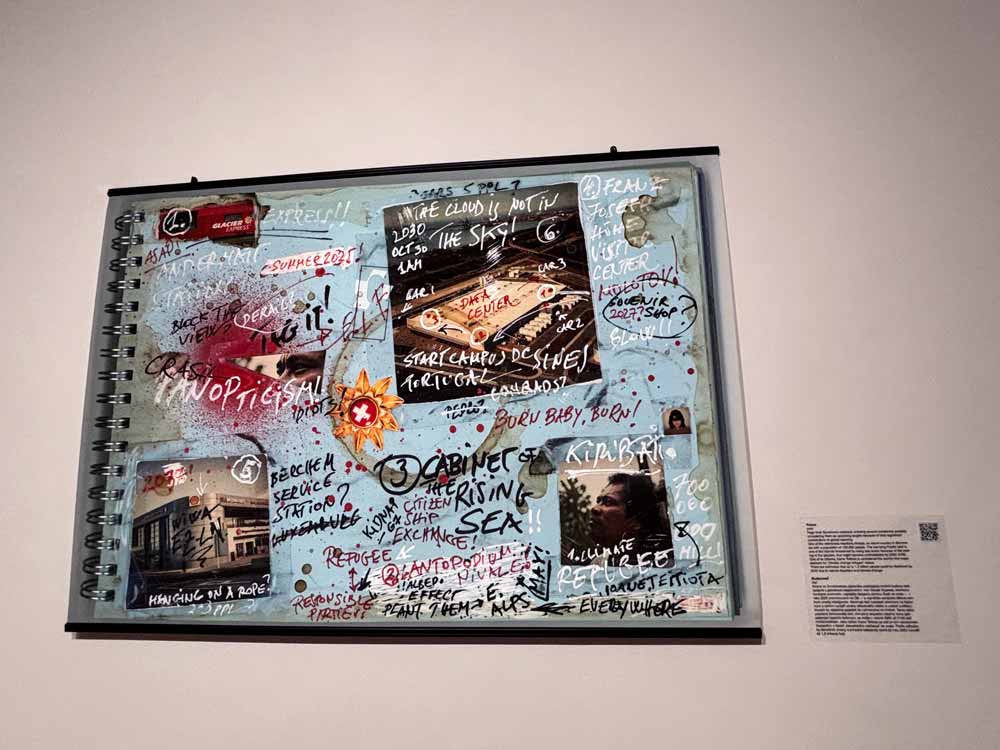
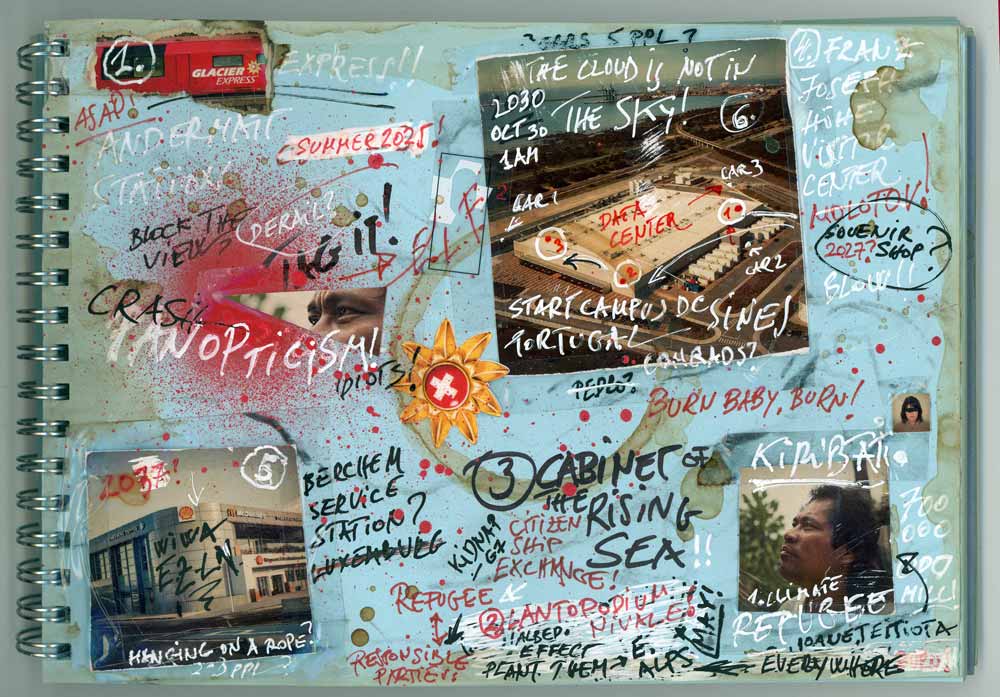
digital print on dibond, 100 x 70 cm
A page from Sunshine’s notebook listing possible future targets linked to global warming: the Glacier Express, a mountain souvenir shop, the world’s largest Shell fuel station—rebranded as Q8 in 2025—and Europe’s largest AI data centre. It also proposes planting edelweiss on glaciers to counterbalance changes in the albedo effect, and kidnapping politicians before exiling them to Kiribati. This low-lying Pacific atoll, threatened by glacier-driven sea-level rise, may become uninhabitable between 2050 and 2100. One of its citizens Ioane Teitiota became the world’s first prominent claimant for “climate refugee” status. Estimates suggest that climate change and natural disasters could displace up to 1.2 billion people by 2050.
OpenAI. (2026). ChatGPT (GPT-5.6) [Large language model]. See prompts at the end
Infrastructure, climate feedbacks, political asymmetry and the conversion of observation into action
Abstract
Future centres on a fictional handwritten notebook attributed to Sunshine. The page’s principal elements are:
1. Glacier Express;
2. Edelweiss as a ‘living albedo’;
3. Cabinet of the Rising Sea: Kiribati, climate mobility and political responsibility;
4. Kaiser-Franz-Josefs-Höhe visitor centre;
5. Berchem service station and Zapatista solidarity;
6. Start Campus Sines data centre.
The report asks how industrial power has changed since the 2010s as fossil extraction was joined by platform economies, hyperscale computation, global logistics and adaptation industries. Across panoramic tourism, petroleum retail, cryospheric feedbacks, climate displacement and data infrastructure, the central issue is the changing form, geography and visibility of environmental power. Verified history, scientific evidence, corporate claims and institutional records remain distinct from the notebook’s imagined acts. Future therefore marks the project’s movement from organised observation and consumption towards contested responsibility, representation and action.
Contents
1. Glacier Express: panoramic mobility and the organised gaze
2. White surfaces: albedo and edelweiss
3. Cabinet of the Rising Sea: Kiribati and climate mobility
4. Kaiser-Franz-Josefs-Höhe: motorised access
5. WIWA E.Z.L.N.: Networked autonomy and Zapatista solidarity
6. The cloud is not in the sky: Sines and the digital-industrial landscape
7. Interpretive synthesis: the future tense of infrastructure
8. Primary / institutional evidence links
9. Numbered academic reference list
Appendix: User prompts related to this report
1. Glacier Express: panoramic mobility and the organised gaze
The Glacier Express converts Alpine distance into a reserved visual sequence. Its route was assembled from metre-gauge lines completed by 1926, and the first through train ran in 1930. The contemporary service is electrically hauled, so its environmental meaning is not a simple image of a locomotive burning fossil fuel beside a glacier. The relation is historical and systemic: railway engineering reorganised time and space, connected mountain valleys to wider markets and transformed technical access into scenic tourism.
Panorama cars intensify this visual economy. Ceiling-high glazing, reserved seats, a fixed route, named highlights, timed narration and photography facilities establish a stable observational position. The traveller sees broadly, but within a field already selected and sequenced. Maintenance labour, ordinary settlement, energy supply and climatic instability can withdraw behind a branded succession of viaducts, gorges and summits. Panoptic tourism here means not literal surveillance but the institutional organisation, anticipation and commercial reproduction of looking.
Academic source links: The Railway Journey | The Tourist Gaze 3.0 | Tourism’s panoptic photo-industry | Glacier tourism and climate change
References: [1]; [2]; [3], 48–62; [33].
Primary / institutional evidence link: Glacier Express official history
2. White surfaces: albedo and edelweiss
Albedo and permafrost are different physical processes, but both can amplify warming. Snow and clean ice reflect a relatively large share of incoming solar radiation. As these bright surfaces shrink, darker rock, soil, debris or water absorbs more energy, increasing local heating and encouraging further melt. The visual transition from white to grey is therefore also a change in the surface energy balance.
Permafrost is ground or rock that remains at or below 0°C for at least two consecutive years. It is not the same as a glacier, and its thaw does not directly constitute glacier melt. The connection operates through climate feedback. When carbon-rich permafrost warms, previously frozen organic matter can decompose and release carbon dioxide and, in oxygen-poor conditions, methane. These additional greenhouse gases can intensify global warming, which in turn increases pressure on glaciers, snow cover and other frozen environments. The magnitude and timing of this feedback remain uncertain, but its direction is well established.
The two processes join within a broader cryospheric system. Loss of reflective snow and ice increases absorbed energy; thawing permafrost can add greenhouse gases to the atmosphere; glacier retreat changes water storage, slope stability and the material basis of tourism. Feedback does not mean that change becomes instantaneous or unstoppable at one universal threshold. It means that warming can activate processes that make subsequent warming more difficult to limit.
White geotextile coverings intervene locally in the surface-energy balance. A well-documented example is the Presena Glacier conservation project at Ponte di Legno–Tonale in the Italian Alps, where seasonal covering has been undertaken since 2008 under the project title The Protection of Presena Glacier. Peer-reviewed field research on the Presena Ovest and Dosdè Est glaciers found that the tested coverings could reduce local snow and ice loss by as much as 69 per cent in the protected area, principally through increased albedo and, to a lesser extent, thermal insulation. The method is effective at limited scale but labour-, material- and cost-intensive. At Presena, it protects selected ice connected to ski infrastructure, making adaptation, economic conservation and landscape image inseparable.
The notebook’s edelweiss proposal converts this manufactured whiteness into a speculative “living albedo”. Edelweiss brings cultural associations of altitude, endurance, rarity and Alpine authenticity to an imagined planted surface. It is best read as an artistic development of a real adaptation technique, not as a scientifically demonstrated replacement for geotextiles or a scalable response to global glacier loss. Its value lies in making the boundary between local care and systemic warming materially visible.
Academic source links: The Non-Woven Geotextiles as Strategies for Mitigating the Impacts of Climate Change on Glaciers | Comparative Study of Technical Measures to Reduce Snow and Ice Ablation in Alpine Glacier Ski Resorts
References: [19], 371–384; [20].
Primary / institutional evidence link: The Protection of Presena Glacier
3. Cabinet of the Rising Sea: Kiribati and climate mobility
Kiribati is repeatedly used as an image of climate vulnerability, but its future cannot be reduced to a single evacuation date. Low-lying atolls face sea-level rise, coastal erosion, saltwater intrusion, drought and pressure on freshwater and habitation; habitability also depends on engineering, finance, land tenure, public services and political choice.
Mobility is shaped by livelihoods, inequality, conflict, governance, family networks and the capacity to move; it may be forced, anticipatory, adaptive or constrained. In Teitiota v. New Zealand, the UN Human Rights Committee did not find that return to Kiribati violated the Covenant on the evidence and timing presented, but recognised that climate impacts could in principle trigger non-refoulement obligations. The decision opened a human-rights threshold without creating a new refugee category under the 1951 Convention.
Statistics require the same caution. IDMC recorded 62.2 million internal displacement movements during 2025 and 82.2 million people living in internal displacement at year’s end from conflict and disasters combined; these are not counts of “climate refugees”. The World Bank’s Groundswell work gives an upper scenario of up to 216 million internal climate migrants across six regions by 2050 under specified assumptions. The widely repeated figure of 1.2 billion is not a settled scientific forecast. Inflated numbers may draw attention to risk but can also turn vulnerable populations into a security threat.
The notebook’s imagined exile of powerful politicians to Kiribati reverses the geography of responsibility. As parafiction, it places decision-makers from high-emitting systems inside a vulnerability their institutions help structure. The critical point is therefore unequal historical responsibility, mobility rights and adaptation resources, not the fantasy of punishment.
Academic source links: The effect of environmental change on human migration | Migration as adaptation | Protecting people displaced by climate impacts | Small Islands, big players | Climate migration myths | Climate Barbarians at the Gate? | From denial to domestication
References: [22], S3–S11; [23], 447–449; [24], 708–725; [25], 2201–2207; [26], 901–903; [27], 63–72; [28].
Primary / institutional evidence links: UN Human Rights Committee: Teitiota v. New Zealand | UNHCR: climate change, displacement and legal protection | World Bank Groundswell overview | IDMC: Global Report on Internal Displacement 2026
4. Kaiser-Franz-Josefs-Höhe: motorised access
Kaiser-Franz-Josefs-Höhe produces a related but spatially fixed and motorised viewpoint. The Grossglockner High Alpine Road opened in 1935 as a national engineering project and scenic route. Its bends, stopping places, parking areas and visitor facilities brought motorists to the Pasterze Glacier; the visitor centre now combines glacier interpretation with restaurants, retail and exhibitions of cars and motorcycles. The contradiction is structural rather than accusatory: a retreating glacier is observed from an institution created by the fossil-mobility culture that normalised high-energy access to remote landscapes.
Roads, terraces, paths, information panels, historical photographs and recession markers channel visitors towards designated positions from which loss becomes measurable and photographically repeatable. The site can therefore be read as catastrophe theatre: climatic change is made visible, interpreted and commercially reproducible, while the energy systems and construction history that produced the viewpoint largely remain outside the frame. Unlike the moving panorama of the train, the terrace fixes the observer at a calibrated distance from the ice. The two sites refer to one another as complementary architectures of the organised gaze, but they remain historically and materially distinct.
Academic source links: The Tourist Gaze 3.0 | The ‘System’ of Automobility | Glacier tourism and climate change
References: [2]; [4], 25–39; [33].
Primary / institutional evidence links: Kaiser-Franz-Josefs-Höhe visitor centre | Grossglockner High Alpine Road history
5. WIWA E.Z.L.N.: Networked autonomy and Zapatista solidarity
The Berchem service station presents petroleum as a familiar retail interface: a low building, canopy, pumps and price board connecting the driver to a global extraction system. The motorway sites were long associated with Shell; Q8 took them over in 2025. The rebranding is revealing because logos change more quickly than tanks, deliveries, traffic patterns and consumer routines. Exploration, pipelines, shipping, refining, finance and political security disappear behind a short transaction, while many ecological costs remain concentrated at distant extraction frontiers.
Shell’s history in the Niger Delta makes this geography visible. Petroleum became central to Nigerian state revenue, while producing communities experienced spills, gas flaring, damaged fisheries and farmland, and limited authority over the wealth removed from their territories. In Ogoniland, the Movement for the Survival of the Ogoni People joined environmental degradation to minority rights, representation and territorial self-determination. Nigeria’s military government executed Ken Saro-Wiwa and eight other Ogoni activists in 1995 after a trial widely condemned internationally. The state carried out the executions; Shell’s political and moral responsibilities remain disputed in scholarship and litigation. UNEP later documented severe, persistent contamination requiring long-term remediation.
The notebook’s references to Chiapas and “Wiwa” extend the argument from extraction to Indigenous autonomy and transnational solidarity. The Zapatista uprising became globally visible on 1 January 1994, the date NAFTA entered into force. Its politics linked land, communal self-government and Indigenous rights to resistance against a model of modernisation that treats territory, labour and culture as interchangeable market resources. Early email lists, university servers and supporter websites connected this territorial movement to a dispersed network of translation and solidarity; digital infrastructure served both globalisation and its critique.
A North American ELF communiqué dated 28 June 1998 claimed an action against the building housing the Mexican Consulate in Boston, describing red paint, handprints and “VIVA EZLN” as solidarity with Indigenous people in Chiapas. Contemporaneous reporting corroborates the claimed action and broad motive, while the detailed iconography is preserved chiefly through the movement’s own archive. The station, Ogoniland, Chiapas and the consulate are not a tactical chain and the report does not endorse property damage. They form a sequence of symbolic surfaces through which remote conflicts are translated into metropolitan visibility and imagined intervention.
Academic source links: Resource curse? Governmentality, oil and power in the Niger Delta | Oil extraction, dispossession, resistance, and conflict in Nigeria’s oil-rich Niger Delta | The Niger Delta: “petro violence” and “partnership development” | Resisting neoliberal homogenization: The Zapatista autonomy movement | The Zapatista Effect | Radical environmentalism in an age of antiterrorism | Terrorist and non-terrorist attacks by radical environmental and animal-rights groups
References: [5], 50–80; [6], 219–236; [7], 401–424; [29], 48–63; [30], 621–640; [31], 299–318; [32], 295–319.
Primary / contemporaneous evidence links: UNEP Environmental Assessment of Ogoniland | Q8 takeover of Berchem service areas, 2025 | ELF communiqué archive, 28 June 1998 | CBS News contemporaneous report | FBI testimony on the eco-terrorism category
6. The cloud is not in the sky: Sines and the digital-industrial landscape
At Sines, the cloud reaches land as concrete, substations, fibre, cooling equipment and server halls. The Start Campus SINES Data Campus is being developed in an industrial and logistics zone near a deep-water port, subsea cables and the former coal-fired power station; its design reuses part of the plant’s seawater infrastructure. This is not a clean break between a dirty industrial past and an immaterial digital future, but an infrastructural succession in which land, grid connections, water channels and permits are reorganised for computation.
Data centres have become central to energy planning as cloud services, financial systems and platform economies are joined by machine learning and generative AI. The International Energy Agency estimates that data centres used about 415 TWh of electricity in 2024, around 1.5 per cent of global consumption, and projects roughly 945 TWh by 2030 in its base case, with AI the leading driver of growth. These figures cover all data-centre workloads, not AI alone, and a globally modest share can become a major local load when facilities cluster around a grid connection, water system or cable landing.
The developer advertises six buildings, 1.2 GW of IT capacity, a design PUE of 1.1, seawater cooling and renewable electricity. Each claim has a narrower meaning than the combined sustainability narrative. PUE measures facility overhead relative to IT electricity; it is not a carbon certificate and does not disclose absolute load, hourly grid carbon, embodied emissions or the social value of the computation. Avoiding conventional evaporative freshwater cooling is significant in a drought-prone region, but WUE 0 does not mean that seawater intake, thermal discharge or indirect water use have no ecological effects.
At continuous full utilisation, 1.2 GW of IT capacity and a PUE of 1.1 imply 1.32 GW of facility load and about 11.56 TWh per year. Compared with the 53.1 TWh supplied through Portugal’s public grid in 2025, the upper-bound scenario equals about 21.8 per cent. This is a scale calculation, not a forecast of measured consumption; actual demand depends on construction phases, customers, utilisation, achieved efficiency and operational flexibility.
Metric | Value | Interpretation |
Advertised full-campus IT capacity | 1.2 GW | Future design and connection scale, not present measured load. |
Target PUE | 1.1 | About 10% facility overhead above IT load under the stated boundary; not a carbon certificate. |
Full-load facility scenario | 1.32 GW; 11.56 TWh/year | Upper-bound continuous-utilisation context, not a demand forecast. |
Portugal public-grid consumption, 2025 | 53.1 TWh | National comparison denominator reported by REN. |
Scenario share | 21.8% | Illustrates potential system scale; does not establish the timing or likelihood of full use. |
Start Campus is directly backed by private investors but publicly enabled through industrial land management, nationally significant-project coordination, environmental licensing, grid allocation and water governance. The independent Sines review found no public, audited campus-wide dataset for annual electricity use, achieved PUE, Scope 1–3 emissions, backup generation, embodied carbon or hourly renewable matching. It also records a confirmed ecological failure: construction of the first phase destroyed a protected temporary Mediterranean pond. Brownfield reuse, efficient design and habitat damage can therefore coexist within the same project.
Sines exemplifies a new geography of environmental conflict. The emblematic industrial site may no longer be a smokestack, but a sealed campus whose emissions are displaced into electricity systems and hardware supply chains, whose cooling is hidden in water infrastructure, and whose public significance is expressed through capacity reservations rather than visible smoke.
Academic source links: Atlas of AI | The Undersea Network | The Environmental History of Computing | Data Centre Water Consumption | Sources of Data Center Energy Estimates | Green, Innovative, and Unfair | The carbon and water footprints of data centers
References: [8]; [9]; [10], S7–S33; [11]; [12], 2032–2056; [13]; [14], 1–10.
Primary / institutional evidence links: Start Campus SINES DC | Start Campus SIN01 inauguration and design claims | REN: Portugal electricity consumption in 2025 | IEA: Energy demand from AI
Source distinction: The 1.2 GW, 100% renewable, PUE 1.1 and WUE 0 figures are developer claims or design targets. The 11.56 TWh and 21.8% figures are transparent upper-bound calculations based on those claims and REN data; they are not measured operating consumption.
Interpretive synthesis: the future tense of infrastructure
The notebook’s sequence belongs to a world in which industrial power has become simultaneously more extensive and less visually concentrated. The nineteenth-century factory and the twentieth-century refinery remain active forms, but they are joined by data campuses, logistics corridors, cable landings, financial platforms, managed tourist landscapes and adaptation technologies. Smoke has not disappeared. It has been redistributed across electricity grids, supply chains and distant extraction zones.
Current scientific assessments do not identify AI or tourism as the largest global sources of greenhouse gases. The energy system remains the principal driver: fossil-fuel combustion for electricity and heat, transport, buildings and industrial production dominates carbon dioxide emissions, while agriculture, land-use change and industrial processes add further greenhouse gases. Energy-related CO₂ emissions reached a new high of nearly 38.4 Gt in 2025. Electricity generation, steel, cement, chemicals, road transport, aviation, shipping, and the construction and operation of buildings remain among the most consequential infrastructures because of their scale, material throughput and long-lived capital stock.
Resource intensity cannot be ranked by one number. A coal plant is carbon-intensive; a semiconductor fabrication chain is material-, chemical- and water-intensive; a hyperscale data centre concentrates electricity demand and grid capacity; a motorway produces emissions through the vehicles and settlement patterns it enables; a glacier resort depends on mobility while converting climate damage into a consumable view. The effects are cumulative and relational. One infrastructure changes what another must supply.
Data centres illustrate the contemporary shift most clearly. Their global electricity share is still far below that of the entire power, transport or industrial system, yet demand is growing unusually quickly and is geographically concentrated. They can influence where new generation and transmission are built, how water is allocated, and which consumers compete for firm electricity. The cloud is therefore not only a technical service. It is territorial and energy policy expressed through architecture.
The same logic returns in the white glacier covering. The textile does not reverse global warming; it protects a limited surface by adding material, labour and maintenance. The petrol station does not display the Niger Delta; it converts extraction into a clean consumer interface. The panorama train does not show the energy and labour systems that sustain its view. Kiribati is made hyper-visible as a threatened image, while the infrastructures producing risk remain distributed and politically insulated.
Within this changed landscape, an updated radical-environmentalist imaginary might attach symbolic importance to sites that make hidden systems briefly visible: the branded transport object, the fossil retail interface, the cloud campus, the visitor centre beside retreating ice, or the institution that distributes protection and exposure. Future does not nominate operational targets. It examines why such sites acquire symbolic force when responsibility is diffuse and ordinary political processes appear too slow. The notebook converts infrastructure into a field of signs; the report returns those signs to their histories, material dependencies and unequal consequences.
The result is neither a hierarchy of villains nor a defence of spectacular action. It is a map of changing industrial power. The most damaging systems are often those with the greatest cumulative scale and lock-in, while the most symbolically legible objects may be comparatively small interfaces. Between those two levels lies the project’s central tension: how to make a distributed crisis visible without mistaking visibility for causation.
Academic source links: Atlas of AI | The Environmental History of Computing | Sources of Data Center Energy Estimates | The carbon and water footprints of data centers | Accelerated global glacier mass loss | Climate migration myths | Glacier tourism and climate change
References: [8]; [10], S7–S33; [12], 2032–2056; [14], 1–10; [15], 726–731; [26], 901–903; [33].
Primary / institutional evidence links: IPCC AR6 Working Group III | UNEP: Energy | IEA Global Energy Review 2026 | IEA: Energy demand from AI | UNEP Emissions Gap Report 2025
Primary / institutional evidence links
These records support current operational, legal or institutional claims, and include a clearly identified movement archive. They are not included in the numbered academic bibliography; the movement archive is self-description rather than independent verification.
· Glacier Express official history and company information
· Grossglockner High Alpine Road: Kaiser-Franz-Josefs-Höhe visitor centre
· Grossglockner High Alpine Road history
· UNEP Environmental Assessment of Ogoniland
· Q8 takeover of Berchem service areas, 2025
· ELF communiqué archive: 28 June 1998
· CBS News contemporaneous report on the Boston consulate action
· FBI testimony: The Threat of Eco-Terrorism
· Start Campus: SINES Data Campus
· Start Campus: SIN01 inauguration and advertised design metrics
· REN: Portugal electricity consumption, 2025
· IEA: Global Energy Review 2026 – CO₂ emissions
· IPCC AR6 Working Group III: Mitigation of Climate Change
· UNEP Emissions Gap Report 2025
· UN Human Rights Committee: Teitiota v. New Zealand
· UNHCR: Law and policy for protection and climate action
· World Bank Groundswell overview
· IDMC: Global Report on Internal Displacement 2026
Numbered academic reference list
Chicago bibliography style. The numbered list contains only peer-reviewed journal articles and scholarly books issued by academic presses.
1. Schivelbusch, Wolfgang. The Railway Journey: The Industrialization of Time and Space in the Nineteenth Century. Berkeley: University of California Press, 1986. Persistent link
2. Urry, John, and Jonas Larsen. The Tourist Gaze 3.0. 3rd ed. London: SAGE, 2011. Persistent link
3. Noy, Chaim. “Staging Portraits: Tourism’s Panoptic Photo-Industry.” Annals of Tourism Research 47 (2014): 48–62. Persistent link
4. Urry, John. “The ‘System’ of Automobility.” Theory, Culture & Society 21, nos. 4–5 (2004): 25–39. Persistent link
5. Watts, Michael. “Resource Curse? Governmentality, Oil and Power in the Niger Delta, Nigeria.” Geopolitics 9, no. 1 (2004): 50–80. Persistent link
6. Obi, Cyril I. “Oil Extraction, Dispossession, Resistance, and Conflict in Nigeria’s Oil-Rich Niger Delta.” Canadian Journal of Development Studies 30, nos. 1–2 (2010): 219–236. Persistent link
7. Zalik, Anna. “The Niger Delta: ‘Petro Violence’ and ‘Partnership Development.’” Review of African Political Economy 31, no. 101 (2004): 401–424. Persistent link
8. Crawford, Kate. Atlas of AI: Power, Politics, and the Planetary Costs of Artificial Intelligence. New Haven, CT: Yale University Press, 2021. Persistent link
9. Starosielski, Nicole. The Undersea Network. Durham, NC: Duke University Press, 2015. Persistent link
10. Ensmenger, Nathan. “The Environmental History of Computing.” Technology and Culture 59, no. 4S (2018): S7–S33. Persistent link
11. Mytton, David. “Data Centre Water Consumption.” npj Clean Water 4 (2021): article 11. Persistent link
12. Mytton, David, and Masaō Ashtine. “Sources of Data Center Energy Estimates: A Comprehensive Review.” Joule 6, no. 9 (2022): 2032–2056. Persistent link
13. Campos, Inês, Sérgio Maraschin, and Kaya Maria Schwemmlein. “Green, Innovative, and Unfair: The Case of Unjust Energy Transitions and Civic Resistance and Opposition in Portugal.” Energy Research & Social Science 124 (2025): 104068. Persistent link
14. de Vries-Gao, Alex. “The Carbon and Water Footprints of Data Centers and What This Could Mean for Artificial Intelligence.” Patterns 7, no. 1 (2026): 1–10, article 101430. Persistent link
15. Hugonnet, Romain, Robert McNabb, Etienne Berthier, Brian Menounos, Christopher Nuth, Luc Girod, Daniel Farinotti, et al. “Accelerated Global Glacier Mass Loss in the Early Twenty-First Century.” Nature 592 (2021): 726–731. Persistent link
16. Flanner, Mark G., Karen M. Shell, Mathew Barlage, David K. Perovich, and Michael A. Tschudi. “Radiative Forcing and Albedo Feedback from the Northern Hemisphere Cryosphere between 1979 and 2008.” Nature Geoscience 4 (2011): 151–155. Persistent link
17. Schuur, Edward A. G., A. David McGuire, Christina Schädel, Guido Grosse, Jennifer W. Harden, David J. Hayes, Gustaf Hugelius, et al. “Climate Change and the Permafrost Carbon Feedback.” Nature 520 (2015): 171–179. Persistent link
18. Armstrong McKay, David I., Arie Staal, Jesse F. Abrams, Ricarda Winkelmann, Boris Sakschewski, Sina Loriani, Ingo Fetzer, et al. “Exceeding 1.5°C Global Warming Could Trigger Multiple Climate Tipping Points.” Science 377, no. 6611 (2022): eabn7950. Persistent link
19. Olefs, Marc, and Andrea Fischer. “Comparative Study of Technical Measures to Reduce Snow and Ice Ablation in Alpine Glacier Ski Resorts.” Cold Regions Science and Technology 52, no. 3 (2008): 371–384. Persistent link
20. Senese, Antonella, Roberto Sergio Azzoni, Davide Maragno, Claudia D’Agata, Davide Fugazza, Barbara Mosconi, and Guglielmina Diolaiuti. “The Non-Woven Geotextiles as Strategies for Mitigating the Impacts of Climate Change on Glaciers.” Cold Regions Science and Technology 173 (2020): 103007. Persistent link
21. Maghiar, Lăcrămioara M., Ilie A. Stoica, and Andrew J. Tanentzap. “Integrating Demography and Distribution Modeling for the Iconic Leontopodium alpinum Colm. in the Romanian Carpathians.” Ecology and Evolution 11, no. 18 (2021): 12322–12334. Persistent link
22. Black, Richard, W. Neil Adger, Nigel W. Arnell, Stefan Dercon, Andrew Geddes, and David Thomas. “The Effect of Environmental Change on Human Migration.” Global Environmental Change 21, supplement 1 (2011): S3–S11. Persistent link
23. Black, Richard, Stephen R. G. Bennett, Sandy M. Thomas, and John R. Beddington. “Migration as Adaptation.” Nature 478 (2011): 447–449. Persistent link
24. McAdam, Jane. “Protecting People Displaced by the Impacts of Climate Change: The UN Human Rights Committee and the Principle of Non-refoulement.” American Journal of International Law 114, no. 4 (2020): 708–725. Persistent link
25. Ourbak, Timothée, and Alexandre K. Magnan. “The Paris Agreement and Climate Change Negotiations: Small Islands, Big Players.” Regional Environmental Change 18, no. 8 (2018): 2201–2207. Persistent link
26. Boas, Ingrid, Carol Farbotko, Helen Adams, Harald Sterly, Simon Bush, Kees van der Geest, Hanne Wiegel, et al. “Climate Migration Myths.” Nature Climate Change 9, no. 12 (2019): 901–903. Persistent link
27. Bettini, Giovanni. “Climate Barbarians at the Gate? A Critique of Apocalyptic Narratives on ‘Climate Refugees.’” Geoforum 45 (2013): 63–72. Persistent link
28. Bettini, Giovanni, and Anna Casaglia. “From Denial to Domestication: Unpacking Italy’s Right-Wing Approach to Climate Migration and Security.” Geoforum 155 (2024): 104079. Persistent link
29. Stahler-Sholk, Richard. “Resisting Neoliberal Homogenization: The Zapatista Autonomy Movement.” Latin American Perspectives 34, no. 2 (2007): 48–63. Persistent link
30. Cleaver, Harry M., Jr. “The Zapatista Effect: The Internet and the Rise of an Alternative Political Fabric.” Journal of International Affairs 51, no. 2 (1998): 621–640. Persistent link
31. Vanderheiden, Steve. “Radical Environmentalism in an Age of Antiterrorism.” Environmental Politics 17, no. 2 (2008): 299–318. Persistent link
32. Carson, Jennifer Varriale, Gary LaFree, and Laura Dugan. “Terrorist and Non-Terrorist Criminal Attacks by Radical Environmental and Animal Rights Groups in the United States, 1970–2007.” Terrorism and Political Violence 24, no. 2 (2012): 295–319. Persistent link
33. Salim, Emmanuel, Ludovic Ravanel, Philippe Bourdeau, and Philip Deline. “Glacier Tourism and Climate Change: Effects, Adaptations, and Perspectives in the Alps.” Regional Environmental Change 21 (2021): article 120. Persistent link
Appendix: User prompts related to this report
Prompts are reproduced chronologically as a research-process record. Wording and meaningful line breaks are preserved; only obvious encoding artefacts are normalised.
Condensed Working Prompt
You are writing an English-language website report for The Sunshine Find / Glacial Archaeology, a contemporary art project combining documentary research and parafiction. The report concerns a fictional handwritten notebook attributed, within the project’s narrative, to Sunshine, a former Earth Liberation Front participant. Keep this fictional background implicit. Do not narrate Sunshine’s biography or explain the notebook as a literal target list. Treat it instead as a critical cartography of contemporary economic, ecological and political power.
The report must function independently as a rigorous, readable analysis in political ecology, cultural theory and infrastructure studies. Its central question is how industrial power has changed since the 2010s. Digitalisation has not replaced industrial society: it has reorganised it through data centres, electricity grids, cooling systems, semiconductor production, cables, logistics, mineral extraction, finance and state-supported infrastructure. Examine not only which sectors emit most, but how responsibility has become geographically dispersed, technically complex and less visible.
Do not write isolated descriptions of the notebook’s references. Reveal the structural relations among them through material processes and recurring motifs such as heat and cold, visibility and invisibility, extraction and computation, centre and periphery, mobility and environmental damage, observation and consumption, preservation and exploitation, efficiency and absolute growth, historical responsibility and present vulnerability. Transitions should emerge through images, materials or infrastructures rather than didactic phrases.
Give particular attention to the following strands:
- 1. Glacier Express: analyse the electrically operated train as a historical product of industrial modernity, scenic railway tourism and the technical reorganisation of Alpine space. Discuss tunnels, viaducts, panorama carriages, reserved viewpoints, narration, photography and branding. Interpret panopticism not as literal surveillance but as an organised architecture of visibility that frames, sequences and commercialises the landscape.
- 2. Kaiser-Franz-Josefs-Höhe: treat this as a separate chapter, not under the same heading as the Glacier Express. Analyse the Grossglockner High Alpine Road, parking, terraces, visitor facilities, vehicle exhibitions, souvenir culture and the observation of the retreating Pasterze Glacier. The central contradiction is that glacier loss is made visible through infrastructure created by motorised modernity. The Glacier Express and Kaiser-Franz-Josefs-Höhe may refer to one another, but they must remain distinct sections.
- 3. Cryospheric processes: distinguish precisely between glacier melt, albedo feedback, permafrost thaw and tipping points. Explain that albedo loss operates through changing surface reflectivity, while permafrost feedback works through greenhouse-gas release from thawing carbon-rich ground. Do not use “tipping point” as a synonym for every accelerating process or claim that every Alpine glacier has one precise global-temperature threshold.
- 4. Glacier covering and edelweiss: present white geotextile covering as a real, locally effective adaptation method that can reduce melt on limited areas. Analyse it positively as engineering, care, temporary conservation and landscape intervention, while acknowledging cost, labour, scale and tourism-related limitations. Treat the notebook’s edelweiss proposal as a constructive artistic and botanical development of this method: a speculative “living albedo”, not an established scientific technology.
- 5. Sines and digital infrastructure: present the Start Campus development as a meeting point between fossil-industrial and digital-industrial systems. The former coal-power site, seawater infrastructure, grid connection, port and submarine cables become supports for computation. Distinguish planned IT capacity, theoretical full-load scenarios, measured consumption, developer claims and independent calculations. Explain the difference between low PUE and absolute electricity demand. Treat renewable-energy, water and net-zero statements as corporate claims unless independently verified. Address habitat damage, marine impacts, public enabling, grid allocation and the relationship between private investment and state infrastructure.
- 6. Shell, Ogoniland and Zapatismo: analyse the petrol station as the everyday interface of a dispersed fossil system linking extraction, refining, transport, finance and consumer mobility. Address the Niger Delta, environmental justice, Ken Saro-Wiwa and unequal control over territory. Present Zapatismo through Indigenous autonomy, land, communal institutions and resistance to neoliberal resource systems. Keep the historical 1998 ELF action in solidarity with Chiapas separate from the notebook’s parafictional condensation. Do not invent an operational connection between Shell, the EZLN and the ELF.
- 7. Kiribati and climate mobility: avoid reducing Kiribati to a “sinking island”. Examine habitability, water, land, infrastructure, sovereignty, cultural continuity, adaptation and mobility. Treat “climate refugee” as a contested legal and political term. Emphasise multi-causality, agency and the distinction between forced, anticipatory and constrained movement.
- 8. Political institutions: discuss the G7, G20, UN Security Council and COP through historical emissions, present economic power, unequal negotiating capacity, climate vulnerability and representation rather than through organisational description alone.
Maintain a strict distinction between verified history, scientific findings, official or corporate claims, independent interpretation and parafiction. Do not invent dates, actions, slogans, participants or corporate links. Do not include operational information that could facilitate sabotage.
Use the uploaded project materials as the primary basis. Verify unstable contemporary claims through current academic, governmental, regulatory and institutional sources. Corporate communications establish what companies claim, not what has necessarily been achieved. Interpret every significant statistic by explaining its scale, uncertainty, system-level meaning and limitations.
Write in British English with an analytical, essayistic, visually attentive and politically aware tone. Avoid encyclopaedic listing, corporate-report language, moralising, repeated explanations, excessive subheadings and formulaic transitions. Begin sections with concrete objects, landscapes or material processes.
The final report must remain concise. The abstract must be no longer than 200 words and must include a numbered list of the principal notebook propositions:
- 1. Glacier Express;
- 2. Kaiser-Franz-Josefs-Höhe;
- 3. Shell / fossil infrastructure and Chiapas solidarity;
- 4. Kiribati and political exile or climate mobility;
- 5. glacier covering and the speculative edelweiss “living albedo”;
- 6. Sines Data Campus and the material infrastructure of “the cloud”.
Follow the approved project structure, citation policy, cross-referencing method and distinction between academic and institutional evidence.