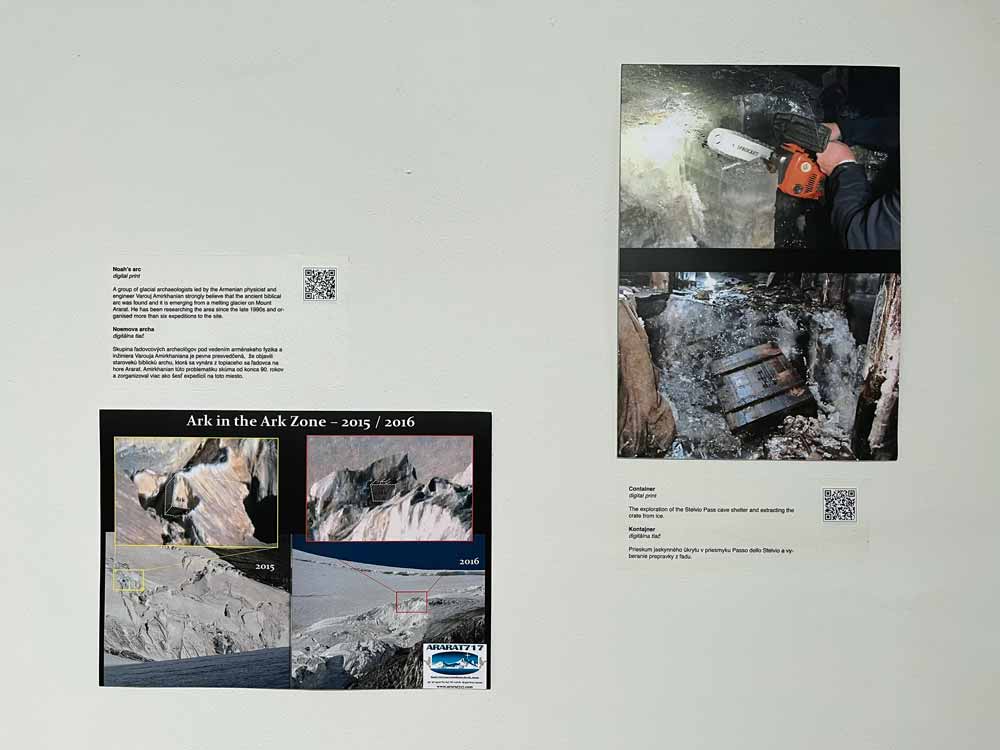
Container
digital print, 21 x 30 cm
The exploration of the Stelvio Pass cave shelter and extracting the crate from ice.

OpenAI. (2026). ChatGPT (GPT-5.6) [Large language model]. See prompts at the end
Mount Scorluzzo’s Frozen First World War Cave Shelter
Discovery chronology, recovery, artefacts, scientific significance and comparative Alpine finds
Scope: The Mount Scorluzzo shelter near the Stelvio Pass; chronology of exposure and recovery; organisers; artefact categories; scientific significance; comparable military finds and publication status.
Abstract
The Austro-Hungarian cave shelter below Mount Scorluzzo’s 3,094-metre summit is best understood as a gradually exposed and systematically recovered First World War site, not as a single-day discovery in 2017. The shelter was known and monitored before that year; thaw in 2015–2016 revealed its timber interior, and organised recovery by the Museo della Guerra Bianca in Adamello with Stelvio National Park began in summer 2017. Approximately 300 objects, extensive wooden architecture, paper, textiles, food remains, bedding, bones and botanical material survived together in a tightly dated living environment abandoned on 3 November 1918. Its main scientific contribution is therefore contextual completeness: it permits reconstruction of daily life, logistics, hunger, health and environmental stress at an extreme-altitude military post. Within The Sunshine Find, Scorluzzo is the factual archaeological anchor from which the fictional crate and the attribution to Sunshine depart. The report keeps that boundary explicit while connecting glacial archaeology, heritage tourism and the project’s later movement toward environmental radicalism.
Project links and cross-references: Project website · Exhibition pages · Supporting archive
Contents
1. What was found and where?
2. When was the discovery made?
3. Who organised the recovery?
4. What items were found?
5. Primary scientific contribution
6. Comparable military finds revealed by Alpine ice
7. Archaeological and academic literature
8. Conclusions and unresolved questions
Numbered academic reference list
Appendix: User prompts
1. What was found and where?
Site: an Austro-Hungarian cave shelter immediately below the summit of Mount Scorluzzo, in the Lombardy sector of Stelvio National Park, close to the Stelvio Pass and the wartime frontier between Italy and Austria-Hungary.
Elevation | approximately 3,094 m above sea level |
Approximate internal dimensions | 11 m long × 3.5 m wide × 2.5 m high |
Construction | artificial rock cave containing a timber-built barrack or lining |
Wartime function | all-season shelter for the Austro-Hungarian garrison controlling the Stelvio Pass sector |
Occupancy | approximately twenty soldiers according to contemporary reporting |
Abandonment | 3 November 1918, during the Austro-Hungarian withdrawal |
Preservation mechanism | post-war snow entry and meltwater infiltration filled the interior with ice |
Academic source links: High-altitude military landscape survey | Stelvio and Adamello heritage chapter
References: [1], 195–208; [4], 114–127.
Interpretive caution. English-language reports sometimes call the feature a “bunker”, “barracks”, “cave barracks” or “shelter”. The official Italian description, ricovero austro-ungarico in caverna, is best translated as an Austro-Hungarian cave shelter. “Barrack” describes the substantial timber interior installed within the cave.
2. When exactly was the discovery made?
Answer: No exact day is published in the authoritative records located for this report. The commonly repeated year 2017 marks the beginning of organised recovery work. It should not be presented as a precise moment of first discovery.
Date / period | What happened | Interpretation |
Early 2000s | The Museo della Guerra Bianca carried out specific inspections and monitoring of the already-known cave shelter. | The site itself was known before 2017. |
Summers 2015–2016 | Unusually warm summers and low winter snowfall caused progressive melting inside the cave, fully exposing roof beams and planks. Unauthorised relic hunters were able to break through the roof. | This was the decisive physical “revelation” of the preserved interior. |
2015 | A contemporary field report states that researchers could enter once the ice seal had melted sufficiently. | Useful testimony, but the official record describes gradual exposure across 2015–2016 rather than a single day. |
Summer 2017 | The museum, after notifying the relevant Carabinieri Forestali and heritage office, began removing ice and recovering objects in close logistical collaboration with Stelvio National Park. | Best-supported date for the beginning of organised archaeological recovery. |
2017–2018 | Approximately 80% of roughly 60 m³ of ice was removed; objects were recovered and smaller timber elements dismantled. | Rescue excavation and stabilisation phase. |
Summer 2019 | Ice clearance and removal of the major beams and boards were completed; glaciological, microbiological, epidemiological, botanical, zoological, geomorphological and historical studies were initiated. | Transition from rescue recovery to full interdisciplinary investigation. |
2020–2021 | Conservation, dismantling and preparation for museum reconstruction continued; international media coverage followed in 2021. | Public “discovery” narratives largely date from this later publicity phase. |
Academic source links: Stelvio and Adamello heritage chapter
References: [4], 114–127.
Recommended dating formula: “The shelter was known and monitored from the early 2000s, exposed by thaw in 2015–2016, and systematically recovered from summer 2017; no exact first-excavation day is stated in the published official record.”
3. Who organised the recovery expedition?
Institutional organiser and field operator. The Museo della Guerra Bianca in Adamello, based in Temù, carried out the ice removal, artefact recovery and dismantling of timber elements.
Logistical and territorial partner. The Lombardy sector of Stelvio National Park provided close logistical collaboration and supported the wider heritage and research project.
Regulatory oversight. Before the 2017 operations, the museum notified the Carabinieri Forestali serving the park and the relevant regional heritage-protection office of the Ministry of Cultural Heritage.
Person / institution | Documented role | Assessment |
Museo della Guerra Bianca in Adamello | Performed monitoring, ice clearance, recovery, initial conservation and timber dismantling. | Primary operational organiser. |
Stelvio National Park, Lombardy | Close logistical collaborator and partner in heritage interpretation and scientific coordination. | Primary institutional partner. |
Walter Belotti | President and administrative director of the museum; publicly associated with presentation and coordination of the recovery. | Best-supported individual field-project leader, although the official project page emphasises institutions rather than naming a single expedition leader. |
Stefano Morosini | Historian, Stelvio National Park heritage-project coordinator, University of Bergamo scholar, and author of the principal published academic discussion. | Key scientific and interpretive coordinator. |
Interdisciplinary research team | Botany, glaciology, microbiology, epidemiology, zoology, geomorphology, cartography, conservation and historical research. | The project expanded beyond archaeology into a multi-institutional scientific programme. |
Academic source links: Stelvio and Adamello heritage chapter
References: [4], 114–127.
Conclusion on wording. It is more accurate to write that “the multi-season recovery was organised by the Museo della Guerra Bianca in Adamello with Stelvio National Park” than to attribute it to an unnamed one-off “expedition”.
4. What items were found?
The publicly described assemblage comprises approximately 300 objects, in addition to the complete or near-complete timber interior. No comprehensive final catalogue was located in the public academic literature, so the following list consolidates repeatedly documented categories rather than claiming to be exhaustive.
Category | Documented examples |
Architecture and fittings | Timber beams, roof planks, boards and smaller wooden structural elements; the interior arrangement of the shelter itself. |
Sleeping and insulation materials | Straw beds or mattresses, hay and plant material used as bedding or insulation. |
Food and kitchen remains | Tinned-food containers, bottles, dishes or plates, other food containers, and animal bones with the marrow removed. |
Lighting and heating-related objects | Lanterns and associated everyday fittings. |
Clothing and personal equipment | Clothes, uniforms or animal-skin jackets, personal effects and cigarette holders or filters. |
Military equipment | Helmets, ammunition and other munitions; reports use these broad terms but do not publish a complete typological inventory. |
Documents and printed matter | Newspapers, postcards, letters or books, providing chronological and personal evidence. |
Money and small personal objects | Coins and other small belongings. |
Biological and environmental remains | Seeds preserved in hay or bedding, plant remains, animal bones and microbial material trapped in the ice. |
Academic source links: Stelvio and Adamello heritage chapter | Emerging archaeology of glaciers and ice patches | Ice-patch archaeology in global perspective | The emergence of glacial archaeology | Documenting glacial sites in the Anthropocene
References: [4], 114–127; [5], 129–143; [6], 323–385; [7], 1–9; [8], 149–163.
Especially diagnostic observations. The marrowless animal bones and sparse food remains are consistent with severe hunger; the bedding preserves plant macroremains and seeds; and the survival of paper, leather, textiles, wood and food-related material makes the shelter much more informative than a surface scatter of metal military objects.
5. Primary scientific contribution
Primary contribution: an intact archaeological context of high-altitude military daily life. The value of the find lies less in any single spectacular object than in the association of architecture, artefacts, organic remains and environmental material inside a sealed living space. The shelter is effectively a tightly dated occupation assemblage whose terminal date is 3 November 1918.
- Contextual integrity: Objects remained spatially associated with the shelter’s structure and use areas. This permits interpretation of behaviour, not merely identification of isolated relics.
- Organic preservation: Wood, straw, leather, textiles, paper, food remains, bones and seeds survived in conditions that usually destroy them, greatly enlarging the evidential range of conflict archaeology.
- Microhistory of survival: The assemblage documents sleeping, eating, lighting, clothing, smoking, reading and supply under extreme cold, hunger and isolation.
- Archaeobotany and environmental history: Bedding and frozen botanical remains can identify transported plant material, local vegetation, provisioning practices and the ecological setting of the wartime occupation.
- Human and animal health: Microbiological, epidemiological and faunal studies can investigate sanitation, disease exposure, food stress and the biological consequences of occupation at 3,000 metres.
- Glaciology and site formation: The ice body records how water infiltration, freezing and thawing sealed, moved and subsequently exposed the material context.
- Conservation science: The project tests methods for stabilising waterlogged and frozen wood, paper, leather and composite objects immediately after thaw.
- Climate-change rescue archaeology: It demonstrates that deglaciation simultaneously reveals and rapidly endangers cultural heritage, requiring monitoring, legal protection, rapid documentation and conservation capacity.
Why it is scientifically stronger than many comparable finds. Human remains or single artefacts emerging from glaciers can answer important osteological, identification or typological questions. Scorluzzo, however, preserves an entire operational and domestic environment. This enables a reconstruction of the “system” of daily life—space, supplies, waste, bodily stress and environmental interaction—rather than one object or one individual alone.
Academic source links: Stelvio and Adamello heritage chapter | Emerging archaeology of glaciers and ice patches | Ice-patch archaeology in global perspective | The emergence of glacial archaeology | Documenting glacial sites in the Anthropocene
References: [4], 114–127; [5], 129–143; [6], 323–385; [7], 1–9; [8], 149–163.
6. Comparable military finds revealed by Alpine ice
The following is a representative, source-verifiable list rather than a complete census. Dates refer to discovery or the beginning of archaeological recovery, not to the wartime construction or death date.
Date | Site | Find | Significance / relation to Scorluzzo |
August 2004 | Punta San Matteo, Ortler–Cevedale | Three exceptionally preserved Austro-Hungarian soldiers emerged at about 3,400 m; museum director Maurizio Vicenzi identified the site. | A major example of glacier-preserved military human remains and personal equipment. |
Summer 2009 onward | Punta Linke, Ortler–Cevedale | Scientific excavation began at a high-altitude Austro-Hungarian cableway station and tunnel complex preserved by ice. | The closest methodological precedent explicitly cited by the Scorluzzo project; unlike Scorluzzo, the timber structure was principally documented in place rather than recovered wholesale. |
September 2012; recovered 28 September | Presena Glacier | Two very young Austro-Hungarian artillerymen, with uniform elements, a gas-mask bag, spoon and cigarette filter, were recovered after technicians observed the remains. | Shows how osteology, uniform analysis and associated objects can reconstruct age, unit and cause of death. |
4 August 2017 onward | Western slopes of Corno di Cavento, Adamello | The remains and equipment of Italian Alpino Rodolfo Beretta were recovered; damaged paper objects enabled identification. | Demonstrates the value of fragile documentary material preserved in frozen contexts. |
Summer 2020 | Adamello Glacier | A hiker found the remains of an Italian soldier wrapped in the national flag. | Another example of retreating ice exposing an individual burial or battlefield deposit. |
2023 | Mount Scorluzzino, Stelvio sector | Archaeological work documented another high-altitude cave shelter whose abandonment assemblage preserves the final day of the war. | A closely related site in the same military landscape, useful for comparison of shelter organisation and abandonment. |
August 2024 | Forcella Serauta, Marmolada | A hiker found the remains of two First World War infantrymen at approximately 2,700 m after summer thaw. | Confirms that new military human remains continue to emerge as Alpine ice retreats. |
Academic source links: Punta Linke geophysical study | Alpine First World War archaeology | WWI Alpine mass-grave taphonomy
References: [2], 798–812; [3], 33–39; [9], article 45086.
Comparative conclusion. Punta Linke is the most important archaeological comparator because it preserved a military installation and prompted a formal glacial-archaeology methodology. The Presena, San Matteo, Corno di Cavento and Marmolada finds are primarily human-remains contexts. Scorluzzo is distinctive because the whole timber living environment and its domestic assemblage could be dismantled, conserved and reconstructed.
7. Archaeological and academic literature
The peer-reviewed literature directly devoted to the Mount Scorluzzo shelter remains limited. Morosini’s scholarly chapter is the most substantial published discussion that names the recovery and places it within the heritage routes of the Stelvio and Adamello parks. Cardaci, Azzola and Versaci analyse the documentation and conservation of the wider high-altitude military landscape at the Stelvio Pass. Francese and colleagues provide the strongest methodological comparator through geophysical investigation of the ice-preserved First World War installation at Punta Linke. [1–4]
The scientific significance of Scorluzzo is therefore best framed through the broader peer-reviewed literature of glacial archaeology. This literature emphasises the exceptional preservation of organic materials, the rapid deterioration that follows thaw, the need for systematic monitoring and the importance of treating exposed finds as spatial contexts rather than isolated curiosities. [5–8]
Conference abstracts and technical reports have announced botanical, microbiological and interdisciplinary work on the shelter, but they are not included in the numbered bibliography because they do not meet the present report’s peer-review rule. No final peer-reviewed excavation monograph, complete artefact catalogue or comprehensive journal article was located. The absence is itself important: public visibility has advanced faster than full archaeological publication.
Academic text | Type | Use for this report |
Morosini 2022 | Scholarly book chapter | Directly identifies the recovery and situates it within movement heritage and park interpretation. |
Cardaci, Azzola and Versaci 2023 | Peer-reviewed journal article | Documents the wider Stelvio military landscape and its conservation problems. |
Francese et al. 2019 | Peer-reviewed Journal of Glaciology article | Provides the closest scientific comparator for integrating conflict archaeology, ice and geophysics. |
Dixon et al. 2005; Reckin 2013; Dixon et al. 2014; Pilø et al. 2022 | Peer-reviewed glacial-archaeology literature | Establishes preservation, survey and rescue principles for artefacts released from ice. |
Baranowska et al. 2025 | Peer-reviewed Scientific Reports article | Adds a recent forensic and taphonomic comparator for First World War remains in an Alpine environment. |
Academic source links: High-altitude military landscape survey | Punta Linke geophysical study | Alpine First World War archaeology | Stelvio and Adamello heritage chapter | Emerging archaeology of glaciers and ice patches | Ice-patch archaeology in global perspective | The emergence of glacial archaeology | Documenting glacial sites in the Anthropocene
References: [1]–[8].
8. Conclusions and unresolved questions
- No exact calendar day of “discovery” can be supported. The shelter was known and monitored before 2017; thaw in 2015–2016 exposed the timber interior, and systematic recovery began in summer 2017.
- The recovery was organised institutionally by the Museo della Guerra Bianca in Adamello with Stelvio National Park, rather than by a single independent expedition.
- The shelter contained approximately 300 objects together with unusually complete timber architecture and organic remains.
- Its primary scientific contribution is contextual completeness: architecture, equipment, food, paper, textiles, plant material and biological residues can be studied as one tightly dated living environment.
- Punta Linke is the closest archaeological comparator; other Alpine military finds are more often human-remains contexts or isolated artefact groups.
- The peer-reviewed record remains incomplete. Conference and technical outputs indicate ongoing botanical and interdisciplinary work, but a final excavation monograph and full catalogue have not yet been located.
- For the installation, the documented shelter is the factual anchor of the parafiction. The crate and its attribution to Sunshine belong to the artistic narrative and should remain visibly distinguishable from the archaeological record.
Unresolved points requiring institutional enquiry include the first exact field-entry date, a season-by-season field diary, the final inventory, the present conservation status of every object, and the publication status of the multidisciplinary studies announced in conference and technical records.
Primary evidence links
These institutional records support exact chronology, organisational responsibility and ongoing research status. They are primary evidence and are deliberately not included in the numbered academic bibliography.
- Italian Ministry of Culture: Mount Scorluzzo Austro-Hungarian cave shelter project record
- Museo della Guerra Bianca in Adamello
- CNR repository record for the Scorluzzo botanical conference contribution
- CNR technical-report record: palaeoecological and microbiological research at Scorluzzo
- Trentino cultural heritage record for Punta Linke
Numbered academic reference list
Chicago bibliography style. The numbered list contains only peer-reviewed journal articles and scholarly books or chapters issued by academic publishers.
1. Cardaci, Alessio, Pietro Azzola, and Antonella Versaci. “High-Altitude Architecture and Landscape: A Survey for the Conservation of Military Works at the Stelvio Pass.” diségno 12 (2023): 195–208. https://doi.org/10.26375/disegno.12.2023.20. Persistent link
2. Francese, Roberto G., Aldino Bondesan, Massimo Giorgi, Stefano Picotti, José M. Carcione, Maria C. Salvatore, Franco Nicolis, and Carlo Baroni. “Geophysical Signature of a World War I Tunnel-Like Anomaly in the Forni Glacier (Punta Linke, Italian Alps).” Journal of Glaciology 65, no. 253 (2019): 798–812. https://doi.org/10.1017/jog.2019.59. Persistent link
3. Kofler Engl, Waltraud. “Archaeology of World War I in the Alpine Region: Locations and Traces of the High Mountain Front of the First World War in the Dolomites and on the Ortler Glacier.” In A Future for Our Recent Past: Model Projects of Modern Heritage Conservation in Europe, 33–39. ICOMOS—Hefte des Deutschen Nationalkomitees 73. Berlin: ICOMOS, 2020. Persistent link
4. Morosini, Stefano. “‘Following in the Footsteps of History’: Sixteen Multimedia Itineraries through the First World War Sites in the Stelvio National Park and Adamello Park (Italy).” In Pathways: Exploring the Routes of a Movement Heritage, edited by Daniel Svensson, Katarina Saltzman, and Sverker Sörlin, 114–127. Winwick, Cambridgeshire: The White Horse Press, 2022. https://doi.org/10.3197/63787710662654.ch05. Persistent link
5. Dixon, E. James, William F. Manley, and Craig M. Lee. “The Emerging Archaeology of Glaciers and Ice Patches: Examples from Alaska’s Wrangell–St. Elias National Park and Preserve.” American Antiquity 70, no. 1 (2005): 129–143. https://doi.org/10.2307/40035272. Persistent link
6. Reckin, Rachel. “Ice Patch Archaeology in Global Perspective: Archaeological Discoveries from Alpine Ice Patches Worldwide and Their Relationship with Paleoclimates.” Journal of World Prehistory 26, no. 4 (2013): 323–385. https://doi.org/10.1007/s10963-013-9068-3. Persistent link
7. Dixon, E. James, Martin Callanan, Albert Hafner, and P. Gregory Hare. “The Emergence of Glacial Archaeology.” Journal of Glacial Archaeology 1, no. 1 (2014): 1–9. https://doi.org/10.1558/jga.v1i1.1. Persistent link
8. Pilø, Lars, Espen Finstad, Elling Utvik Wammer, Julian R. Post-Melbye, Axel Hee Rømer, Øystein Rønning Andersen, and James H. Barrett. “On a Mountain High: Finding and Documenting Glacial Archaeological Sites During the Anthropocene.” Journal of Field Archaeology 47, no. 3 (2022): 149–163. https://doi.org/10.1080/00934690.2021.2012330. Persistent link
9. Baranowska, Wiktoria, Mauro Gobbi, Stefano Vanin, Franco Nicolis, and Daniel Gaudio. “Taphonomic Patterns of a WWI Alpine Mass Grave: Insights from the Italian Front.” Scientific Reports 15 (2025): 45086. https://doi.org/10.1038/s41598-025-32171-y. Persistent link
Appendix: User prompts related to this report
Prompts are reproduced as a research-process record. Minor typographic normalisation has been limited to quotation marks and line breaks; wording and instructions are otherwise retained.
1. Melting ice on Mount Scorluzzo near the Stelvio Pass in the Italian Alps revealed an intact World War I Austro-Hungarian cave shelter in 2017.
Make an internet research on:
1. when exactly the discovery has been made?
2. who was organizing the expedition?
3. What kind of items were found?
4. what is the primary scientific contribution of this find?
5. were there any similar military finds? (enlist with dates)
6. what kind of archaeological academic texts are reffering to this find?
7. create a structured word document, with the list of references in chicago style at the end
2. create a short, two paragraph abstract of the main information concluded in the document
3. In your report convert the outgoing links to open a new browser tab. Leave the rest unchanged.
4. General remarks and new request:
1. I have been asking you to create individual reports on different topics, in this case the train service and model of Glacier Express.
2. Nonetheless these materials should converge into a unity which is the archive itself and the supporting physical installation. This convergence should be based on a synthesys of all of my other topics, questions and criteria raised in all of the other chat sessions, which are all part of the same project the main scope of which is an art installation and a supporting archive that grows by time. The archive is meant for both professional and nonprofessional use, it should be informative within its artistic and pedagogical scope as well.
3. the main line of thoughts of the project departs from panoptic tourism and concludes to ecoterrorism in a narrative line. Therefore all the reports should follow this general direction in their approach and references.
4. The reports we are working on now will all serve as a background research material published on the project website for the set of objects that will be on display, Each object will have its own page (see: https://glacial-archaeology.net/category/exhibition/). See: Szabolcs KissPál – The sunshine find_for translation. I am also adding the brief description of the project’s general concept, see: Szabolcs KissPál – The sunshine find. The website will have a separate but interconnected section for both the exhibition and the supporting archive. https://glacial-archaeology.net/an-archive-of-narratives-on-global-warming-copy/ Inspect the site while note that it doesn’t have its final structure yet!
5. the scope with the reports is to produce a set of background research material for each object in part that should refer to each other, and should be unified in their narrative and typographic structure, tone, and scope. Pay attention to snychronise the focus points of different partial research tasks when possible with cross references!
6. I am attaching two of your previous reports (noahs_ark_expeditions_1959_1990_academic_sources_new_tab_links.docx, Container_Mount_Scorluzzo_WWI_Shelter_Research_Report). Please develop and and apply to these reports a uniform structure both content wise and in formal aspects while mostly keeping their original content.
7. Main further formal criteria:
– you should always start with an abstract summarizing your finds in a text no longer than 200 words.
– you should always enlist at the very end of the document all my prompts related to that topic
– the external links should always open in a different tab
– you should be using only valid, peer reviewed academic sources listed and numbered at the end of the documents
– you should apply a somewhat unified narrative structured and a unified formatting (including typeface styles, subtitles structure, etc.
8. – note and memorise the above in your cross-chat memory for rurther tasks
– return the three reports keeping their main content but slightly modified (!) according to the above