Edelweiss 1.
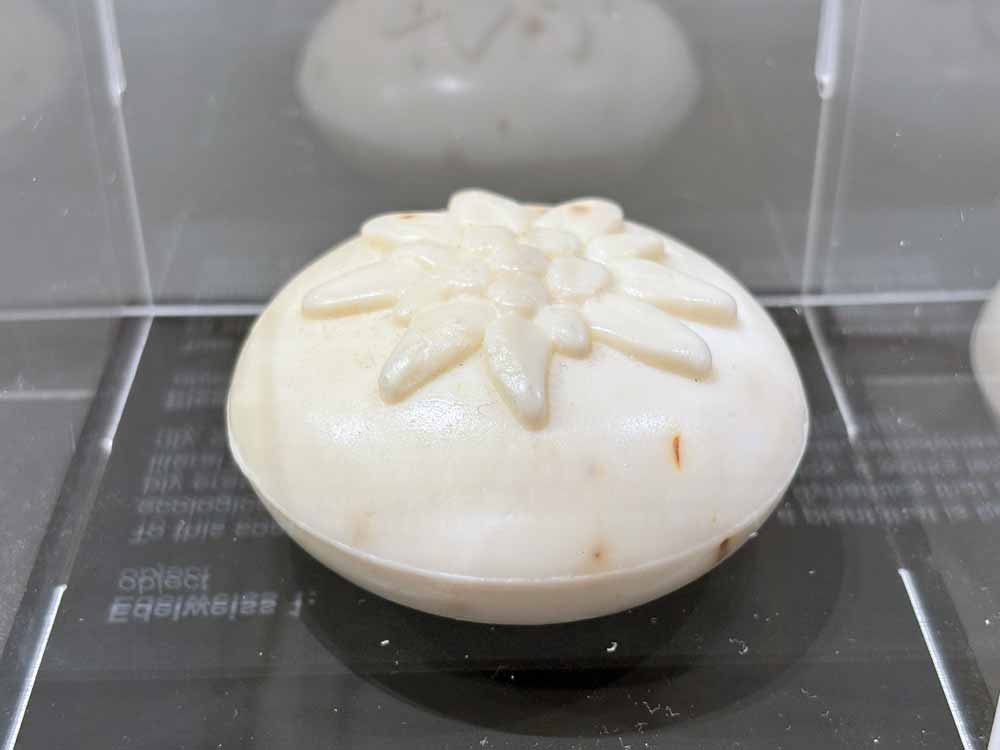
object (soap), 8 x 4 cm
To this soap extract of edelweiss was added, a plant that is becoming ecologically unstable under the same warming dynamics that are visibly erasing glaciers. The plant is a climate paradox, it works less as a literal flower than as a compressed code for altitude, remoteness, purity, endurance, and a culturally legible version of the Alps.
OpenAI. (2026). ChatGPT (GPT-5.6) [Large language model]. See prompts at the end
Edelweiss Soap
Alpine cleansing, cosmetic evidence and souvenir commerce beside the Pasterze Glacier
Scope: The soap acquired at the Kaiser-Franz-Josefs-Höhe visitor-centre shop; its probable manufacturer and formulation; the modern history of edelweiss in soap and cosmetics; evidentiary limits of skin-benefit claims; souvenir-shop history; and relations to Edelweiss 2 and the project’s Grossglockner lighter.
Abstract
The object is most plausibly an Original Florex sheep-milk soap in the “Edelweiß” range, manufactured in Sierning, Upper Austria, and distributed through Alpine gift retail. This identification remains provisional until the wrapper or ingredient declaration is photographed. Florex dates its sheep-milk soap line to 1998; its documented process combines conventional vegetable-oil saponification with sheep milk, lanolin, fragrance, colour and, in at least one 150-gram Edelweiss formulation, Leontopodium alpinum extract. Edelweiss extracts contain compounds with antioxidant and anti-inflammatory activity, and one small study reported benefits from a leave-on callus-culture formulation. These findings do not demonstrate equivalent effects in a briefly applied rinse-off soap of unknown extract concentration. The product’s strongest operation is therefore symbolic: edelweiss converts altitude, rarity, purity and endurance into a portable commodity. At Kaiser-Franz-Josefs-Höhe, the soap, Edelweiss seeds and a Grossglockner lighter form a compact souvenir ecology around a retreating glacier—care, propagation and combustion sold within the same managed panorama.
Project links and cross-references: Exhibition objects · Supporting archive · Edelweiss 2 · Ignite / attached Grossglockner lighter report · Glacier Express
Contents
1. Probable identification and production background
2. Edelweiss in soap: history, technology and effects
3. Souvenir shops and the Kaiser-Franz-Josefs-Höhe retail ecology
4. Interpretive synthesis: cleansing, cultivation and combustion
5. Numbered academic reference list
Appendix: User prompt
1. Probable identification and production background
Without the wrapper, the manufacturer cannot be established with certainty. The strongest available match is the “Sheep milk soap 150g ‘Edelweiß’, Edelweiss” (article 9204A3-EW) sold wholesale by Gerlinde Hofer–Florex GmbH. It is Austrian-made, visually and thematically suited to Alpine souvenir retail, and belongs to a broad Florex Edelweiss family of bars, liquids, creams and gift formats.
Field | Documented information |
Probable product | Original Florex sheep-milk soap 150g “Edelweiß”, article 9204A3-EW; identification provisional. |
Producer | Gerlinde Hofer–Florex GmbH, Sierning, Upper Austria. Company founded in 1995; sheep-milk soap first presented in September 1998. |
Base technology | Vegetable fats and oils are reacted with sodium hydroxide (saponification), producing soap and glycerin; the mass is blended, rolled, extruded and stamped. |
Added materials | Manufacturer documentation lists Austrian organic sheep milk, lanolin, fragrance, colour, herbs or essential oils. A Florex 150g cold-stirred Edelweiss declaration also lists Leontopodium alpinum extract. |
Supply-chain limits | The public record does not disclose the source or concentration of the plant extract, all vegetable-oil origins, production volume for this variant, or a product life-cycle assessment. |
Primary / institutional evidence links: Florex 150g “Edelweiß” product page | Florex company history | Florex manufacturing description | 150g Edelweiss ingredient declaration
Florex’s history is itself a miniature narrative of rural value addition. A family farm shifted towards sheep in the late 1980s; floral craft and agricultural products became a gift-business platform; and sheep milk was reformulated into a durable, branded toiletry. The soap is therefore not made at the glacier, nor necessarily from wild local edelweiss. Its “locality” is assembled through Austrian manufacture, Alpine iconography and sale at a destination shop.
2. Edelweiss in soap: history, technology and effects
Edelweiss has a documented Alpine folk-medicinal history, but the evidence reviewed does not support a long, continuous vernacular tradition of making soap from it. The commercial category is better understood as modern convergence: an old cleansing technology, a plant already charged with Alpine meaning, late-twentieth-century gift manufacture, and twenty-first-century extract science. Florex can date its general sheep-milk soap line to 1998, but no reliable source found gives the launch year of its Edelweiss variant. By the 2000s, chemical work had isolated leontopodic acids and helped turn edelweiss into a standard “active” in cosmetic marketing.
Academic source links: Edelweiss chemistry and pharmacology review | Leontopodic acid study
References: [1], 295–308; [2], 4621–4630.
2.1 Production technology: extract, scent and soap base
In conventional bar-soap production, triglyceride-rich fats or oils react with alkali to form fatty-acid salts and glycerin. Florex describes a boiled base that is subsequently mixed with sheep milk, lanolin, fragrances, essential oils, herbs and colour before milling, extrusion and stamping. Its separate “cold-stirred” 150-gram Edelweiss declaration lists coconut-, palm- and olive-derived soap salts, water, perfume, glycerin, edelweiss extract, alcohol, lanolin and sheep milk, together with fragrance allergens. This is not “soap made from edelweiss” in the structural sense: the plant is a minor additive to a soap matrix formed from vegetable oils. The product name simultaneously denotes ingredient, scent family and Alpine image.
2.2 Supposed effects versus evidentiary status
Marketing proposition | Evidence-based assessment |
Antioxidant / anti-ageing | Leontopodic acids and extracts show antioxidant, DNA-protective and anti-inflammatory activity in laboratory studies. A small four-week trial reported improvements from a leave-on callus-culture formulation. Neither result proves a comparable effect from this rinse-off bar. |
Moisturising / nourishing | Glycerin and lanolin may support a less dry after-feel, but cleansing surfactants and soap alkalinity can disturb the skin barrier. “Sheep milk” is not, by itself, clinical evidence of superior moisturisation. |
Natural purity / mountain protection | This is principally a cultural analogy: a plant adapted to high-altitude stress is made to signify resilience on human skin. The formula remains an industrial cosmetic containing perfume, allergens and, in the documented variant, palm-derived soap salts. |
Academic source links: Edelweiss callus-culture anti-ageing study | Review of soaps, syndets and skin-barrier effects
References: [2], 4621–4630; [3], article 230; [4], article 2010.
The gap is therefore not between a “false” plant and a “real” chemical effect. Edelweiss contains bioactive compounds, but formulation, concentration, stability, contact time and delivery determine whether those compounds matter on skin. No product-specific clinical study was found for the souvenir bar. Its verified function is cleansing; its more expansive efficacy belongs to a marketing transfer from extract research to the finished commodity.
3. Souvenir shops and the Kaiser-Franz-Josefs-Höhe retail ecology
Travel mementoes long predate modern tourism, from pilgrimage tokens and relic-like keepsakes to objects collected on the Grand Tour. The modern souvenir shop consolidated with mass transport, scenic routes, museums and purpose-built attractions: it placed standardised, portable objects at the point where an experience could be converted into purchase. Souvenir scholarship describes these objects as material messengers that make an extraordinary place available for later memory, gifting and display. Their “authenticity” often lies less in local manufacture than in the buyer’s association between object and visit.
Academic source links: The souvenir as messenger | Souvenirs, meaning and commoditisation
References: [5], 135–146; [6], 489–499.
The Kaiser-Franz-Josefs-Höhe complex is a particularly concentrated version of this apparatus. Reached by the Grossglockner High Alpine Road, the centre combines glacier and mountain views with exhibitions on nature, glaciers and cars, digital interpretation, food, parking and retail. The Pasterze is thus encountered as a managed panorama before it is miniaturised into merchandise. The shop is not peripheral to the attraction: it is one of the mechanisms through which the road, visitor centre and glacier become a single consumable itinerary.
Primary / institutional evidence links: Kaiser-Franz-Josefs-Höhe visitor centre | Grossglockner shop
Edelweiss is especially effective in this setting because it is an Alpine symbolic species used on logos, brands and souvenirs even when the marketed object has no direct ecological relation to the plant’s local presence. Scholarship notes that such representations sell the idea of a place and can persist independently of the species itself. The soap’s white flower, pastoral milk and bodily care translate the mountain into purity and intimacy; the commodity can be used up, while the memory and branded association are meant to remain.
Academic source links: Symbolic Alpine species and tourism branding | Glacier tourism under climate change | Pasterze as an iconic tourism glacier
References: [7], 711–730; [8], article 120; [9], article 51.
4. Interpretive synthesis: cleansing, cultivation and combustion
Read together, Edelweiss 1 and Edelweiss 2 divide the flower into two tourist futures. The soap turns the plant into extract, fragrance and a consumable surface treatment; the cup of five seeds promises cultivation, propagation and deferred life. One object dissolves through use, the other asks to be planted. Both detach edelweiss from the inaccessible high-altitude encounter that historically sustained its myth and place it within a portable domestic ritual.
The attached Grossglockner lighter adds a third operation. The same destination that sells cleansing and germination also sells—or is represented by—ignition. In the project’s archive, the lighter’s combustion and tobacco-adjacent economy sit beside the soap’s language of purity and care. Their contradiction is not proof of a company scandal; it is a material synopsis of tourist consumption. The alpine landscape is reached by motor road, interpreted through exhibitions, witnessed in retreat and carried away as flower, seed, scent and flame.
The project’s term catastrophe theatre is most useful here as an interpretation rather than a scholarly category. Glacier-tourism research documents attractions adapting to retreat through interpretation, infrastructure and “last-chance” motivations. At Kaiser-Franz-Josefs-Höhe, the disappearing Pasterze is both the evidence on view and the scarcity that intensifies the visit. The shop multiplies stable icons while the material landscape that authorises them becomes unstable. Sunshine’s supposed 2008 visit extends this contradiction parafictionally: a future environmental fugitive passes through the carefully managed marketplace of the catastrophe she may later be imagined to resist.
5. Numbered academic reference list
Chicago bibliography style. Only peer-reviewed scholarly sources appear in this numbered list; manufacturer and visitor-centre materials are identified above as primary/institutional evidence.
1. Tauchen, Jan, and Ladislav Kokoska. “The Chemistry and Pharmacology of Edelweiss: A Review.” Phytochemistry Reviews 16, no. 2 (2017): 295–308. DOI
2. Schwaiger, Stefan, Rinaldo Cervellati, Christoph Seger, Ernst P. Ellmerer, Nancy About, Isabelle Renimel, Céline Godenir, Patrice André, Frank Gafner, and Hermann Stuppner. “Leontopodic Acid—A Novel Highly Substituted Glucaric Acid Derivative from Edelweiss (Leontopodium alpinum Cass.) and Its Antioxidative and DNA Protecting Properties.” Tetrahedron 61, no. 19 (2005): 4621–4630. DOI
3. Cho, Won Kyong, Hye-In Kim, Soo-Yun Kim, Hyo Hyun Seo, Jihyeok Song, Jiyeon Kim, Dong Sun Shin, Yeonhwa Jo, Hoseong Choi, Jeong Hun Lee, and Sang Hyun Moh. “Anti-Aging Effects of Leontopodium alpinum (Edelweiss) Callus Culture Extract through Transcriptome Profiling.” Genes 11, no. 2 (2020): 230. DOI
4. Mijaljica, Dalibor, Fabrizio Spada, and Ian P. Harrison. “Skin Cleansing without or with Compromise: Soaps and Syndets.” Molecules 27, no. 6 (2022): 2010. DOI
5. Gordon, Beverly. “The Souvenir: Messenger of the Extraordinary.” Journal of Popular Culture 20, no. 3 (1986): 135–146. DOI
6. Swanson, Kristen K., and Dallen J. Timothy. “Souvenirs: Icons of Meaning, Commercialization and Commoditization.” Tourism Management 33, no. 3 (2012): 489–499. DOI
7. Schirpke, Uta, Claude Meisch, and Ulrike Tappeiner. “Symbolic Species as a Cultural Ecosystem Service in the European Alps: Insights and Open Issues.” Landscape Ecology 33, no. 5 (2018): 711–730. DOI
8. Salim, Emmanuel, Ludovic Ravanel, Philippe Bourdeau, and Philip Deline. “Glacier Tourism and Climate Change: Effects, Adaptations, and Perspectives in the Alps.” Regional Environmental Change 21 (2021): 120. DOI
9. Abermann, Jakob, Manuel Theurl, Elisabeth Frei, Bernhard Hynek, Wolfgang Schöner, and Karl W. Steininger. “Too Expensive to Keep—Bidding Farewell to an Iconic Mountain Glacier?” Regional Environmental Change 22 (2022): 51. DOI
Appendix: User prompt related to this report
Prompt reproduced chronologically as a research-process record.
1. The next object is a soap made from Edelweiss acquired in the Souvenir shop of Franz Jozef Höhe visitor Center’s souvenir shop.
1. make a research on its production background
2. on the history of producing soap from Edelweiss, its production technology, its supposed efects versus its marketing image
3. its relation to the context of the rest of the souvenir items in general and in particular the ones that are part of the archive — Edelweiss 2 (cup containing 5 Edelweiss seeds from the same shop, beside the shrinking Pasterze Glacier) and Burn baby, burn! (attached report)
4. a short history of the souvenir shops as auxiliary spaces of the tourism industry, and how this Centre relates to them
5. keep the document within maximum 5 pages
2. General remarks and new request:
1. I have been asking you to create individual reports on different topics, in this case the train service and model of Glacier Express.
2. Nonetheless these materials should converge into a unity which is the archive itself and the supporting physical installation. This convergence should be based on a synthesys of all of my other topics, questions and criteria raised in all of the other chat sessions, which are all part of the same project the main scope of which is an art installation and a supporting archive that grows by time. The archive is meant for both professional and nonprofessional use, it should be informative within its artistic and pedagogical scope as well.
3. the main line of thoughts of the project departs from panoptic tourism and concludes to ecoterrorism in a narrative line. Therefore all the reports should follow this general direction in their approach and references.
4. The reports we are working on now will all serve as a background research material published on the project website for the set of objects that will be on display, Each object will have its own page (see: https://glacial-archaeology.net/category/exhibition/). See: Szabolcs KissPál – The sunshine find_for translation. I am also adding the brief description of the project’s general concept, see: Szabolcs KissPál – The sunshine find. The website will have a separate but interconnected section for both the exhibition and the supporting archive. https://glacial-archaeology.net/an-archive-of-narratives-on-global-warming-copy/ Inspect the site while note that it doesn’t have its final structure yet!
5. the scope with the reports is to produce a set of background research material for each object in part that should refer to each other, and should be unified in their narrative and typographic structure, tone, and scope. Pay attention to snychronise the focus points of different partial research tasks when possible with cross references!
6. I am attaching two of your previous reports (noahs_ark_expeditions_1959_1990_academic_sources_new_tab_links.docx, Container_Mount_Scorluzzo_WWI_Shelter_Research_Report). Please develop and and apply to these reports a uniform structure both content wise and in formal aspects while mostly keeping their original content.
7. Main further formal criteria:
– you should always start with an abstract summarizing your finds in a text no longer than 200 words.
– you should always enlist at the very end of the document all my prompts related to that topic
– the external links should always open in a different tab
– you should be using only valid, peer reviewed academic sources listed and numbered at the end of the documents
– you should apply a somewhat unified narrative structured and a unified formatting (including typeface styles, subtitles structure, etc.
8. – note and memorise the above in your cross-chat memory for rurther tasks
– return the three reports keeping their main content but slightly modified (!) according to the above