Edelweiss 2.
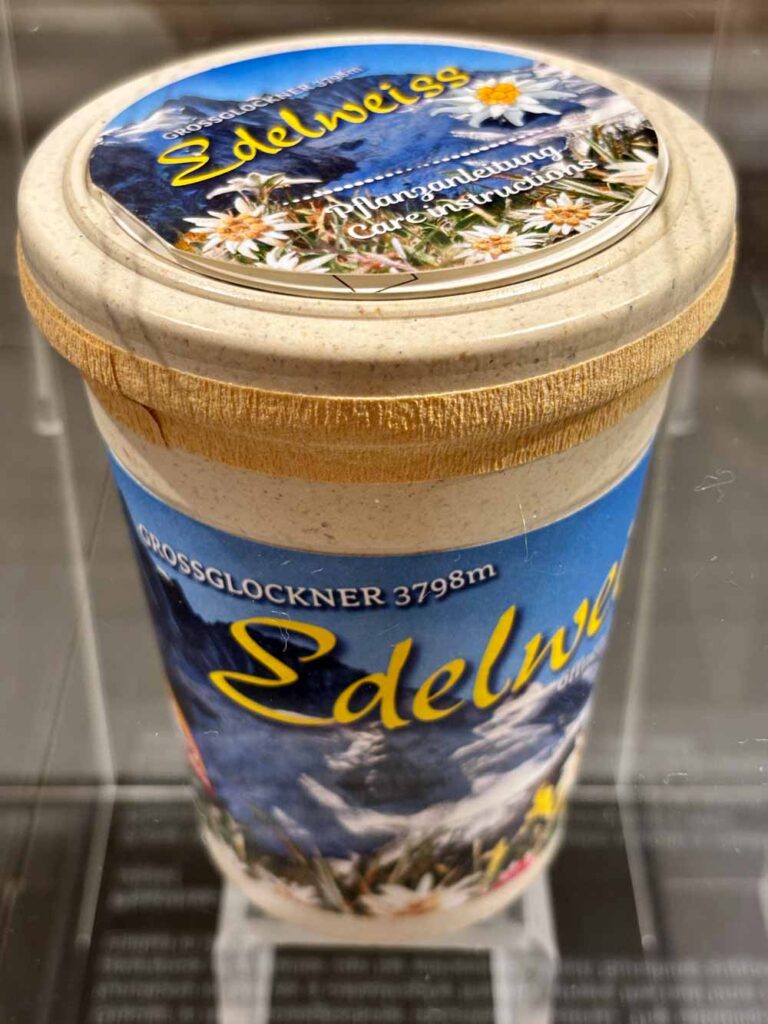
object (plastic cap, soil, seeds), 8,5 x 10,6 cm
The cup contains 5 seeds of Edelweiss plant, and together with the object Edelweiss 1. it originates from the Kaiser-Franz-Josefs-Höhe Information Centre souvenir shop located at the shrinking Pasterze Glacier in the Grossglockner mountain (Austria). The establishment functions in fact as a catastrophe theater, where the real time disappearance of a glacier can be witnessed, which Sunshine supposedly visited in 2008.
OpenAI. (2026). ChatGPT (GPT-5.6) [Large language model]. See prompts at the end
Edelweiss: Distribution, Glacier-Related Change, Cultivation and Plant Souvenirs
A source-critical account of Leontopodium geography, population responses, cultivation systems and the circulation of living botanical mementos
Scope: The genus Leontopodium across Europe and Asia, with detailed attention to European edelweiss (Leontopodium nivale and its subspecies); evidence concerning population responses to climate warming and glacier retreat; horticultural and commercial cultivation; selected established distributors; and plants, seeds and dried specimens as souvenirs. The former survey of institutions, services, promotions and souvenir objects using edelweiss has been excluded.
Abstract
Edelweiss is not a single narrowly Alpine species but a Eurasian genus whose main diversity lies in central and eastern Asia. Current taxonomic treatments differ in the number of accepted species, while scholarship consistently identifies western and south-western China and the Himalayan–Tibetan region as major centres of diversity. For European edelweiss, the strongest population study projects a 14–35 per cent contraction of suitable range in the Romanian Carpathians by 2050 and a decline in total seed production, despite locally favourable responses among surviving plants. No study located isolates glacier melt as a direct causal variable for Leontopodium; glacier retreat is therefore treated as one component of warming-driven habitat reorganisation. Cultivation has developed along two partly separate lines: ornamental alpine gardening and standardised medicinal or cosmetic crop production, exemplified by the Swiss ‘Helvetia’ cultivar. Seed packets and nursery plants convert a protected or difficult-to-reach mountain plant into a portable living souvenir. This may reduce pressure on wild populations when propagation is documented, but provenance, species identity and plant-health rules remain important.
Project links and neutral cross-references: Exhibition object pages · Supporting archive · The report supplies factual background for the objects Edelweiss 1 (soap containing edelweiss extract) and Edelweiss 2 (a cup containing five seeds). It may also be consulted beside the separate glacier-cosmetics and Pasterze/Grossglockner reports. These cross-references identify shared subject matter only.
Evidence limitation: no population study located for this revision experimentally separates glacier melt from correlated changes in temperature, snow cover, soil development, moisture and vegetation competition. Claims about edelweiss in glacier forelands are therefore stated as process-based inference, not direct species-specific measurement.
Contents
1. Taxonomy and geographic distribution
2. Population ecology under warming and glacier retreat
3. Cultivation culture and production systems
4. Selected distributors and supply channels
5. Plants as souvenirs
6. Neutral archive cross-references
Primary, botanical and commercial evidence links
Numbered academic reference list
Appendix: User prompts related to this report
1. Taxonomy and geographic distribution
The familiar European plant is now commonly treated as Leontopodium nivale, with the widespread alpine taxon recognised as L. nivale subsp. alpinum and a more restricted nominate subspecies, L. nivale subsp. nivale. Older and horticultural literature frequently uses Leontopodium alpinum. These names should not be silently conflated: databases and publications differ in accepted rank and synonymy.
1.1 A Eurasian genus centred in Asia
Recent molecular work describes Leontopodium as a monophyletic Eurasian genus concentrated in central and eastern Asia. A 2023 synthesis reports 58 species across Asia and Europe, including 37 species in China, 17 of them endemic; western and south-western China form the principal Chinese diversity centre. Earlier molecular work estimated approximately 30 species and located the main centre of diversity in the Himalayan–Tibetan region. The difference is taxonomic rather than an ecological increase: species boundaries, synonymy and infrageneric classification remain contested.
Academic source links: Molecular phylogeny of the edelweiss | Phylogeny of Leontopodium in China
References: [1], 235–264; [2], Introduction and Conclusions.
1.2 Representative distribution by species and subspecies
Taxon | Native distribution | Research note |
L. nivale subsp. alpinum | European mountain systems | The widespread European edelweiss; records span the Alps, Pyrenees, Carpathians and other European ranges. Taxonomic sources often retain the older name L. alpinum. |
L. nivale subsp. nivale | Central Apennines and north-western Balkans, including the Pirin Mountains | A disjunct and habitat-restricted taxon associated with calcareous or marble substrates; local populations require separate conservation attention. |
L. himalayanum | Northern Pakistan through the Himalaya and Tibetan region to north-western Yunnan and northern Myanmar | A high-mountain Asian species with a broad west–east Himalayan distribution. |
L. nanum | Afghanistan to Mongolia and western/central China | A wide continental and high-elevation range including parts of the Himalaya, Tibet and Xinjiang. |
L. leontopodioides | Pakistan to southern Siberia and Japan | One of the genus’s broadest trans-Asian distributions, extending across continental and north-east Asian regions. |
L. discolor | Russian Far East and Sakhalin to Hokkaido | A north-east Asian distribution separated from the European taxa. |
L. coreanum | Korean Peninsula | A geographically restricted Korean taxon; Asian edelweiss diversity is not reducible to Himalayan species alone. |
Primary / botanical database evidence links: Kew: L. nivale | Kew: L. himalayanum | Kew: L. nanum | Kew: L. leontopodioides | Kew: L. discolor | Kew: L. coreanum | Flora of China: Leontopodium
References: [1], 235–264; [2], Introduction.
1.3 Distribution is not population security
A mapped native range records where a taxon occurs or has occurred; it does not show abundance, recruitment, genetic connectivity or future viability. This distinction is especially important for high-elevation plants. A species may remain present across several mountain systems while individual populations contract, become isolated or produce fewer viable seeds. For the Asian members of the genus, distributional knowledge is substantially better than long-term demographic monitoring; the available climate-response literature is therefore uneven and strongly weighted towards European edelweiss.
2. Population ecology under warming and glacier retreat
2.1 Direct evidence for European edelweiss
The most detailed integrated demographic and distribution study examined 45 plots at seven Romanian Carpathian sites. Under projected 2050 climates, suitable range contracted by 14–35 per cent and shifted towards higher elevations. Total seed number and seed mass across Romania were projected to decline, even though the fitness of individuals remaining in locally suitable, warmer and wetter sites could improve. The study also found higher reproductive performance farther from hiking trails, demonstrating that climate and local disturbance can act together rather than as competing explanations.
Academic source links: Integrating demography and distribution modelling for edelweiss | Ecological conditions for edelweiss in the Swiss Alps
References: [3], 12322–12334; [4], 541–558.
2.2 Habitat characteristics and likely mechanisms
Swiss modelling and vegetation surveys associate European edelweiss with open subalpine and alpine grasslands, high elevations, comparatively dry sites, steep slopes and low surrounding grass cover. These conditions help explain why warming can produce both short-term local gains and long-term regional losses. A warmer season may increase growth or seed production at some occupied sites, while the total area retaining open, cool and weakly competitive habitat contracts. Expansion of denser vegetation from lower elevations can reduce the sparse cover on which edelweiss depends.
Academic source links: Ecological conditions for edelweiss in the Swiss Alps | Integrating demography and distribution modelling for edelweiss
References: [4], 541–558; [3], 12322–12334.
2.3 Glacier retreat: direct evidence, indirect pathways and uncertainty
Process | Expected population effect | Evidence status |
Loss of cold, open high-elevation habitat | Negative at regional scale | Direct edelweiss projections show range contraction and upward displacement; glacier loss is part of the same warming regime but was not isolated experimentally. |
Newly exposed glacier foreland | Site-dependent, not automatically beneficial | Deglaciation creates open ground, but early substrates may be unstable, nutrient-poor, dry or geologically unsuitable. Colonisation also depends on dispersal and substrate chemistry. |
Successional change after deglaciation | Initially mixed; increasingly competitive | Foreland research shows that plant diversity can rise during early succession and decline after glacier extinction as competition strengthens. Edelweiss itself was not among the modelled species in the cited study. |
Microtopographic refuges | Partial local buffer | Rock ledges, steep slopes and sparse calcareous grassland can preserve suitable microclimates, but refuges do not cancel regional contraction. |
Population isolation | Potentially negative | As suitable patches become smaller and more separated, dispersal and genetic exchange may become more difficult; direct multi-population genetic tests remain limited. |
Academic source links: The consequences of glacier retreat are uneven between plant species | Integrating demography and distribution modelling for edelweiss
References: [6], Article 616562; [3], 12322–12334.
2.4 Restricted populations: the nominate subspecies
Research on L. nivale subsp. nivale in the North Pirin marble range describes a local, disjunct, stenobiont taxon: it occupies a narrow set of environmental conditions and proved difficult to establish ex situ. Adult transplantation from the wild was unsuccessful as a conservation strategy, seedling survival was low and winter was a critical stage. These results caution against assuming that all edelweiss populations will respond alike or that cultivation methods developed for ornamental L. nivale subsp. alpinum can be transferred to restricted wild lineages.
Academic source links: Autecology and ex situ growth of L. nivale subsp. nivale
References: [5], 187–206.
2.5 Geographic evidence gaps
No comparable range-wide demographic projections were located for the majority of Asian Leontopodium species. This prevents a defensible genus-wide statement that all species are declining in the same manner. The Asian centre of diversity spans the Himalaya, Tibetan Plateau, western and south-western China, Mongolia, Russia, Korea and Japan; these regions differ greatly in glacier dependence, monsoon exposure, substrate, grazing and land use. Future work requires species-level monitoring rather than extrapolation from European edelweiss alone.
3. Cultivation culture and production systems
3.1 From wild collection to deliberate propagation
Edelweiss cultivation developed in response to three overlapping demands: ornamental alpine gardening, conservation and research, and the production of standardised plant material for foods, herbal preparations and cosmetics. Cultivation changes the plant from a seasonally encountered wild specimen into a reproducible crop. It can reduce reliance on wild collection, but only when the cultivated stock is clearly identified, propagated rather than collected, and kept separate from conservation-sensitive wild populations.
3.2 Ornamental alpine cultivation
Commercial seed and nursery culture generally treats European edelweiss as a rock-garden perennial. Guidance converges on full sun, sharply drained mineral soil and protection from prolonged winter wet. Seed is surface-sown or lightly covered; germination protocols vary among suppliers and may use a cool period. Garden performance cannot be used as a proxy for wild-population resilience: horticultural stock is selected, watered, weeded and placed in artificial substrates, while natural populations experience dispersal limits, competition and extreme weather.
Primary / institutional horticultural evidence links: Royal Horticultural Society plant profile | Jelitto sowing guidance
References: [5], 187–206.
3.3 Swiss crop breeding and the ‘Helvetia’ cultivar
Swiss agronomic work converted variable wild-derived material into a more homogeneous commercial crop. The breeding programme compared selected parent plants and hybrid clones for morphology, dry-matter yield and chemical composition. The selected cultivar ‘Helvetia’ was designed for reliable mountain cultivation and for extract production. Its development demonstrates that industrial edelweiss is not simply wild edelweiss transferred intact into a field: it is selected biological material incorporated into a controlled value chain.
Primary / institutional evidence links: Agroscope cultivar report | Helvetia conference abstract
Academic source links: The chemistry and pharmacology of edelweiss
References: [7], 295–308.
3.4 Cultivation channels and their material outputs
Cultivation context | Typical output | Selection priorities | Main caution |
Ornamental horticulture | Seed packets, plug plants, potted perennials | Visual form, garden hardiness, compact growth and flowering | Garden provenance may be distant from local wild populations; labels often retain the older name L. alpinum. |
Agronomic crop production | Dried aerial parts and standardised extracts | Homogeneous biomass, harvestability, active-compound profile and traceability | Often based on selected cultivars such as ‘Helvetia’ and contracted mountain growers. |
Botanical-garden or research culture | Living accessions and seed collections | Taxonomic verification, conservation research and public education | Requires accession data and separation from commercial stock. |
Ex situ conservation of restricted taxa | Seedlings, seed lots and experimental populations | Preservation of specific population lineages | Success is taxon-specific; adult translocation may fail and winter mortality can be high. |
Primary / institutional evidence links: Agroscope: cultivation of aromatic and medicinal plants | Valplantes growers’ cooperative | dsm-firmenich ALPAFLOR Edelweiss
References: [5], 187–206; [7], 295–308.
4. Selected distributors and supply channels
Publicly accessible market-share or production-volume data are insufficient for a ranked list of the world’s largest edelweiss distributors. The following organisations are therefore presented as selected established participants in distinct channels: specialist perennial seed retail, general seed retail, Swiss crop cultivation and industrial botanical extraction. Their inclusion documents current availability, not market dominance or endorsement.
Organisation | Channel / reach | Material distributed | Evidence note | Official link |
Jelitto Perennial Seeds | Germany; international specialist trade | L. alpinum seed portions; specialist perennial catalogue | Official catalogue lists more than 3,700 species and varieties; current edelweiss listing checked 27 July 2026. | |
Chiltern Seeds | United Kingdom; mail-order seed retail | L. alpinum seed packets | Current catalogue listing checked 27 July 2026. | |
Sluis Garden / Garden Seeds BV | Netherlands; packaged garden seeds | “Edelweiss, Common European” seed packet | Illustrates mass-packaged living souvenirs and garden retail. | |
Valplantes | Valais, Switzerland; grower cooperative | Organic aromatic and medicinal plant production, including edelweiss within the regional crop sector | A supply-chain producer rather than a souvenir retailer. | |
dsm-firmenich / ALPAFLOR | Swiss alpine cultivation and global cosmetic-ingredient supply | L. alpinum “Helvetia” extract | Official page states cultivation at 1,000–1,500 metres in the Swiss Alps; this is company evidence. |
Primary / commercial evidence links: Jelitto | Chiltern Seeds | Sluis Garden | Valplantes | dsm-firmenich
5. Plants as souvenirs
5.1 From removed specimen to portable living plant
A botanical souvenir may be wild-collected, preserved, cultivated or represented through derived material. The key distinction is not simply between ‘natural’ and ‘manufactured’. A pressed flower is a removed organism transformed into a memory object; a seed packet is a commercial product containing dormant living material; a potted plant continues to grow after travel; and a soap or extract carries chemically processed plant material without reproducing the whole organism. Each form creates a different relationship to place, ownership and ecological risk.
Academic source links: Souvenirs: Magical objects in everyday life | Meanings of tourist souvenirs
References: [9], 52–60; [10], 718–734.
5.2 Natural souvenirs and collection pressure
Research on natural souvenirs shows that travellers value shells, rocks, sand, plants and other materials because they are perceived as unique, genuine and directly connected to a visited place. This direct material link can also produce cumulative extraction. A Polish survey of 426 young adults found that 61.4 per cent collected natural souvenirs; its results are not globally representative, but they demonstrate that removal of natural material is a common rather than exceptional practice. For protected or small alpine populations, repeated collection of flowering stems can reduce reproductive output and damage local plants.
Academic source links: Young people collecting natural souvenirs | Integrating demography and distribution modelling for edelweiss
References: [8], 1–12; [3], 12322–12334.
5.3 Cultivated seed packets as souvenirs
A cultivated seed souvenir replaces immediate removal from the visited landscape with delayed germination elsewhere. Its portability, low price and small size make it suited to souvenir retail. The seed packet also compresses several claims into a label: species name, place association, cultivation promise and often an image of the adult flower. Yet the object may not disclose the geographic provenance of the seed, the cultivar, the generation removed from wild stock or whether the supplied taxon matches local populations. For the Edelweiss 2 object—a cup containing five seeds—these are factual questions that can be investigated from packaging, batch information and supplier records.
5.4 Principal souvenir forms and ecological questions
Souvenir form | Material relation to plant | Memory function | Ecological / documentary question |
Wild-picked flower or whole plant | Direct removal from source population | Immediate material connection to place | Loss of reproductive structures; legal protection; damage to small populations. |
Pressed or dried specimen | Preserved plant material | Durable visual and tactile record | May derive from legal cultivation or illegal collection; provenance is often absent. |
Seed packet or seed-containing object | Dormant living propagules in a manufactured package | Portable promise of regrowth | Identity, cultivar and geographic provenance; import rules; germination success; escape from cultivation. |
Potted nursery plant | Living cultivated individual | Ongoing care and transplantation | Plant-health certification, pests, unsuitable climates and mixing with local gene pools. |
Plant-derived soap, cosmetic or extract | Processed biomass or chemical extract | Scent, ingredient name and claimed biological properties | Traceability of cultivation, extract concentration and separation of evidence from marketing claims. |
Academic source links: Young people collecting natural souvenirs | Souvenirs: Magical objects in everyday life | The chemistry and pharmacology of edelweiss
References: [8], 1–12; [9], 52–60; [7], 295–308.
5.5 Provenance, biosecurity and documentation
For an archival description, ‘edelweiss seeds’ should be treated as an initial label rather than a complete botanical identification. Useful documentation includes the accepted scientific name and synonym used on the package, cultivar, supplier, country of seed production, batch or lot number, collection or purchase date, germination instructions and any plant-health information. Movement of live plants and seed across borders may be subject to plant-health rules that vary by origin and destination. The report therefore does not assume that a souvenir seed packet is suitable for sowing in the region where it is displayed.
Primary / institutional evidence links: European Commission: plant health and biosecurity | Royal Botanic Garden Edinburgh: plant health and biosecurity
6. Neutral archive cross-references
• Edelweiss 1: the present report provides species, cultivation and extract-production background for assessing the ingredient claim on an edelweiss soap. Product-specific composition and efficacy require a separate formulation and marketing review.
• Edelweiss 2: the report provides a framework for documenting the five seeds as a cultivated botanical souvenir, including taxon, cultivar, supplier, batch and provenance.
• Glacier-cosmetics report: shared factual subject matter includes cultivated edelweiss extracts, ingredient supply chains and the difference between botanical evidence and cosmetic claims.
• Pasterze / Grossglockner reports: shared factual subject matter includes glacier retreat and the location where the seed and soap objects were acquired. No causal relation between that glacier and the seed stock is assumed.
• Future reports on alpine planting or albedo proposals: species-specific ecological and cultivation limits in this report should be consulted before treating edelweiss as a generic high-altitude planting material.
Primary, botanical and commercial evidence links
Royal Botanic Gardens, Kew. Plants of the World Online: Leontopodium nivale.
Royal Botanic Gardens, Kew. Plants of the World Online: Leontopodium nivale subsp. alpinum.
Royal Botanic Gardens, Kew. Plants of the World Online: Leontopodium nivale subsp. nivale.
Agroscope. Cultivation of Aromatic and Medicinal Plants.
Carron et al. Agroscope cultivar report: Helvetia.
Vouillamoz et al. Helvetia conference abstract.
Valplantes. Official cooperative website.
Jelitto Perennial Seeds. Leontopodium alpinum.
Chiltern Seeds. Leontopodium alpinum.
Sluis Garden. Edelweiss, Common European.
dsm-firmenich. ALPAFLOR Edelweiss CB.
European Commission. Plant Health and Biosecurity.
Numbered academic reference list
Chicago bibliography style. This numbered list contains scholarly books and peer-reviewed journal articles only.
1. Blöch, Cordula, W. Bernhard Dickoré, Rosabelle Samuel, and Tod F. Stuessy. “Molecular Phylogeny of the Edelweiss (Leontopodium, Asteraceae–Gnaphalieae).” Edinburgh Journal of Botany 67, no. 2 (2010): 235–264. Persistent link
2. Xu, Xue-Min, Zhen Wei, Jun-Zhe Sun, Qing-Fei Zhao, Yang Lu, Zhen-Long Wang, and Shi-Xin Zhu. “Phylogeny of Leontopodium (Asteraceae) in China—with a Reference to Plastid Genome and Nuclear Ribosomal DNA.” Frontiers in Plant Science 14 (2023): 1163065. Persistent link
3. Maghiar, Lăcrămioara M., Ilie A. Stoica, and Andrew J. Tanentzap. “Integrating Demography and Distribution Modeling for the Iconic Leontopodium alpinum Colm. in the Romanian Carpathians.” Ecology and Evolution 11, no. 18 (2021): 12322–12334. Persistent link
4. Ischer, Mélanie, Anne Dubuis, R. Keller, and Pascal Vittoz. “A Better Understanding of the Ecological Conditions for Leontopodium alpinum Cassini in the Swiss Alps.” Folia Geobotanica 49, no. 4 (2014): 541–558. Persistent link
5. Kozuharova, Ekaterina, Momchil Panayotov, and Vivienne Spadaro. “Autecology and Ex Situ Growth of Leontopodium nivale subsp. nivale (Asteraceae) from North Pirin Marbles (SW Bulgaria).” Flora Mediterranea 28 (2018): 187–206. Persistent link
6. Losapio, Gianalberto, Bruno E. L. Cerabolini, Chiara Maffioletti, Duccio Tampucci, Mauro Gobbi, and Marco Caccianiga. “The Consequences of Glacier Retreat Are Uneven Between Plant Species.” Frontiers in Ecology and Evolution 8 (2021): 616562. Persistent link
7. Tauchen, Jan, and Ladislav Kokoška. “The Chemistry and Pharmacology of Edelweiss: A Review.” Phytochemistry Reviews 16, no. 2 (2017): 295–308. Persistent link
8. Pabian, Arnold, Aleksander Pabian, and Andrzej Brzeziński. “Young People Collecting Natural Souvenirs: A Perspective of Sustainability and Marketing.” Sustainability 12, no. 2 (2020): 514. Persistent link
9. Haldrup, Michael. “Souvenirs: Magical Objects in Everyday Life.” Emotion, Space and Society 22 (2017): 52–60. Persistent link
10. Masset, Julie, and Alain Decrop. “Meanings of Tourist Souvenirs: From the Holiday Experience to Everyday Life.” Journal of Travel Research 60, no. 4 (2021): 718–734. Persistent link
11. Stewart, Susan. On Longing: Narratives of the Miniature, the Gigantic, the Souvenir, the Collection. Durham, NC: Duke University Press, 1993. Persistent link
Appendix: User prompts related to this report
Prompts are reproduced chronologically as a research-process record. Obvious typographic errors have not been silently corrected.
1. The next object is a soap made from Edelweiss acquired in the Souvenir shop of Franz Jozef Höhe visitor Center’s souvenir shop.
1. make a research on its production background
2. on the history of producing soap from Edelweiss, its production technology, its supposed efects versus its marketing image
3. its relation to the context of the rest of the souvenir items in general and in particular the ones that are part of the archive
– Edelweiss 2., Label: “The cup contains 5 seeds of Edelweiss plant, and together with the object Edelweiss 1. it originates from the Kaiser-Franz-Josefs-Höhe Information Centre souvenir shop located at the shrinking Pasterze Glacier in the Grossglockner mountain (Austria). The establishment functions in fact as a catastrophe theater, where the real time disappearance of a glacier can be witnessed, which Sunshine supposedly visited in 2008.”
– Burn baby, burn! (see the attached report)
4. a short history of the souvenir shops as auxiliary spaces of the tourism industry, and how this Centre relates to them
5. keep the document within maximum 5 pages
2. 1. please review the attached report based on the general research criteria communicated with you
2. reformat and resend the document
3. Exclude the section: Institutions, services, promotions, and souvenir objects using edelweiss
Shift the focus of the research from tourism to:
4. Expand the research on the geographic distribution of different species, and the behaviour of those population in relation to glacier melt
5. expand the research with the cultivation culture of the plant, naming the main distributors
6. expand the research to the cultural phenomenon of plants as souvenirs
Please memorise and add these prompts to all of the future reports:
3. General remarks:
a. do not generate the section ‘Interpretive synthesis’, the scope of these reports is to provide background information on the objects and phenomena, and not on the objects as artworks.
b. when referring to other items of the archive you should avoid interpretative tone as well
General remarks:
1. I have been asking you to create individual reports on different topics, in this case the train service and model of Glacier Express.
2. Nonetheless these materials should converge into a unity which is the archive itself and the supporting physical installation. This convergence should be based on a synthesys of all of my other topics, questions and criteria raised in all of the other chat sessions, which are all part of the same project the main scope of which is an art installation and a supporting archive that grows by time. The archive is meant for both professional and nonprofessional use, it should be informative within its artistic and pedagogical scope as well.
3. the main line of thoughts of the project departs from panoptic tourism and concludes to ecoterrorism in a narrative line. Therefore all the reports should follow this general direction in their approach and references.
4. The reports we are working on now will all serve as a background research material published on the project website for the set of objects that will be on display, Each object will have its own page (see: https://glacial-archaeology.net/category/exhibition/). See: Szabolcs KissPál – The sunshine find_for translation. I am also adding the brief description of the project’s general concept, see: Szabolcs KissPál – The sunshine find. The website will have a separate but interconnected section for both the exhibition and the supporting archive. https://glacial-archaeology.net/an-archive-of-narratives-on-global-warming-copy/ Inspect the site while note that it doesn’t have its final structure yet!
5. the scope with the reports is to produce a set of background research material for each object in part that should refer to each other, and should be unified in their narrative and typographic structure, tone, and scope. Pay attention to snychronise the focus points of different partial research tasks when possible with cross references!
6. I am attaching two of your previous reports (noahs_ark_expeditions_1959_1990_academic_sources_new_tab_links.docx, Container_Mount_Scorluzzo_WWI_Shelter_Research_Report). Please develop and and apply to these reports a uniform structure both content wise and in formal aspects while mostly keeping their original content.
7. Main further formal criteria:
– you should always start with an abstract summarizing your finds in a text no longer than 200 words.
– you should always enlist at the very end of the document all my prompts related to that topic
– the external links should always open in a different tab
– you should be using only valid, peer reviewed academic sources listed and numbered at the end of the documents
– you should apply a somewhat unified narrative structured and a unified formatting (including typeface styles, subtitles structure, etc.
8. – note and memorise the above in your cross-chat memory for rurther tasks