Expedition artist
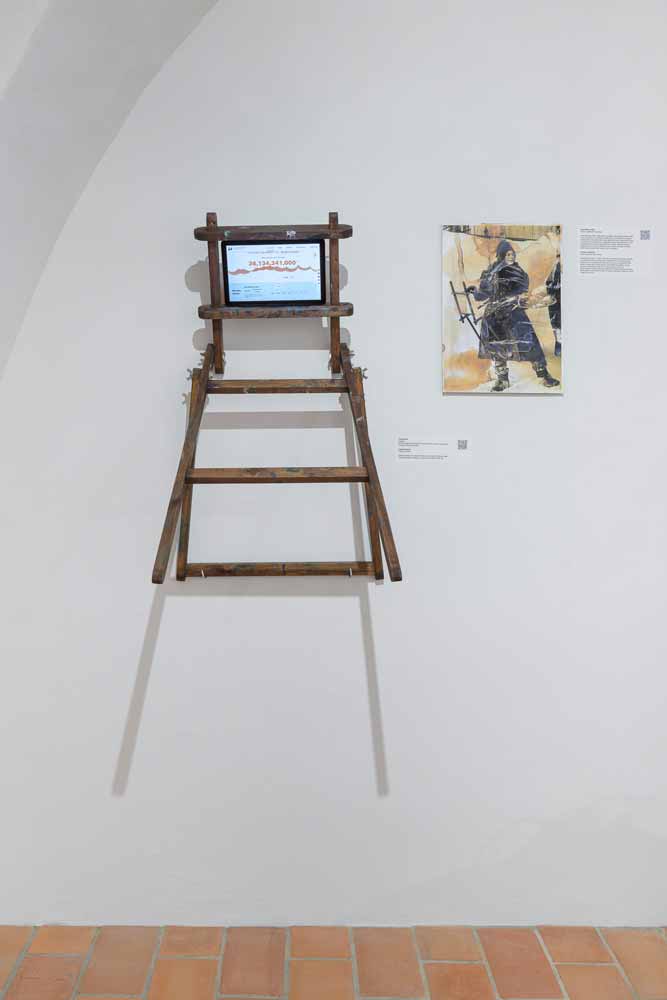
Supported by: GLOCAL EQUALITY AND HOSPITALITY (invalidated ideas?),
Photographer: _isonative © Trenčín 2026
object, wood, metal, 4 x 6 x 1 cm
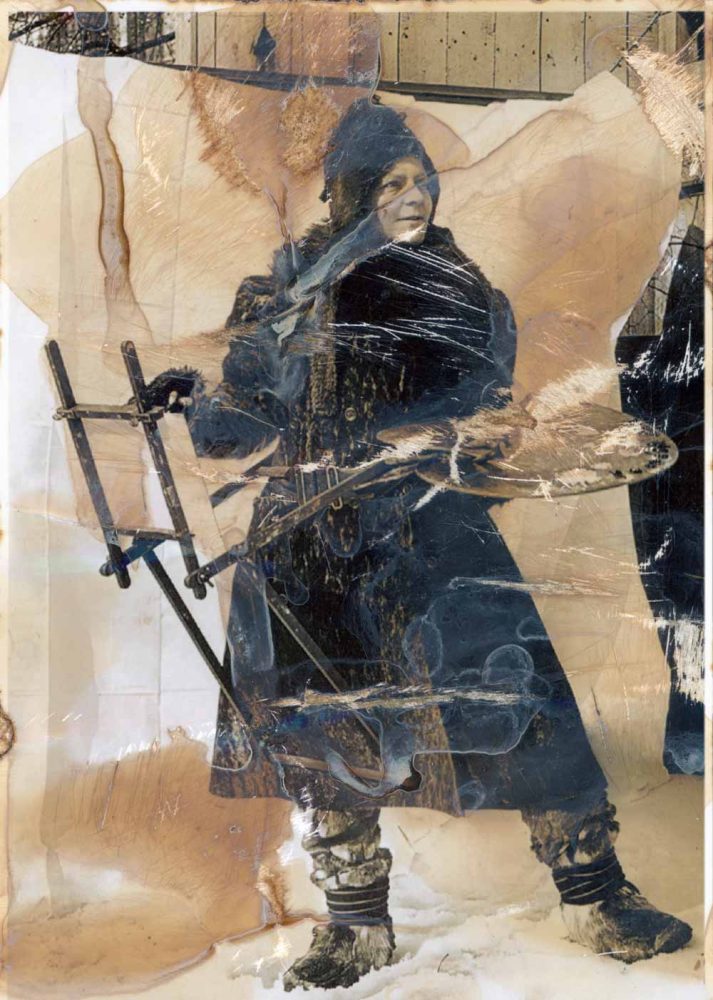
digital print on dibond, 29,7 x 42 cm
Anna Boberg (1864–1935) was a versatile, self-taught Swedish artist most famous for her dramatic oil paintings of the Arctic landscapes and glaciers. She has joined many alpine and arctic expeditions documenting the landscapes as an expedition artist. Her depictions of arctic landscapes as „polar researcher“ are highly valued by climate researchers as precise, historical visual records to study the early20th-century extent and retreat of Arctic glaciers.
(Thanks to Mur Samson Elek for easel reconstruction)
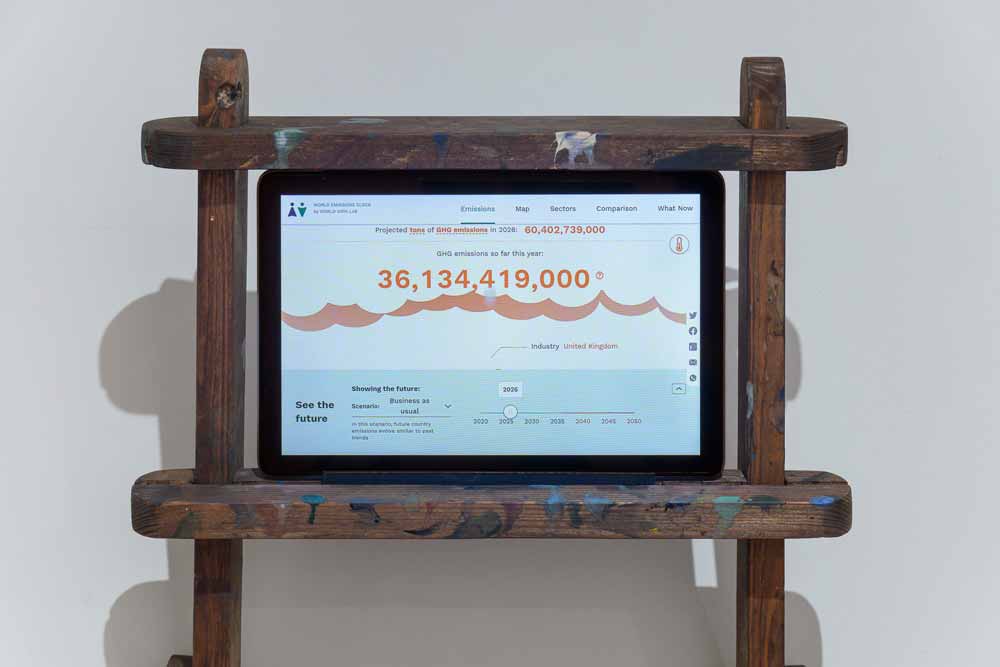
OpenAI. (2026). ChatGPT (GPT-5.6) [Large language model]. See prompts at the end
Expedition Artist
Anna Boberg, field witnessing, war reportage, feminist polar histories and the visual archive of ice
Scope: The changing role of artists in scientific, imperial, polar and military field operations from the eighteenth to the twenty-first century; Anna Boberg’s Arctic practice from 1901; the evidentiary use of glacier imagery; the relation between expedition art and war correspondence; and feminist, decolonial and ecofeminist interpretations.
Abstract
The expedition artist was never a single profession. Across botanical surveys, naval voyages, polar journeys and military campaigns, artists produced portable evidence: specimens translated into images, coastlines made legible, distant landscapes staged for metropolitan audiences and conflict converted into eyewitness news. Anna Boberg belongs to this history through repeated field journeys to Arctic Norway after 1901, where she painted Lofoten and glaciers including Engabreen and Øksfjordjøkelen, sometimes travelling with Ferdinand Boberg and often working independently. Current scholarship does not establish that she held a formal expedition appointment, joined numerous scientific expeditions, or that climate researchers already use her paintings as precise quantitative records. It instead identifies her works as promising environmental evidence whose dates, viewpoints, topography and artistic licence require validation. The report compares Boberg’s embodied field practice with Louise Arner Boyd’s scientifically integrated photography and with war artists from William Simpson and Roger Fenton to Paul Nash and Lee Miller. A feminist and ecofeminist reading reveals both Boberg’s disruption of masculine polar heroism and the limits of a white European gaze that largely excluded Sámi presence. Within The Sunshine Find, the object links panoramic looking, glacial archives, militarised witnessing and situated environmental knowledge.
Project links and cross-references: Exhibition objects · Supporting archive · The Sunshine Find project
Contents
1. Defining the expedition artist
2. Historical genealogy: visual labour in exploration
3. Anna Boberg: Arctic field practice and evidentiary limits
4. Glacier images as environmental evidence
5. Expedition art and war correspondence
6. A feminist expeditionary and glaciological line
7. Ecofeminist and ecocritical perspectives
Primary / institutional evidence links
Numbered academic reference list
Appendix: User prompts
1. Defining the expedition artist
The expression ‘expedition artist’ is useful precisely because it gathers together roles that institutions historically named differently. On an eighteenth-century botanical expedition, visual practitioners prepared taxonomically legible plant images. On naval voyages they recorded coastlines, peoples, weather and events. In polar travel they combined topography, natural history, narrative illustration and later photography or film. In military campaigns, the ‘special artist’ supplied illustrated newspapers with sketches that engravers converted into reproducible news, while official war artists worked under state patronage and censorship. The common feature was not a medium or employer but a chain of field presence, selection, translation and circulation.
Field presence | The image is made from travel to, or sustained observation within, a geographically or politically restricted field site. |
Logistical dependence | Transport, guides, ships, military access, scientific instruments, tourism routes or patronage structure what can be seen and recorded. |
Evidentiary claim | The work is received not only as art but as testimony, topography, natural-history documentation, strategic information or visual proof. |
Mediation | Sketches, paintings, photographs and notes are edited, engraved, exhibited, archived or published for audiences who did not share the journey. |
Power relation | The image may serve science and public memory, but can also support imperial classification, territorial possession, military authority or tourist consumption. |
Academic source links: Visible Empire | European Vision and the South Pacific
References: [3]; [4].
This definition prevents two opposite errors. It avoids romanticising the artist as a free witness outside institutional power, and it avoids reducing every field image to propaganda. Expeditionary pictures can simultaneously carry observation, aesthetic convention, commercial expectation and political hierarchy. Their historical value therefore depends on reconstructing the conditions of production as carefully as the scene represented.
2. Historical genealogy: visual labour in exploration
European expedition art developed within older practices of natural-history collection, maritime reconnaissance and imperial survey. Daniela Bleichmar’s study of Spanish botanical expeditions shows that images were active instruments of empire: they stabilised specimens, enabled comparison across distance and made colonial nature administratively visible. Bernard Smith’s account of Pacific voyage art similarly demonstrates that artists such as William Hodges and John Webber did more than illustrate discovery. Their images translated unfamiliar environments into European pictorial languages of the picturesque and sublime, influencing what exploration appeared to reveal.
Example | Visual and institutional function |
Spanish botanical expeditions, late eighteenth century | Large teams of illustrators converted collected plants into standardised visual knowledge. Their labour linked taxonomy, commerce, imperial administration and metropolitan display. |
William Hodges, Cook’s second Pacific voyage, 1772–75 | Landscape painting combined eyewitness travel with European conventions of atmosphere, sublimity and civilisational comparison. |
John Webber, Cook’s third voyage, 1776–80 | Drawings and later prints became a principal public record of places, encounters and the voyage’s fatal conclusion. |
Alfred T. Agate, United States Exploring Expedition, 1838–42 | A designated expedition artist produced portraits, ethnographic scenes, natural-history studies and topographical images within a state survey. |
Edward Adrian Wilson, British Antarctic expeditions, 1901–04 and 1910–12 | Watercolour, zoological observation and expedition narrative remained tightly connected; artistic skill served scientific description and public memory. |
Louise Arner Boyd, Greenland expeditions, 1920s–1950s | As organiser, photographer and recorder, Boyd integrated high-quality imagery with cartographic and glaciological programmes rather than occupying a subordinate illustrative role. |
Academic source links: Visible Empire | European Vision and the South Pacific | The Queen of the Arctic
References: [3]; [4]; [8], 1–11.
Primary / institutional evidence links: Alfred T. Agate — Smithsonian American Art Museum | Edward Wilson archive, Scott Polar Research Institute
The sequence also reveals a shift in visual authority. Hand drawing was initially indispensable because it could isolate diagnostic details and compose information that a camera could not yet capture. Photography later acquired a reputation for automatic truth, although expedition photographs remained framed, selected, captioned and institutionally circulated. Painting did not simply disappear. It moved towards atmosphere, duration, colour and the subjective experience of place—qualities central to Boberg’s Arctic work—and retained an evidentiary afterlife when images could be matched to known terrain.
3. Anna Boberg: Arctic field practice and evidentiary limits
3.1 A repeated northern practice, not a documented appointment
Anna Boberg (1864–1935) was a Swedish artist, writer and designer who was largely self-taught as a painter. Her first journey to the Lofoten Islands in 1901 initiated approximately three decades of sustained engagement with northern Norway. She returned repeatedly, including during winter, and worked on location in a climate and geography that contemporary culture coded as masculine, heroic and scientifically specialised. Her access was enabled by class, tourism and transport networks, but her practice cannot be reduced to comfortable sightseeing. Photographs show her with easel and equipment close to glacial terrain, while her own account stresses that she frequently remained to work without Ferdinand Boberg and managed the practical demands herself.
Documented field geography | Lofoten and northern Norwegian regions including Nordland, Troms and Finnmark; glacier subjects included Engabreen and Øksfjordjøkelen. |
Working method | Repeated travel, en plein air studies, portable painting materials, photographic documentation, later studio development and exhibition. |
Institutional status | No scholarly source located identifies Boberg as a formally appointed artist on a named scientific or state polar expedition. |
Scientific identity | Boberg jokingly imagined that she offered the appearance of a respectable ‘polar researcher’; scholarship characterises her observations as amateur glaciological insight, not professional glaciology. |
Recommended terminology | Repeated independent Arctic field artist; expeditionary image-maker; artist working in sustained proximity to polar and glacial research cultures. |
Academic source links: A Woman in the Far North | An Arctic Impressionism?
References: [1], 82–96; [2], 90–102.
Primary / institutional evidence links: Anna Boberg, Svenskt kvinnobiografiskt lexikon
3.2 Ice, colour and embodied observation
Boberg’s northern paintings are often structured by unstable light rather than by the panoramic command associated with mapping. Peaks, snowfields and sea are compressed by twilight, storm, moonlight and reflected colour. Her close glacier studies tend to exclude human figures, making ice occupy the whole pictorial field. Yet the absence of people should not be confused with a view from nowhere. The pictures were produced by a particular body carrying materials, choosing positions and enduring weather. Their authority is situated rather than panoptic: they offer proximity, repetition and sensory attention, but do not erase artistic transformation.
This distinction is crucial for the project. Boberg’s work departs from the stable tourist overlook and the carriage window, but it does not escape the infrastructures that made Arctic travel available to privileged visitors. Nor does it automatically become environmentalist. The historical paintings precede contemporary climate politics. Their relevance emerges retrospectively, as glacial retreat changes how viewers read images of snow and ice that were initially exhibited as landscape art.
3.3 The Sámi absence and the limits of a feminist recovery
Recovering Boberg from male-centred polar art history is necessary but insufficient. Gapp contrasts her with women artists such as Anna Nordlander and Emilie Demant Hatt, whose practices engaged Sámi communities more directly. Boberg’s Arctic landscapes generally remove Indigenous presence, labour and land relations from view. Her gender complicated the heroic explorer model, while her whiteness, class position and tourist mobility still situated her within colonial structures of northern representation. A feminist account should therefore neither assimilate her to male conquest narratives nor treat female authorship as automatically decolonial.
Academic source links: A Woman in the Far North | Women in the Arctic
References: [1], 88–95; [6], 182–204.
4. Glacier images as environmental evidence
4.1 From landscape image to proxy record
Historical paintings can extend glacier histories beyond systematic measurement, but they do not become data merely because they show ice. Interdisciplinary glacier research has successfully used dated drawings, paintings, prints, maps and photographs to reconstruct the extent of well-identified Alpine glaciers. The method depends on source criticism: the image must be linked to a specific site and date; the viewpoint and scale must be recoverable; the represented margin must be topographically plausible; and pictorial convention or later alteration must be assessed. Multiple independent images are stronger than a single dramatic composition.
Identification | Can the glacier, valley, landmark and approximate viewpoint be securely located? |
Chronology | Is the field date known, or only the later exhibition or sale date? Was the work revised in the studio? |
Topographic fidelity | Are ice margins, rock forms and relative distances consistent with maps, photographs and terrain? |
Artistic transformation | Do atmospheric effects, compositional compression, colour or omission alter measurable features? |
Corroboration | Can the image be compared with other artworks, photographs, written observations, maps or moraine evidence? |
Use claim | Is the image being used qualitatively to interpret environmental perception, or quantitatively to reconstruct glacier extent? |
Academic source links: 19th Century Glacier Representations and Fluctuations | Non-traditional Data to Inform Modern Climate Science
References: [9], 42–57; [10], article 1518768.
4.2 Boberg’s present evidentiary status
Boberg’s paintings meet several preliminary conditions for environmental study: she worked repeatedly in identifiable northern regions; some photographs document her presence and equipment; and named glacier subjects can be connected to monitored landscapes. They also present difficulties. Titles and dates may refer to finished paintings rather than field studies, atmospheric emphasis can obscure margins, and the corpus has not yet been systematically georeferenced against historical maps and photographs. The strongest peer-reviewed Boberg study explicitly states that the scientific opportunities offered by her glacier images remain to be explored.
Supported claim | Boberg’s glacier paintings and associated photographs form a historically significant visual archive with potential value for interdisciplinary environmental research. |
Unsupported overstatement | Her paintings are already highly valued and routinely used by climate researchers as precise records of early twentieth-century glacier extent and retreat. |
Responsible formulation | Her works may contribute to glacier-history research after source-critical validation; current scholarship identifies this as an unrealised research opportunity rather than an established scientific practice. |
Academic source links: A Woman in the Far North | 19th Century Glacier Representations and Fluctuations
References: [1], 86–96; [9], 42–57.
4.3 Louise Arner Boyd as a methodological contrast
Louise Arner Boyd provides a useful comparison because her photographs, annotations and expedition leadership were explicitly integrated with scientific and cartographic objectives. Boyd organised Arctic voyages, worked with specialists and produced technically high-quality glacier images that could be revisited as records of change. Boberg’s paintings offer different strengths—colour, atmosphere, duration and the embodied experience of looking—but the contrast prevents anachronistically attributing Boyd’s scientific infrastructure to Boberg. Both women unsettled masculine polar authority; only one operated a formal research programme.
Academic source links: The Queen of the Arctic | Women in Glaciology
References: [8], 1–11; [7], 944–964.
5. Expedition art and war correspondence
5.1 Shared infrastructures of the distant eyewitness
Expedition art and war reporting became closely related in the nineteenth century because both answered the same media problem: how could distant, inaccessible and dangerous events be made visible to a mass audience? Steam transport, the telegraph, illustrated newspapers and reproductive engraving created a market for rapid eyewitness images. The ‘special artist’ travelled with armies or followed campaigns, sent sketches and written explanations to editors, and relied on engravers to convert field marks into printable scenes. Like the expedition artist, the war correspondent combined observation with logistics and institutional access. Unlike most scientific or scenic expeditions, military reporting was shaped by censorship, propaganda, operational secrecy and the immediate suffering of human subjects.
Figure | Relation between field art and war reporting |
William Simpson, Crimean War and Abyssinian campaign | Worked as a field artist whose sketches were transformed into lithographs and illustrated-press images. His career moved directly between military campaign reporting and expeditionary travel. |
Roger Fenton, Crimea, 1855 | Photography intensified the claim of eyewitness truth, but technical limitations, access and selection produced a partial visual war that largely avoided combat itself. |
Muirhead Bone and Paul Nash, First World War | Official schemes placed artists inside state systems of access, censorship, commemoration and propaganda. Their works oscillated between record, testimony and symbolic reconstruction. |
Lee Miller, Second World War | An accredited correspondent and photographer whose work for Vogue crossed fashion, surrealism, battlefield reporting and the documentation of liberation and concentration camps. |
Academic source links: The Ultimate Spectacle | Witness to War | Modern Art, Britain and the Great War
References: [16]; [17], 370–384; [19].
Primary / institutional evidence links: William Simpson’s Crimean War, Victoria and Albert Museum | Roger Fenton Crimean War photographs, Library of Congress | Lee Miller: A Woman’s War, Imperial War Museums
5.2 The illustrated press as an expeditionary machine
The Illustrated London News and related periodicals did not merely receive images; they organised a production system. Field sketches, captions and letters were detached from their original context, redrawn for wood engraving, combined with editorial text and placed within national narratives. This process resembles the metropolitan circulation of voyage art and scientific illustration. In both cases, the field witness was only one part of a distributed apparatus that converted distant experience into a coherent page. The apparent immediacy of the finished image could conceal delay, alteration and the institutional interests that authorised the journey.
Academic source links: Dynamics of the Pictured Page | Witness to War
References: [18]; [17], 370–384.
5.3 Boberg and the boundary of reportage
Boberg was not a war correspondent, and no evidence located for this report places her within a military reporting institution. The connection is methodological rather than biographical. Her glacier photographs have been described as a form of photographic reportage because they document the artist’s bodily presence and working conditions. From 1915 she also travelled through Sweden with Ferdinand Boberg in the Svenska Bilder heritage project: he drew buildings considered threatened by modernisation, while she prepared descriptive texts. This was a preservation survey, not war news, yet it shared the expeditionary logic of serial fieldwork, portable recording and the rescue of a disappearing material world.
The comparison clarifies what war reporting adds to the project. A glacier landscape can be rendered as a remote spectacle, a scientific archive or an operational theatre. The shift does not require Boberg to have witnessed war. It reveals how visual authority changes when terrain is placed under military, scientific or climatic emergency, and how the artist’s claim to have been there is mobilised by different institutions.
Academic source links: A Woman in the Far North | Modern Art, Britain and the Great War
References: [1], 86–93; [19].
Primary / institutional evidence links: Anna Boberg, Svenskt kvinnobiografiskt lexikon
6. A feminist expeditionary and glaciological line
6.1 Access, attribution and the heroic model
Women’s participation in alpine, polar and glaciological work is as old as the discipline, but access to education, societies, ships, field stations, funding and publication was systematically restricted. Histories centred on a succession of heroic male explorers can make women visible only as exceptional intruders. Feminist scholarship instead asks how institutions defined legitimate fieldwork, who performed uncredited observation and logistical labour, and why certain forms of knowledge—travel writing, photography, illustration, local testimony—were separated from authoritative science.
Person / programme | Feminist significance |
Elizabeth Main / Lady Aubrey Le Blond | Mountaineer, photographer and first president of the Ladies’ Alpine Club. Her northern photographs and notes later enabled comparison of historic glacier behaviour. |
Ida Ogilvie | Geologist whose work and field experience belong to an early generation of women entering glacial and geomorphological research despite restricted professional access. |
Ebba Hult de Geer | Swedish geochronologist and geologist whose research extended varve chronology and glacial history within a field still structured by gendered institutions. |
Louise Arner Boyd | Shifted from wealthy traveller to expedition organiser, photographer and scientific patron, controlling resources and research agendas rather than merely accompanying male leadership. |
Anna Boberg | Claimed autonomous artistic field practice without institutional scientific authority; her career demonstrates that embodied observation can sit between landscape art, travel and glaciological culture. |
Girls on Ice Austria, 2021 | A contemporary all-female expedition combined glacier science, mountaineering, art and theatre to develop confidence and plural forms of environmental knowledge. |
Academic source links: Women in Glaciology | A Woman in the Far North | The Queen of the Arctic | Glaciers Are for Girls
References: [7], 944–964; [1], 82–96; [8], 1–11; [20], 1–6.
6.2 From adding women to changing the knowledge system
A feminist history does more than add neglected names to an unchanged canon. Carey and colleagues’ feminist glaciology framework asks four connected questions: who produces glacier knowledge; how science and its categories are gendered; how colonial, military and institutional power structures research; and which alternative representations of glaciers are excluded. Boberg’s case is useful because it resists a simple opposition between objective science and subjective art. Her paintings are partial, located and aesthetically transformed, yet scientific photographs and maps are also produced through particular instruments, access regimes and research priorities.
Academic source links: Glaciers, Gender, and Science | Situated Knowledges
References: [11], 770–793; [23], 575–599.
6.3 Indigenous knowledge and the social life of glaciers
The category ‘expedition’ often begins with the arrival of an outsider and thereby erases people whose knowledge of ice, weather, routes and danger precedes the expedition. Julie Cruikshank’s work in the Yukon shows that glaciers can be understood through Indigenous narratives not as passive scenery but as responsive beings embedded in moral and social relations. Such knowledge cannot be treated as decorative cultural context for technoscience. It challenges the division between an active observer and an inert object and exposes the colonial assumption that territory becomes known only when mapped by an expedition.
Academic source links: Do Glaciers Listen? | Glaciers, Gender, and Science
References: [12]; [11], 770–793.
7. Ecofeminist and ecocritical perspectives
7.1 Boberg was not an ecofeminist
Ecofeminism emerged decades after Boberg’s principal Arctic work. Calling her an ecofeminist would therefore confuse a contemporary interpretive framework with a historical identity. The productive question is not whether a woman painting glaciers is naturally closer to nature. That essentialist assumption repeats the very hierarchy ecofeminist scholarship has criticised: men aligned with reason and culture, women aligned with body and nature. A critical ecofeminist reading instead examines how gendered domination, extractive attitudes and the treatment of nonhuman environments as passive matter are historically connected.
Academic source links: Feminism and the Mastery of Nature | Ecofeminism Revisited
References: [21]; [22], 26–53.
7.2 The double position of the glacier image
A glacier painting can participate in mastery by presenting frozen terrain as empty, available and visually possessed. It can also interrupt mastery by recording instability, scale, opacity and the limits of human control. Boberg’s close views often deny the spectator an easy route through the landscape; ice becomes a material presence rather than a distant decorative summit. Yet the absence of Sámi life and the conversion of northern terrain into works for southern exhibitions remain part of the same image. Ecocritical interpretation must hold these positions together rather than assigning the painting a single environmental virtue.
The concept of situated knowledge offers a precise bridge between art and science. It rejects both the fantasy of an all-seeing, disembodied observer and the claim that all perspectives are equally adequate. Boberg’s viewpoint matters because it is embodied, gendered and historically specific; its limitations matter for the same reason. A scientifically useful reading would not strip the work of subjectivity. It would document the conditions under which that subjectivity encountered a measurable glacier.
Academic source links: Situated Knowledges | Glaciers, Gender, and Science | Artistic Visions of the Anthropocene North
References: [23], 575–599; [11], 770–793; [14].
7.3 From sublime commodity to threatened archive
Arctic and Alpine art helped make ice culturally legible as sublime spectacle, national landscape and tourist destination. Climate change has not erased these meanings; it has layered a new evidentiary demand onto them. The same glacier can now function as an attraction, a lost baseline, a scientific indicator and a symbol of planetary crisis. Ecofeminist and postcolonial approaches warn that this transition can still privilege distant spectators while marginalising communities living with altered water, travel and hazard. The challenge is to convert visual attention into accountable relations rather than merely producing a more urgent spectacle.
Academic source links: Narratives and Counter-Narratives of Climate Change | Artistic Visions of the Anthropocene North | Ecocriticism and the Anthropocene in Nineteenth-Century Art
References: [13], 237–255; [14]; [15].
Primary / institutional evidence links
These records support exact biographical, collection and professional details. They are not included in the numbered academic bibliography.
· Anna Boberg — Svenskt kvinnobiografiskt lexikon
· Alfred T. Agate — Smithsonian American Art Museum
· Edward Adrian Wilson archive — Scott Polar Research Institute
· William Simpson’s Crimean War — Victoria and Albert Museum
· Roger Fenton Crimean War photographs — Library of Congress
· Lee Miller: A Woman’s War — Imperial War Museums
Numbered academic reference list
Chicago bibliography style. The numbered list contains only peer-reviewed journal articles, scholarly books and academic chapters.
1. Gapp, Isabelle. “A Woman in the Far North: Anna Boberg and the Norwegian Glacial Landscape.” Kunst og Kultur 104, no. 2 (2021): 82–96. Persistent link.
2. Gapp, Isabelle. “An Arctic Impressionism? Anna Boberg and the Lofoten Islands.” In Mapping Impressionist Painting in Transnational Contexts, edited by Emily C. Burns and Alice M. Rudy Price, 90–102. New York: Routledge, 2021. Persistent link.
3. Bleichmar, Daniela. Visible Empire: Botanical Expeditions and Visual Culture in the Hispanic Enlightenment. Chicago: University of Chicago Press, 2012.
4. Smith, Bernard. European Vision and the South Pacific, 1768–1850: A Study in the History of Art and Ideas. 2nd ed. New Haven, CT: Yale University Press, 1985.
5. Bloom, Lisa. Gender on Ice: American Ideologies of Polar Expeditions. Minneapolis: University of Minnesota Press, 1993.
6. Reeploeg, Silke. “Women in the Arctic: Gendering Coloniality in Travel Narratives from the Far North, 1907–1930.” Scandinavian Studies 91, nos. 1–2 (2019): 182–204. Persistent link.
7. Hulbe, Christina L., Weili Wang, and Simon Ommanney. “Women in Glaciology, a Historical Perspective.” Journal of Glaciology 56, no. 200 (2010): 944–964. Persistent link.
8. Isaksson, Elisabeth, and Anka Ryall. “The Queen of the Arctic: Louise Arner Boyd.” Polar Research 42 (2023): article 9075, 1–11. Persistent link.
9. Zumbühl, Heinz J., Daniel Steiner, and Samuel U. Nussbaumer. “19th Century Glacier Representations and Fluctuations in the Central and Western European Alps: An Interdisciplinary Approach.” Global and Planetary Change 60, nos. 1–2 (2008): 42–57. Persistent link.
10. Miner, Kimberley R., E. Wong, Bradley A. Gay, and Charles E. Miller. “Non-traditional Data to Inform Modern Climate Science.” Frontiers in Communication 10 (2025): article 1518768. Persistent link.
11. Carey, Mark, M Jackson, Alessandro Antonello, and Jaclyn Rushing. “Glaciers, Gender, and Science: A Feminist Glaciology Framework for Global Environmental Change Research.” Progress in Human Geography 40, no. 6 (2016): 770–793. Persistent link.
12. Cruikshank, Julie. Do Glaciers Listen? Local Knowledge, Colonial Encounters, and Social Imagination. Vancouver: UBC Press, 2005.
13. Sörlin, Sverker. “Narratives and Counter-Narratives of Climate Change: North Atlantic Glaciology and Meteorology, c. 1930–1955.” Journal of Historical Geography 35, no. 2 (2009): 237–255. Persistent link.
14. Hedin, Gry, and Ann-Sofie N. Gremaud, eds. Artistic Visions of the Anthropocene North: Climate Change and Nature in Art. New York: Routledge, 2018. Persistent link.
15. Coughlin, Maura, and Emily Gephart, eds. Ecocriticism and the Anthropocene in Nineteenth-Century Art and Visual Culture. New York: Routledge, 2020. Persistent link.
16. Keller, Ulrich. The Ultimate Spectacle: A Visual History of the Crimean War. Australia: Gordon and Breach, 2001.
17. Gervais, Thierry. “Witness to War: The Uses of Photography in the Illustrated Press, 1855–1904.” Journal of Visual Culture 9, no. 3 (2010): 370–384. Persistent link.
18. Sinnema, Peter W. Dynamics of the Pictured Page: Representing the Nation in the Illustrated London News. Aldershot: Ashgate, 1998.
19. Malvern, Sue. Modern Art, Britain and the Great War: Witnessing, Testimony and Remembrance. New Haven, CT: Yale University Press for the Paul Mellon Centre for Studies in British Art, 2004.
20. Lodes, Emma B. “Glaciers Are for Girls: The Inaugural Expedition of Girls on Ice Austria Succeeded in Empowering Nine Young Women in August 2021.” Polarforschung 90 (2022): 1–6. Persistent link.
21. Plumwood, Val. Feminism and the Mastery of Nature. London: Routledge, 1993.
22. Gaard, Greta. “Ecofeminism Revisited: Rejecting Essentialism and Re-Placing Species in a Material Feminist Environmentalism.” Feminist Formations 23, no. 2 (2011): 26–53. Persistent link.
23. Haraway, Donna. “Situated Knowledges: The Science Question in Feminism and the Privilege of Partial Perspective.” Feminist Studies 14, no. 3 (1988): 575–599. Persistent link.
Appendix: User prompts related to this report
1. Initial research request
Prepare an English-language description of the topic ‘Expedition Artist’. Research its historical development through named participants and concrete examples, with particular emphasis on Anna Boberg. Treat the exhibition element as an object, digital print and drawing. Investigate the supplied account of Boberg as a versatile, largely self-taught Swedish artist known for Arctic landscapes and glaciers, and assess the claim that she participated in multiple Alpine and Arctic expeditions as an expedition artist and that climate researchers use her images as precise historical records of early twentieth-century glacier extent and retreat. Follow the project’s established criteria and return the result as an English DOCX. Begin with an abstract of no more than 200 words; reproduce all topic-related prompts at the end; use valid peer-reviewed academic sources in a numbered Chicago bibliography; preserve a unified narrative and typographic structure; and ensure external website links open in a new tab through the project’s publication workflow.
2. Requested expansion
Expand the Expedition Artist report by adding the history and perspective of war correspondents and war artists.
3. Consolidated and directed research brief
Develop the report into a source-critical history of expeditionary image-making. Include concrete artists and institutional examples; place Anna Boberg at the centre while correcting unsupported claims. Research the relationship between expedition art and war correspondence, including artists who produced visual reporting from military campaigns, and connect that comparison carefully to Boberg without claiming that she was a war correspondent. Add a distinct feminist genealogy of expeditionary practice, women in glaciology and glacier art, and an ecofeminist interpretation.
2. General remarks:
1. I have been asking you to create individual reports on different topics.
2. Nonetheless these materials should converge into a unity which is the archive itself and the supporting physical installation. This convergence should be based on a synthesys of all of my other topics, questions and criteria raised in all of the other chat sessions, which are all part of the same project the main scope of which is an art installation and a supporting archive that grows by time. The archive is meant for both professional and nonprofessional use, it should be informative within its artistic and pedagogical scope as well.
3. the main line of thoughts of the project departs from panoptic tourism and concludes to ecoterrorism in a narrative line. Therefore all the reports should follow this general direction in their approach and references.
4. The reports we are working on now will all serve as a background research material published on the project website for the set of objects that will be on display, Each object will have its own page (see: https://glacial-archaeology.net/category/exhibition/). See: Szabolcs KissPál – The sunshine find_for translation. I am also adding the brief description of the project’s general concept, see: Szabolcs KissPál – The sunshine find. The website will have a separate but interconnected section for both the exhibition and the supporting archive. https://glacial-archaeology.net/an-archive-of-narratives-on-global-warming-copy/ Inspect the site while note that it doesn’t have its final structure yet!
5. the scope with the reports is to produce a set of background research material for each object in part that should refer to each other, and should be unified in their narrative and typographic structure, tone, and scope. Pay attention to snychronise the focus points of different partial research tasks when possible with cross references!
6. I am attaching two of your previous reports (noahs_ark_expeditions_1959_1990_academic_sources_new_tab_links.docx, Container_Mount_Scorluzzo_WWI_Shelter_Research_Report). Please develop and and apply to these reports a uniform structure both content wise and in formal aspects while mostly keeping their original content.
7. Main further formal criteria:
– you should always start with an abstract summarizing your finds in a text no longer than 200 words.
– you should always enlist at the very end of the document all my prompts related to that topic
– the external links should always open in a different tab
– you should be using only valid, peer reviewed academic sources listed and numbered at the end of the documents
– you should apply a somewhat unified narrative structured and a unified formatting (including typeface styles, subtitles structure, etc.
8. – note and memorise the above in your cross-chat memory for rurther tasks