Gaze
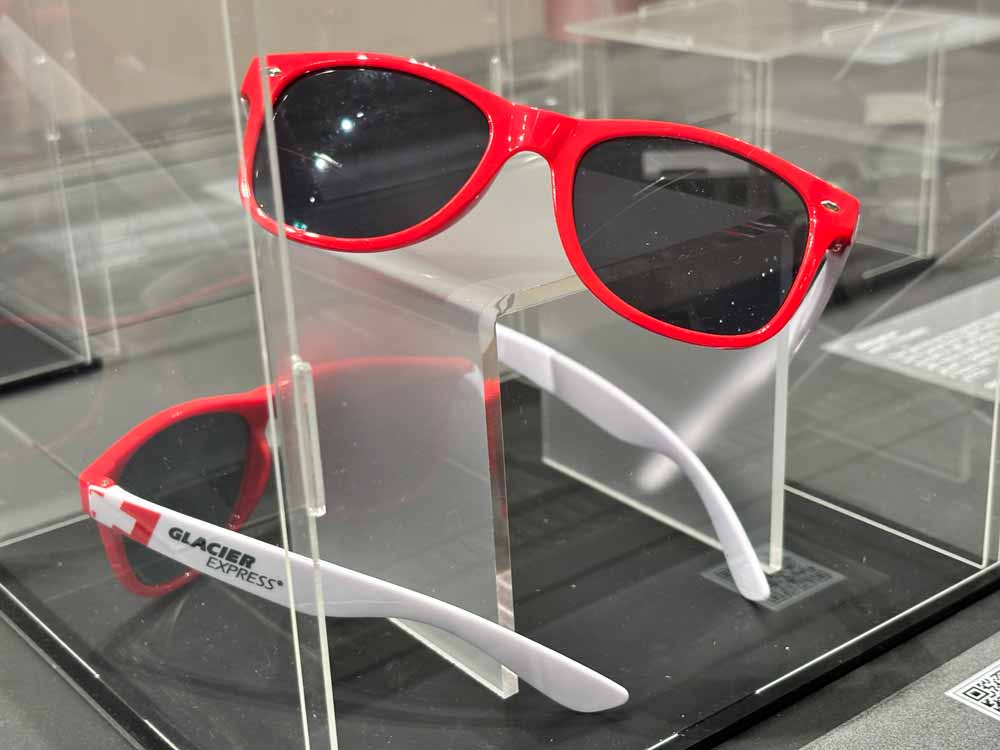
object, plastic, metal, 15 x 20 x 4 cm
OpenAI. (2026). ChatGPT (GPT-5.6) [Large language model]. See prompts at the end
Glacier Express Sunglasses (GEX-060)
Branded alpine vision: merchandise genealogy, glacier eyewear and the tourist gaze
Scope: The red Glacier Express sunglasses sold as article GEX-060; the documented ownership, merchandising and distribution chain of the object; the history of sunglasses and protective glacier eyewear; selected high-mountain accessories; and a concise genealogy of gaze theories relevant to panoramic rail tourism. The report does not attribute a manufacturer, designer, country of manufacture or launch date where no public evidence was located.
Abstract
The Glacier Express sunglasses are a low-cost, red, logo-bearing souvenir sold through both the RhB and Glacier Express web shops and, from at least 2024, aboard the train. Glacier Express AG—the brand company created in 2017 and owned equally by the Rhaetian Railway and Matterhorn Gotthard Railway—is the client behind the dedicated shop, while Pandinavia AG currently provides merchandising and fulfilment. Public records do not disclose the object’s factory, designer, material, batch size or first production date. The product’s UV 400 claim links it to eye protection, but the listing supplies none of the filter-category, transmission, side-shield or performance information needed to identify it as technical glacier eyewear. Historically, such eyewear developed from Arctic snow goggles and nineteenth-century protective optics into purpose-built Alpine glasses for crystal hunters and, by 1950, Julbo’s Vermont model. GEX-060 converts that protective genealogy into a souvenir of panoramic consumption: its copy promises the “best view” of Swiss landmarks. Read through optical modernity, panopticism, psychoanalytic and gendered gaze theory, and the tourist gaze, the glasses literalise how scenic transport selects, frames, commodifies and remembers the Alps.
Project links and cross-references: Glacier Express object and maquette · Gaze object · Tag! train-door fragment · Edelweiss souvenir objects · Supporting archive
Contents
1. Object identification and production genealogy
2. Merchandise, distribution and promotional Swissness
3. From snow goggles to glacier glasses: an alpine accessory history
4. Gaze theories and the construction of panoptic tourism
5. Interpretive synthesis: a portable panoramic apparatus
6. Primary and institutional evidence
7. Numbered academic reference list
Appendix: User prompts
1. Object identification and production genealogy
GEX-060 is best understood as licensed or commissioned railway merchandise rather than as a documented product of an eyewear manufacturer. The official listing foregrounds colour, logo, fashionability, landmark recognition and “UV 400”; it does not identify a maker, designer, country of origin, frame material or compliance class.
Field | Documented information |
Object / article | Red sunglasses labelled “Glacier Express”; article GEX-060. |
Current retail position | CHF 13.85 online; listed as in stock on 26 July 2026. Official onboard menus list sunglasses at CHF 15. |
Brand / commercial client | Glacier Express AG for the dedicated Glacier Express Shop; Rhätische Bahn AG for the RhB Shop. |
Brand-company ownership | Glacier Express AG, founded 23 August 2017; 50% RhB and 50% Matterhorn Gotthard Railway. |
Current merchandising operator | Pandinavia AG, Kloten: shop service provider, fulfilment contact and current stock/distribution operator. |
Published specification | “Trendy design”; UV 400; no published lens category, visible-light transmission, polarisation, side protection or technical mountain-sport certification. |
Unverified / undisclosed | Factory, designer, manufacturing country, materials, production volume, procurement date and exact launch date. |
Primary / institutional evidence links: RhB product page | Glacier Express Shop imprint | Glacier Express company history | Pandinavia fulfilment model
1.1 Documented genealogy and limits
Date / period | Documented development |
1930 | The predecessor railways and RhB establish the Glacier Express tourist offer. This creates the brand and route later extended into merchandise. |
End of 2016 | An official Glacier Express history records the launch of a new glacierexpress.ch web shop for easier booking. This documents digital commercial reorganisation, not yet the sunglasses. |
23 Aug. 2017 | RhB and Matterhorn Gotthard Railway create Glacier Express AG, each holding 50%. The stated purpose is unified market positioning and adaptation to digital and social-media travel behaviour. |
21 Jan. 2021 | The dated RhB Shop terms still name an earlier fulfilment address. This indicates that shop operations have changed over time, but does not date GEX-060. |
By 2024 | The earliest dated official evidence located for the sunglasses: Glacier Express onboard menus list “Sunglasses” among souvenirs at CHF 15; the dedicated e-shop also carries GEX-060. |
2025–26 | Winter and annual menus continue onboard sales. The glasses remain part of a stable souvenir range that includes cap GEX-059, magnet GEX-061, snow globe, mug, pocket knife and postcard. |
26 July 2026 | Both the RhB and Glacier Express shops list GEX-060 at CHF 13.85 and in stock; Pandinavia is the current service provider and fulfilment contact. |
Research conclusion: the available evidence supports a distribution history from at least 2024 to 2026, not an exact production start. The 2017 corporate reorganisation created the unified brand structure within which the object now circulates, but it is not evidence that the glasses were launched in 2017.
Primary / institutional evidence links: RhB founding announcement, 2017 | Glacier Express 2024–25 menu | Glacier Express 2026 menu | Current souvenir range
2. Merchandise, distribution and promotional Swissness
The glasses belong to a deliberately mixed merchandise ecology. Inexpensive memory objects—postcard, magnet, cap, mug and snow globe—sit beside a Swiss pocket knife and a Caran d’Ache pen. This range lets the railway brand migrate from a purchased journey into the home, wardrobe and body. Pandinavia’s published service model describes the outsourced chain—concept, range, production, quality assurance, storage, distribution and e-shop—while stating that the customer retains decision-making power. It therefore clarifies the likely organisational structure, but does not prove that Pandinavia physically manufactured GEX-060.
Promotional register | Evidence and interpretation |
Panoramic promise | The product copy says the glasses give the “best view” of the Landwasser Viaduct, Rhine Gorge and Matterhorn—the same landmarks consumed through the train’s ceiling-high windows. |
Swissness | Glacier Express describes its trains as offering a “Swissness factor” and a free view of Swiss sights; the shop calls itself “The window to the Swiss Alps”. The red frame visually echoes the train and Swiss national colour, although no official source assigns that symbolism to GEX-060. |
Journey-to-souvenir conversion | Onboard menus place the sunglasses under “Glacier Express souvenirs”, embedding purchase within the journey. The object can be worn while viewing, then retained as proof and mnemonic of the view. |
Alpine-sport adjacency | The same merchandise series presents the red-and-white cap as a companion for hiking. GEX-060 is promoted through Alpine looking rather than through a named athlete, race, climbing expedition or technical sport certification. |
Search result / gap | No independently documented advertising campaign, influencer collaboration, athlete endorsement or event sponsorship specifically featuring GEX-060 was located. Its promotional use is principally product-page copy, onboard retail and the larger Glacier Express brand system. |
Primary / institutional evidence links: Glacier Express shop home | Glacier Express “Swissness factor” | Glacier Express cap / hiking copy | Caran d’Ache “piece of Switzerland”
Academic source links: Cool Shades: The History and Meaning of Sunglasses | The Summits of Modern Man | Apostles of the Alps
References: [1], chaps. 2–8; [2], passim; [3], passim.
3. From snow goggles to glacier glasses: an alpine accessory history
Protective mountain eyewear did not begin with modern European sunglasses. Arctic peoples developed slit snow goggles from bone, antler or wood to reduce intense reflected light and wind exposure. European tinted spectacles had eighteenth-century optical and therapeutic uses, but sunglasses became a mass modern accessory only in the twentieth century. In Alpine culture, eye protection entered a broader equipment system that converted high mountains from exceptional expedition terrain into repeatable recreational space.
Period | Development and relation to mountain culture |
Before modern Alpine sport | Inuit and other Arctic snow goggles use narrow apertures rather than tinted lenses. Museum collections preserve archaeological and early twentieth-century examples; their history prevents a purely European invention narrative. |
Mid-19th century | The “golden age” of Alpine climbing consolidates the guide, rope, nailed boot, alpenstock/ice axe and later mountain hut. Equipment, maps and routes make danger more governable while national and bourgeois cultures claim the summit. |
1888 / early 20th century | Jules Baud establishes an optical business in Morez. Julbo’s institutional history dates its first “Cristallier” glasses to the early twentieth century, made at the request of Chamonix crystal hunters. |
1908–09 | Oscar Eckenstein’s ten-point crampon, manufactured by Henry Grivel, reduces dependence on laborious step-cutting. Like protective eyewear, it reorganises bodily contact with ice through a specialised interface. |
1950 | Julbo dates the Vermont as its first glacier sunglasses. Round lenses, side shields and secure temples became an iconic high-altitude form during the post-war age of Himalayan expeditions. |
20th century mass culture | Sunglasses pass from medical, industrial, military and sporting protection into celebrity, speed, glamour and “cool”. Technical mountain models and fashion models increasingly borrow each other’s appearance. |
GEX-060 today | The souvenir inherits the cultural prestige of Alpine protection but is documented only as red, branded, fashionable and UV 400. Without filter-category and coverage data, it cannot be equated with technical glacier glasses. |
3.1 Protection in special visual conditions
Snow-covered high-altitude sites produce unusually strong ultraviolet exposure because altitude shortens the atmospheric path while snow reflects radiation back toward the body. Peer-reviewed Alpine measurements identify the eyes as critical targets and recommend sunglasses alongside other protection. Photokeratitis—often called snow blindness—is an acute, painful UV injury of the cornea and conjunctiva. Technical glacier eyewear therefore combines spectral filtration with very dark visible-light filtering, secure fit and lateral coverage. “UV 400” describes an advertised wavelength cut-off; by itself it does not disclose visible-light transmission or protection against peripheral glare.
Academic source links: Personal UV exposure in high albedo alpine sites | Photokeratitis induced by ultraviolet radiation in travellers | Cool Shades
References: [4], 3749–3760; [5], 40–46; [1], chaps. 2–4 and timeline.
Primary / institutional evidence links: Julbo legacy: Cristallier and Vermont | Smithsonian snow goggles | NMAI archaeological snow goggles
4. Gaze theories and the construction of panoptic tourism
“Gaze” does not name one theory. It is a family of arguments about how vision is organised, who controls it, how the observer is constituted, and how looking distributes power and desire. The following sequence is selective but sufficient to locate the Glacier Express sunglasses within the project’s panoptic-tourism thesis.
Genealogy | Core proposition |
1791: Bentham—Panopticon | An architectural asymmetry: the observed are permanently visible but cannot know when they are watched. Vision becomes an economical technology of conduct. |
1943: Sartre—“the Look” | The look of another person interrupts sovereign self-possession: the subject discovers itself as an object in another’s world. Looking is reciprocal and potentially shaming, not simply mastery. |
1964/1978: Lacan—the gaze | The gaze is not identical with the eye or conscious look. It names the unsettling point from which the visual field seems to look back, exposing a split between seeing and being seen. |
1972–75: Berger and Mulvey—social and gendered looking | Berger ties visual representation to property, publicity and gendered spectatorship. Mulvey shows how classical cinema aligns camera, narrative and spectator around an active masculine look and a feminised spectacle. |
1975: Foucault—panopticism | Bentham’s design becomes a general diagram of modern discipline: visibility individualises, compares, records and normalises. Power works through internalised possible observation. |
1988–90: Jay and Crary—scopic regimes / observer formation | Jay rejects a single modern way of seeing in favour of competing scopic regimes. Crary shifts attention from images to historically produced observers shaped by optical devices, science and institutions. |
1977/1986: Schivelbusch—railway panorama | Rail speed detaches the passenger from traversed ground and turns the side window into a moving panorama. Landscape is consumed as a sequence of framed visual impressions. |
1990–2011: Urry and Larsen—the tourist gaze | Tourism organises anticipation, routes, photography, architecture and difference. The gaze is socially learned and now understood as embodied, mobile and mediated rather than merely ocular. |
4.1 From panorama to “panoptic tourism”
The Glacier Express is not a surveillance institution, but its panoramic apparatus shares a formal ambition with panoptic systems: to maximise visibility while organising bodies, routes and viewpoints. The passenger is seated, ticketed and carried through a preselected corridor; large windows remove much of the physical labour and risk of entering the mountain; landmarks arrive on schedule as named scenes; photography and souvenirs stabilise them as recognisable possessions. The gaze is simultaneously empowered and constrained.
The GEX-060 glasses intensify this arrangement at bodily scale. They mediate light, hide the wearer’s eyes from others, echo the train’s red branding and promise a superior panorama. Yet Sartre and Lacan complicate any fantasy of complete visual command: the landscape, other passengers, cameras and commercial systems also “look back”, placing the tourist within an image economy. Berger, Mulvey and Urry further show that scenic vision is learned through publicity, gender, class, technology and repetition rather than produced by an innocent eye.
Academic source links: Discipline and Punish | Visual Pleasure and Narrative Cinema | Techniques of the Observer | Panoramic Travel | The Tourist Gaze 3.0
References: [6], letters I–XXI; [7], 195–228; [8], part III, chap. 1; [9], 67–119; [10], essays 1 and 3; [11], 6–18; [12], 1–24 and 25–66; [13], 52–69; [14], 3–23; [15], chaps. 1, 7 and 8.
6. Primary and institutional evidence
G. Smithsonian Institution / National Museum of the American Indian. Snow-goggle catalogue records.
7. Numbered academic reference list
Chicago bibliography style. Only scholarly books, academic chapters and peer-reviewed articles are numbered below.
11. Mulvey, Laura. “Visual Pleasure and Narrative Cinema.” Screen 16, no. 3 (Autumn 1975): 6–18.
15. Urry, John, and Jonas Larsen. The Tourist Gaze 3.0. 3rd ed. London: SAGE, 2011.
Appendix: User prompts related to this report
Prompts are reproduced chronologically as a research-process record. Spelling and numbering are retained except for line-break normalisation.
1. Make a research on this object:
https://www.rhb-shop.ch/en/glacier-express/sunglasses-glacier-express-1/
2. summarise its production genealogy (ownership, connection to the luxury train Glacier Express’ merchandise items, timeline of their production and distribution).
3. place it in the historical context of sunglasses in general and the glacier sunglasses used for alpine hiking, this latter concieved as an accessory that helps vision in special conditions (when they started to being produced, and how that relates to other objects and accesories that entered the culture of high mountain hiking).
4. search for eventual commercial, promotional usages of these particular sunglasses that might refer to Swissness and alpine sports.
5. Create a structred hystorical account of the various gaze theories, develop in short their interconnection and their possible links to panoptic tourism.
5. compile your report according to the standards and criteria shared with you earlier (keep the maximum lenght of 7 pages)
2. General remarks and new request:
1. I have been asking you to create individual reports on different topics, in this case the train service and model of Glacier Express.
2. Nonetheless these materials should converge into a unity which is the archive itself and the supporting physical installation. This convergence should be based on a synthesys of all of my other topics, questions and criteria raised in all of the other chat sessions, which are all part of the same project the main scope of which is an art installation and a supporting archive that grows by time. The archive is meant for both professional and nonprofessional use, it should be informative within its artistic and pedagogical scope as well.
3. the main line of thoughts of the project departs from panoptic tourism and concludes to ecoterrorism in a narrative line. Therefore all the reports should follow this general direction in their approach and references.
4. The reports we are working on now will all serve as a background research material published on the project website for the set of objects that will be on display, Each object will have its own page (see: https://glacial-archaeology.net/category/exhibition/). See: Szabolcs KissPál – The sunshine find_for translation. I am also adding the brief description of the project’s general concept, see: Szabolcs KissPál – The sunshine find. The website will have a separate but interconnected section for both the exhibition and the supporting archive. https://glacial-archaeology.net/an-archive-of-narratives-on-global-warming-copy/ Inspect the site while note that it doesn’t have its final structure yet!
5. the scope with the reports is to produce a set of background research material for each object in part that should refer to each other, and should be unified in their narrative and typographic structure, tone, and scope. Pay attention to snychronise the focus points of different partial research tasks when possible with cross references!
6. I am attaching two of your previous reports (noahs_ark_expeditions_1959_1990_academic_sources_new_tab_links.docx, Container_Mount_Scorluzzo_WWI_Shelter_Research_Report). Please develop and and apply to these reports a uniform structure both content wise and in formal aspects while mostly keeping their original content.
7. Main further formal criteria:
– you should always start with an abstract summarizing your finds in a text no longer than 200 words.
– you should always enlist at the very end of the document all my prompts related to that topic
– the external links should always open in a different tab
– you should be using only valid, peer reviewed academic sources listed and numbered at the end of the documents
– you should apply a somewhat unified narrative structured and a unified formatting (including typeface styles, subtitles structure, etc.
8. – note and memorise the above in your cross-chat memory for further tasks