Memory
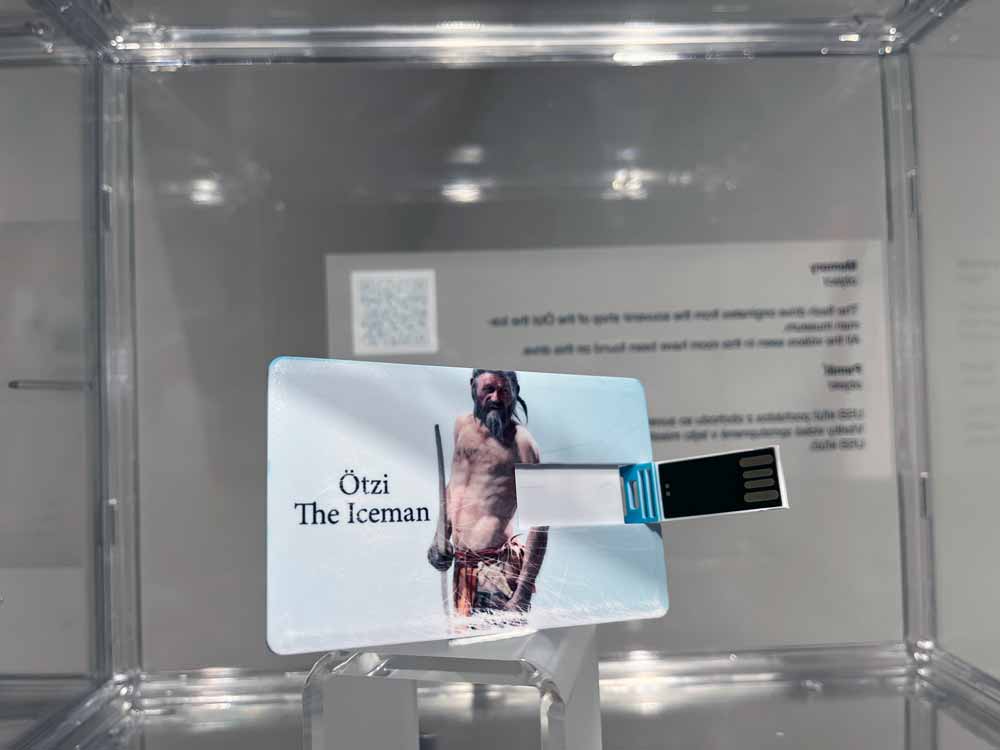
object (flash drive), 8,5 x 5,5 x 0,7
The flash drive originates from the souvenir shop of the Ötzi the Iceman museum.
All the videos seen in this room have been found on this drive.
OpenAI. (2026). ChatGPT (GPT-5.6) [Large language model]. See prompts at the end
Ötzi, glacial archaeology and the carbon cost of data
A museum souvenir that turns a melting-ice discovery into a portable digital archive
Scope: The credit-card-shaped flash drive acquired at the South Tyrol Museum of Archaeology; Ötzi’s discovery and reception; the find’s relation to glacial archaeology; a 1990–2025 climate comparison; and a bounded comparison of data-industry emissions with aviation and cement. Product manufacture, capacity and sales history remain outside the report because no verified packaging or catalogue record was supplied.
Abstract
Memory is a credit-card-shaped USB drive presumably purchased in the South Tyrol Museum of Archaeology, bearing the museum’s forensic reconstruction of Ötzi. In the installation’s parafiction, it contains all moving-image files in the second room. The historical find occurred on 19 September 1991, when hikers Erika and Helmut Simon saw a body protruding from ice at Tisenjoch. Radiocarbon dating identified a Copper Age man more than 5,300 years old. Ötzi did not found glacial archaeology alone—frozen finds were known earlier—but his visibility helped turn scattered discoveries into a recognisable interdisciplinary field. Later research also revised the original ‘sealed time capsule’ narrative: the body probably entered a shallow gully and was covered by stationary snow and ice that could have been repeatedly exposed. The climatic comparison is stark: global mean warming was approximately 0.64°C above 1850–1900 in 1990 and about 1.43°C in 2025. The drive therefore joins archaeological memory to digital infrastructure: data centres currently cause about 0.5% of fuel-combustion CO₂, while broader ICT lifecycle estimates range from 1.4% to 2.8% or higher depending on boundaries.
Project links and cross-references: Project website · Exhibition pages · Supporting archive · Related objects: Necklace; The Random Archive; Notebook; The Cloud Is Not in the Sky!
Contents
1. Object description and the Ötzi find
2. Condensed chronology
3. Ötzi, glacial archaeology and climate change
4. Data-industry emissions in comparison
5. Numbered academic reference list
Appendix: User prompts
1. Object description and the Ötzi find
The object is a flat USB flash drive in the format of a payment card. Its printed face reproduces the museum’s life-size reconstruction of Ötzi, made by palaeo-artists Adrie and Alfons Kennis from CT data, a stereolithographic skull model and forensic modelling. The souvenir therefore does not depict the mummy directly: it circulates a scientifically informed but interpretive image of a possible living face.
Ötzi is a naturally preserved Copper Age man, dated to roughly 5,300 years before present. He was found with clothing and a highly informative equipment assemblage, including a copper-bladed axe, bow, quiver, dagger and containers. The find was first handled as a recent mountaineering death; only after recovery did archaeologists recognise its age. This initial misclassification, and the damage caused by improvised recovery, became a foundational lesson in how rapidly emerging ice finds should be reported, stabilised and excavated.
Academic source links: Sjøvold, “The Stone Age Iceman from the Alps” | Pilø et al., “Ötzi, 30 Years On”
References: [1], 117–124; [2], 112–125.
Primary / institutional evidence links: South Tyrol Museum: reconstruction | South Tyrol Museum: the Iceman
2. Condensed chronology
Date | Documented event and significance |
Late 4th millennium BCE | Ötzi dies near Tisenjoch. Radiocarbon measurements place the remains at 5300–5160 BP; later research identifies a fatal arrow injury. |
19 September 1991 | Erika and Helmut Simon see the upper body protruding from ice at 3,210 m near the Austrian–Italian border. |
20–23 September 1991 | Several recovery attempts are made. The body is freed with ice tools on 23 September without an archaeologist present and transferred to Innsbruck forensic medicine. |
24 September 1991 | Konrad Spindler recognises the archaeological importance and estimates an age of at least 4,000 years. |
25 September–2 October 1991 | Further artefacts are collected; surveying places the find 92.56 m inside Italy. |
July–August 1992 | A systematic archaeological excavation recovers additional material, including Ötzi’s bearskin cap. |
1998 | Ötzi and his equipment go on permanent display at the South Tyrol Museum of Archaeology in Bolzano. |
2022–2023 | A major reassessment argues against the simple ‘sealed beneath a moving glacier for 5,300 years’ model and places the find within normal ice-patch taphonomy. |
Academic source links: Sjøvold, 1992 | Pilø et al., 2023
References: [1], 117–124; [2], 112–125.
Primary / institutional evidence links: Official discovery history | Museum history
3. Ötzi, glacial archaeology and climate change
Ötzi’s discovery was paradigmatic rather than literally the first archaeological object recovered from snow or ice. Earlier finds were known in Norway and Alpine passes, but they had not yet cohered into a widely recognised field. In 1992 archaeologist Werner Meyer predicted a future ‘glacial archaeology’ that would need interdisciplinary and cross-border methods. Ötzi’s global visibility, research intensity and conservation challenges helped make that disciplinary problem legible. From the late 1990s onward, mass melt-outs in the Yukon, Norway and the Alps transformed isolated accidents into systematic survey, monitoring, rescue excavation and predictive modelling.
The find also shows how a young discipline corrects its own founding stories. The older account proposed that Ötzi died in the gully, was rapidly sealed beneath a moving glacier and remained untouched until 1991. The 2023 reassessment instead argues that the body probably rested on spring or early-summer snow above the gully, entered it through later melting, and was covered by a thin, stationary snow-and-ice field frozen to bedrock. It may have been exposed repeatedly over the next 1,500 years. Ötzi remains exceptional in preservation and completeness, but his taphonomy is less unique than first claimed.
Indicator | Around 1990–1991 | Latest complete / current condition |
Global mean temperature | 1990: NASA GISTEMP +0.45°C relative to 1951–1980, approximately +0.64°C relative to 1850–1900 after baseline conversion. | 2025: WMO estimate about +1.43°C relative to 1850–1900; roughly 0.79°C warmer than 1990. |
High-elevation melt context | 1991, the discovery year, was the first substantial mass-loss year in the cited local high-elevation record; an unusually warm summer and Saharan dust aided melt-out. | Losses have intensified over the longer record. Nearby 5,900-year-old Weißseespitze ice was projected in 2020 to disappear within two decades under then-current melt rates. |
Archaeological implication | The body’s exposure was treated largely as a singular accident; climate change was not central to the initial discussion. | Repeated melt creates more finds but also accelerates decay, dispersal and loss, making rapid documentation and recovery essential. |
Academic source links: Pilø et al., 2023 | Rogers, Fischer and Huss, 2014 | Bohleber et al., 2020
References: [2], 112–125; [3], 410–420; [4], article 20513.
Primary / institutional evidence links: NASA GISTEMP data | NASA baseline guidance | WMO State of the Global Climate 2025
4. Data-industry emissions in comparison
‘The data industry’ has no single internationally fixed inventory boundary. A data centre estimate covers operational electricity and may omit server manufacture, buildings, network infrastructure, end-user devices and supply chains. A broader ICT estimate includes more of this lifecycle. The resulting percentages should therefore be presented as a range of definitions rather than one definitive number.
Boundary / sector | Reported global share | What the figure includes |
Data centres: operational electricity | 0.5% of global fuel-combustion CO₂ in 2024 | IEA: about 180 Mt CO₂ from electricity use; backup generation and embodied emissions excluded. |
ICT: broad lifecycle estimate | 1.4% of global GHG in 2020 | Malmodin et al.; user devices, networks and data centres, with lifecycle elements. |
ICT: literature range | 1.8–2.8% of global GHG; potentially 2.1–3.9% | Freitag et al.; higher range adjusts for truncated supply chains. |
Aviation | 3.5% of anthropogenic effective radiative forcing in 2018 | Lee et al.; includes CO₂ and major non-CO₂ effects, so it is not a direct emissions-share comparison. |
Cement | Approximately 7% of anthropogenic CO₂e | Strunge, Renforth and Van der Spek; process emissions make the sector especially difficult to decarbonise. |
The narrowest current measure puts data-centre electricity below aviation and far below cement. The broader ICT footprint is of the same order as aviation’s CO₂-only share, although full aviation warming is larger. The trend matters as much as the present share: data centres used about 415 TWh, or 1.5% of world electricity, in 2024, and the IEA projects around 945 TWh by 2030, with AI the principal growth driver. A small portable drive is therefore not environmentally important because of its stored bytes alone, but because it belongs to a global apparatus of device manufacture, networks, server halls, cooling, electricity generation and repeated playback.
Academic source links: Malmodin et al., 2024 | Freitag et al., 2021 | Lee et al., 2021 | Strunge, Renforth and Van der Spek, 2022
References: [5], article 102701; [6], article 100340; [7], article 117834; [8], article 59.
Primary / institutional evidence links: IEA Energy and AI: climate | IEA Energy and AI: executive summary
5. Numbered academic reference list
Chicago bibliography style. Only verified scholarly sources are included.
1. Sjøvold, Torstein. “The Stone Age Iceman from the Alps: The Find and the Current Status of Investigation.” Evolutionary Anthropology 1, no. 4 (1992): 117–124. DOI
2. Pilø, Lars, Thomas Reitmaier, Andrea Fischer, James H. Barrett, and Atle Nesje. “Ötzi, 30 Years On: A Reappraisal of the Depositional and Post-Depositional History of the Find.” The Holocene 33, no. 1 (2023): 112–125. DOI
3. Rogers, Stephanie R., Mauro Fischer, and Matthias Huss. “Combining Glaciological and Archaeological Methods for Gauging Glacial Archaeological Potential.” Journal of Archaeological Science 52 (2014): 410–420. DOI
4. Bohleber, Pascal, Margit Schwikowski, Martin Stocker-Waldhuber, Ling Fang, and Andrea Fischer. “New Glacier Evidence for Ice-Free Summits during the Life of the Tyrolean Iceman.” Scientific Reports 10 (2020): 20513. DOI
5. Malmodin, Jens, Nina Lövehagen, Pernilla Bergmark, and Dag Lundén. “ICT Sector Electricity Consumption and Greenhouse Gas Emissions – 2020 Outcome.” Telecommunications Policy 48, no. 3 (2024): 102701. DOI
6. Freitag, Charlotte, Mike Berners-Lee, Kelly Widdicks, Bran Knowles, Gordon S. Blair, and Adrian Friday. “The Real Climate and Transformative Impact of ICT: A Critique of Estimates, Trends, and Regulations.” Patterns 2, no. 9 (2021): 100340. DOI
7. Lee, David S., David W. Fahey, Agnieszka Skowron, Myles R. Allen, Ulrike Burkhardt, Qiang Chen, Sarah J. Doherty, et al. “The Contribution of Global Aviation to Anthropogenic Climate Forcing for 2000 to 2018.” Atmospheric Environment 244 (2021): 117834. DOI
8. Strunge, Till, Phil Renforth, and Mijndert Van der Spek. “Towards a Business Case for CO₂ Mineralisation in the Cement Industry.” Communications Earth & Environment 3 (2022): 59. DOI
Appendix: User prompts related to this report
Prompts are reproduced chronologically as a research-process record.
1. Next object description:
object
The flash drive originates from the souvenir shop of the Ötzi the Iceman museum.
All the videos seen in this room have been found on this drive.
The object is a flash drive in the shape of a credit card depicting the reconstructed image of Ötzi.
1. research on Ötzi the Iceman find
2. provide a short description and timeline of the find’s history.
3. analyse its connection to the emergence of glacial archaeology as an academic field and compare the climatic conditions of 1990 with today
4. collect reliable information on data industry’s share on GHG compaer to 1-2 other industry
5. Keep your report within 4 pages
2. General remarks:
1. I have been asking you to create individual reports on different topics.
2. Nonetheless these materials should converge into a unity which is the archive itself and the supporting physical installation. This convergence should be based on a synthesys of all of my other topics, questions and criteria raised in all of the other chat sessions, which are all part of the same project the main scope of which is an art installation and a supporting archive that grows by time. The archive is meant for both professional and nonprofessional use, it should be informative within its artistic and pedagogical scope as well.
3. the main line of thoughts of the project departs from panoptic tourism and concludes to ecoterrorism in a narrative line. Therefore all the reports should follow this general direction in their approach and references.
4. The reports we are working on now will all serve as a background research material published on the project website for the set of objects that will be on display, Each object will have its own page (see: https://glacial-archaeology.net/category/exhibition/). See: Szabolcs KissPál – The sunshine find_for translation. I am also adding the brief description of the project’s general concept, see: Szabolcs KissPál – The sunshine find. The website will have a separate but interconnected section for both the exhibition and the supporting archive. https://glacial-archaeology.net/an-archive-of-narratives-on-global-warming-copy/ Inspect the site while note that it doesn’t have its final structure yet!
5. the scope with the reports is to produce a set of background research material for each object in part that should refer to each other, and should be unified in their narrative and typographic structure, tone, and scope. Pay attention to snychronise the focus points of different partial research tasks when possible with cross references!
6. I am attaching two of your previous reports (noahs_ark_expeditions_1959_1990_academic_sources_new_tab_links.docx, Container_Mount_Scorluzzo_WWI_Shelter_Research_Report). Please develop and and apply to these reports a uniform structure both content wise and in formal aspects while mostly keeping their original content.
7. Main further formal criteria:
– you should always start with an abstract summarizing your finds in a text no longer than 200 words.
– you should always enlist at the very end of the document all my prompts related to that topic
– the external links should always open in a different tab
– you should be using only valid, peer reviewed academic sources listed and numbered at the end of the documents
– you should apply a somewhat unified narrative structured and a unified formatting (including typeface styles, subtitles structure, etc.
8. – note and memorise the above in your cross-chat memory for rurther tasks