Thirst
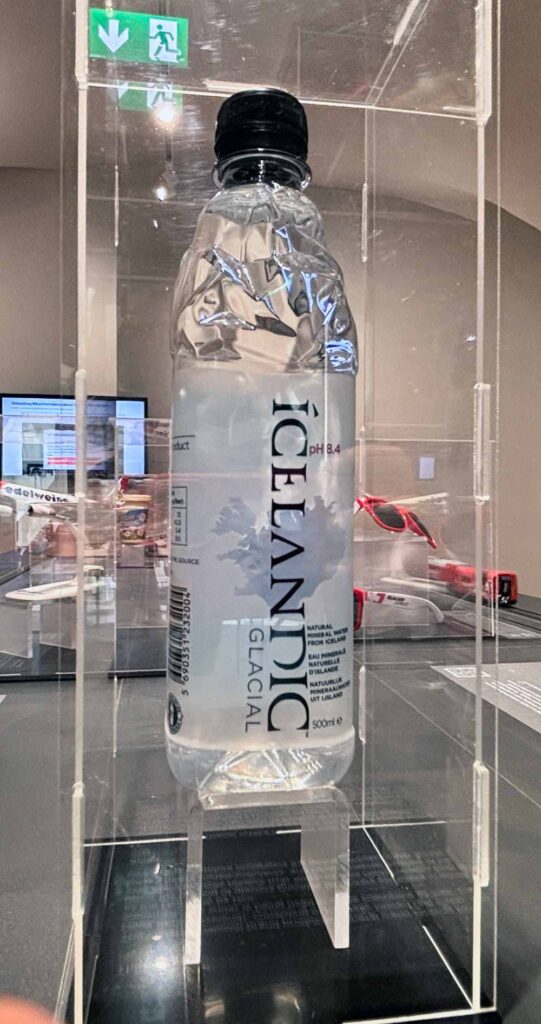
object (water bottle), 6 x 6 x 21,5 cm
The Icelandic Glacial brand produces mineral water coming from Ölfus Spring (Iceland), consisting of naturally filtered rain water, and snowmelt. The water is being used in some cosmetics as well, such as the Diorsnow by Dior.
While the melting of glaciers provides temporary increases in water, it eventually reduces reliable river flows, causes contamination from released heavy metals/pollutants, and causes coastal aquifers to become salty, therefore endangers the global drinkable water supply.
OpenAI. (2026). ChatGPT (GPT-5.6) [Large language model]. See prompts at the end
Icelandic Glacial Water
Spring-water branding, glacier loss and the changing politics of drinking-water security
Scope: Icelandic Glacial’s product, source, company and distribution history from 2004 to July 2026; the evidentiary limits of sales and revenue claims; climate-driven changes in water management; the effects of glacier loss on drinking-water security; the territories at greatest combined risk; and comparable spring- and iceberg-water enterprises. Unsupported revenue estimates and promotional claims without independent verification are excluded.
Abstract
Icelandic Glacial is not bottled glacier melt. Company materials identify it as groundwater from the Ölfus Spring, replenished by rain and snowmelt filtering through volcanic formations. The brand was established in 2004, entered the United States in 2005, expanded through a 2007 Anheuser-Busch distribution and equity agreement, and underwent a further investment and shareholder restructuring in 2023. Publicly verifiable cumulative sales and audited revenue remain unavailable; 30,000 bottles per hour is stated plant capacity, not demonstrated output. The name instead converts Iceland’s frozen landscape into a commercial sign of purity and renewability while actual glacier-fed water systems are becoming less reliable. Global glaciers lost 273 ± 16 gigatonnes annually in 2000–2023, and the loss rate accelerated by 36 ± 10 per cent between the two halves of that period. After temporary “peak water”, runoff declines and shifts seasonally. The strongest combined exposure is documented in the Indus, Amu Darya, Syr Darya and Tarim basins, with serious but locally differentiated risks in the Andes. Water management is consequently moving from historical stationarity and supply expansion towards adaptive basin planning, diversified sources, demand reduction, groundwater protection, quality monitoring and transboundary governance.
Project links and cross-references: Exhibition objects · Random Archive · Related objects/reports: Thirst; Glacier Express; Elixir; Mythos; Nations; Future.
Contents
1. Product, company and evidentiary review
2. Glacier loss and drinking-water security
3. Climate change and the transformation of water management
4. Territories of highest documented vulnerability
5. Comparable enterprises and environmental scrutiny
6. Interpretive synthesis: purity as commodity, melt as crisis
Numbered academic reference list
Appendix: User prompts
1. Product, company and evidentiary review
The preliminary report correctly identified the Ölfus Spring, the adjacent bottling plant and the company’s premium-water positioning, but it did not sufficiently distinguish company claims from independent evidence. Its central factual correction is terminological: the product is spring water associated with a glacial national image, not water drawn from a glacier.
1.1 Source, production and the meaning of “glacial”
Field | Documented information |
Water source | Ölfus Spring, south-west Iceland; an underground spring/aquifer, not a glacier. |
Recharge | The company states that Icelandic rainfall and snowmelt filter gradually through lava fields before reaching the spring. |
Bottling | Bottled beside the source. The company states that the facility uses geothermal and hydroelectric energy. |
Stated capacity | Up to 30,000 bottles per hour. This is installed capacity, not evidence of annual production or sales. |
Evidence limit | No independent hydrological audit of the spring’s flow, extraction share or long-term recharge was located in the accessible sources reviewed. |
Primary / institutional evidence links: Icelandic Glacial: Our Source | Icelandic Glacial: Source and Facility
The word “glacial” therefore operates principally as place-branding: it joins Icelandic nationality, snow, glaciers, lava and remoteness into a purity narrative. This distinction is important for the exhibition object Thirst, because the bottle does not materially preserve a disappearing glacier; it commercialises the cultural authority of frozen landscapes.
1.2 Ownership, distribution and missing sales data
Date | Documented development |
2004 | Icelandic Water Holdings was established and the brand is commonly dated to this year; the exact corporate filing was not examined in this review. |
November 2005 | Icelandic Glacial was introduced in the United States; exports had begun by this period. |
18 July 2007 | Anheuser-Busch announced exclusive United States distribution and a 20 per cent ownership interest. |
2008 | Trade reporting described a major Ölfus bottling-facility expansion. |
5 September 2023 | Iceland Star Property Ltd. and funds managed by BlackRock’s US Private Credit team announced new equity investment and debt conversion. The company described an incoming majority shareholder and retained significant stakes for founders and BlackRock-managed funds. |
2026 status | The company remains privately held. No audited public revenue series or cumulative unit-sales total was located. |
Primary / institutional evidence links: Anheuser-Busch distribution announcement | 2008 facility trade report | 2023 investment and shareholder statement
The earlier report’s revenue figures from Owler, Prospeo, LeadIQ and Growjo are not retained: their estimates differed by more than an order of magnitude and were unsupported by audited accounts. A defensible lifetime-sales estimate would require company records, statutory filings or a transparent market dataset. The honest result is therefore a documented gap.
2. Glacier loss and drinking-water security
Glaciers act as seasonal and multi-year stores. Warming first releases extra water, but shrinking ice reduces the reserve that buffers dry periods. The timing matters as much as the annual total: many communities depend on late-summer melt when rainfall and snowmelt are low.
Mechanism | Drinking-water consequence |
Accelerating mass loss | Glaciers worldwide lost 273 ± 16 gigatonnes annually in 2000–2023. The loss rate was 36 ± 10 per cent higher in 2012–2023 than in 2000–2011. |
“Peak water” | Runoff can rise temporarily, reach a maximum, and then decline. About half of 56 modelled large glacierised basins had not yet passed this point; the others already had. |
Seasonal redistribution | Runoff commonly shifts towards earlier melt, with less late-summer water. One-third of the studied basins could lose more than 10 per cent of glacier runoff in at least one melt-season month by 2100. |
Quality and treatment | Retreat changes sediment and biogeochemical fluxes and can release stored radionuclides, persistent organic pollutants, potentially toxic elements and microplastics. Effects are site-specific; glacier melt should not be treated as universally contaminated. |
Indirect coastal pathway | Glacier and ice-sheet melt raises sea level, increasing saltwater intrusion risk in low-lying coastal aquifers and islands. This is distinct from declining mountain runoff but also affects drinking-water security. |
Academic source links: Global glacier mass-change synthesis | Global hydrological response and peak water | High Mountain Asia glacier sustainability | Glacial contaminants and downstream consequences
References: [1], 382–388; [2], 135–140; [3], article 2868; [4], 790–808.
Primary / institutional evidence links: IPCC: High Mountain Areas and peak water | IPCC AR6: Water
3. Climate change and the transformation of water management
Global warming changes water management by invalidating the assumption that the statistical past is a stable guide to the future. The practical shift is from fixed “predict and control” systems towards iterative, basin-scale management that can revise decisions as climate, demand and evidence change.
Earlier management logic | Climate-adaptive direction |
Historical stationarity | Scenario ranges, stress tests and flexible operating rules for non-stationary floods, droughts and melt seasons. |
Expanding supply from one source | Demand reduction, leakage control and diversified portfolios: surface water, protected groundwater, reuse, rainwater, managed aquifer recharge and—where appropriate—desalination. |
Annual-average planning | Seasonal “peak-water” planning, reservoir re-operation and drought reserves designed around earlier melt and lower late-summer flows. |
Engineering alone | Combined grey and ecosystem-based measures: catchment restoration, wetlands, source protection, distributed storage and hazard buffers. |
Quantity separated from quality | Continuous sediment, temperature, microbial and contaminant monitoring, with treatment capacity adjusted to changing source water. |
Sectoral or national control | Integrated river-basin and transboundary governance, participatory allocation, climate-justice safeguards and data sharing. |
Academic source links: Adaptive water management as learning | Stationarity Is Dead | Peak-water hydrology
References: [5], 49–62; [6], 573–574; [2], 135–140.
Primary / institutional evidence links: UN World Water Development Report 2025 | UNESCO: The way forward | IPCC AR6: Water adaptation
These measures do not remove scarcity; they redistribute risk. Large reservoirs, desalination and inter-basin transfers may protect cities while shifting ecological damage, energy use or costs elsewhere. Adaptive management therefore requires procedural questions—who participates, whose demand is protected, and who bears the cost—alongside technical optimisation.
4. Territories of highest documented vulnerability
No single global ranking can combine glacier dependence, poverty, governance, groundwater, population and infrastructure without contestable weighting. The following are the strongest combined vulnerability clusters in the evidence reviewed, not a definitive league table.
Basin / territory | Geography | Why drinking water is endangered | Assessment |
Indus, Amu Darya, Syr Darya and Tarim basins | High Mountain Asia / Central and South Asia | The most important and vulnerable glacier-fed basins identified in the cited global and regional studies. Meltwater supports the needs of roughly 250 million people across High Mountain Asia. Long-term glacier ablation and dry-season buffering decline even where near-term runoff remains high. | Very high; large populations, arid downstream areas, irrigation dependence and transboundary politics compound physical change. |
Tropical Andes | Peru, Bolivia, Ecuador; especially La Paz–El Alto, Lima/Huaraz-linked basins and rural highland communities | Small tropical glaciers respond rapidly to warming and are important during the dry season. Urban scarcity also reflects demand growth, unequal access, groundwater stress and infrastructure; glacier loss is a major multiplier rather than the sole cause. | High but locally differentiated; the IPCC cautions against attributing all urban shortages to glaciers alone. |
Central Chile and subtropical Andes | Santiago and Maipo headwaters | Glacier and snow decline interact with a long drought, groundwater depletion and rising demand, reducing streamflow and degrading source-water quality. | High regional risk, driven by compound drought–snow–glacier change. |
European Alps and western North America | Rhône/Rhine/Po headwaters; Rocky Mountain and Pacific glacier-fed catchments | Many smaller basins have passed or approach peak water. Late-summer supply, hydropower and local mountain communities face loss, although major cities often have more diversified systems than Asian or Andean drylands. | Serious local and seasonal risk; generally lower combined population exposure than the first two clusters. |
Academic source links: World water-tower vulnerability | High Mountain Asia glacier sustainability | Global peak-water projections
References: [7], 364–369; [3], article 2868; [2], 135–140.
Primary / institutional evidence links: IPCC: High Mountain Areas | IPCC AR6: Central and South America | UNESCO: Andean Glacier and Water Atlas
5. Comparable enterprises and environmental scrutiny
Enterprise | Place | Material source | Commercial genealogy |
Icelandic Glacial | Iceland | Groundwater from Ölfus Spring, recharged by rain and snowmelt | Premium “glacial” Icelandic identity; the glacier relation is symbolic and geographic. |
evian | French Alps | Cachat Spring; rain and snow filtered through glacially formed Alpine geology over about fifteen years | Mountain terroir, mineral composition, health and luxury collaborations; not melted glacier ice. |
Svalbarði Polar Iceberg Water | Svalbard, Norway | Ice harvested from naturally calved icebergs and melted for bottling | Literal Arctic ice as limited-edition luxury; company markets carbon-neutral/negative offsets and climate awareness. |
Iluliaq Original Iceberg Water | Disko Bay, Greenland | Iceberg water collected and bottled in Greenland | Artisanal scarcity and governmental licensing under Greenland’s ice-and-water export framework. |
Primary / institutional evidence links: evian: Our Water | Svalbarði: About the Iceberg Water | Iluliaq: The Water
The comparison exposes a spectrum of commodification: spring water named through a frozen national imaginary; water filtered through Ice Age geology; and literal iceberg ice converted into a scarce, internationally shipped luxury. The environmental burden cannot be inferred from source imagery alone. Bottle manufacture, refrigeration, packaging and transport can dominate life-cycle energy, especially for long-distance freight. Carbon-neutral labels usually depend on a defined accounting boundary and offsets; they should not be read as proof of zero physical emissions.
Academic source links: Bottled Water: The Pure Commodity in the Age of Branding | Energy Implications of Bottled Water
References: [8], 303–325; [9], article 014009.
No well-documented activist direct action against Icelandic Glacial was located in the scholarly, institutional or reputable news sources reviewed. The relevant controversy is broader: single-use packaging, long-distance transport, private appropriation of water, and the use of purity and carbon-neutrality narratives. This finding remains provisional because the company is private and local Icelandic-language coverage was not exhaustively archived.
6. Interpretive synthesis: purity as commodity, melt as crisis
Within The Sunshine Find, Icelandic Glacial belongs first to Thirst, but it also cross-references Elixir and Mythos, where glacier language sells cosmetic purity and scientific exclusivity. Like Glacier Express and the Grossglockner souvenir objects, the bottle translates a remote frozen environment into a controlled consumer encounter. Yet its source is not a glacier: the object’s force lies in the gap between the glacial sign and the hydrological reality.
The glacier appears simultaneously as spectacle, national image, exportable flavour and disappearing water infrastructure. Svalbarði and Iluliaq intensify this logic by turning calved ice into literal luxury matter, while downstream communities must adapt to the loss of seasonal storage and to increasingly unequal access.
Numbered academic reference list
Chicago bibliography style. Only verified scholarly sources are included; company, IPCC and UNESCO records remain separately labelled above.
1. The GlaMBIE Team. “Community Estimate of Global Glacier Mass Changes from 2000 to 2023.” Nature 639 (2025): 382–388. https://doi.org/10.1038/s41586-024-08545-z.
2. Huss, Matthias, and Regine Hock. “Global-Scale Hydrological Response to Future Glacier Mass Loss.” Nature Climate Change 8 (2018): 135–140. https://doi.org/10.1038/s41558-017-0049-x.
3. Miles, Evan, Michael McCarthy, Amaury Dehecq, Marin Kneib, Stefan Fugger, and Francesca Pellicciotti. “Health and Sustainability of Glaciers in High Mountain Asia.” Nature Communications 12 (2021): 2868. https://doi.org/10.1038/s41467-021-23073-4.
4. Beard, Dylan B., Caroline C. Clason, Sally Rangecroft, Ewa Poniecka, Kim J. Ward, and Will H. Blake. “Anthropogenic Contaminants in Glacial Environments II: Release and Downstream Consequences.” Progress in Physical Geography: Earth and Environment 46, no. 5 (2022): 790–808. https://doi.org/10.1177/03091333221127342.
5. Pahl-Wostl, Claudia. “Transitions towards Adaptive Management of Water Facing Climate and Global Change.” Water Resources Management 21, no. 1 (2007): 49–62. https://doi.org/10.1007/s11269-006-9040-4.
6. Milly, P. C. D., Julio Betancourt, Malin Falkenmark, Robert M. Hirsch, Zbigniew W. Kundzewicz, Dennis P. Lettenmaier, and Ronald J. Stouffer. “Stationarity Is Dead: Whither Water Management?” Science 319, no. 5863 (2008): 573–574. https://doi.org/10.1126/science.1151915.
7. Immerzeel, W. W., A. F. Lutz, M. Andrade, A. Bahl, H. Biemans, T. Bolch, S. Hyde, et al. “Importance and Vulnerability of the World’s Water Towers.” Nature 577 (2020): 364–369. https://doi.org/10.1038/s41586-019-1822-y.
8. Wilk, Richard. “Bottled Water: The Pure Commodity in the Age of Branding.” Journal of Consumer Culture 6, no. 3 (2006): 303–325. https://doi.org/10.1177/1469540506068681.
9. Gleick, Peter H., and Heather S. Cooley. “Energy Implications of Bottled Water.” Environmental Research Letters 4, no. 1 (2009): 014009. https://doi.org/10.1088/1748-9326/4/1/014009.
Appendix: User prompts related to this report
1. 1. analyse the attached report
2. complete it with
– the changes in the global water management as a result of global warming
– a research on how the drinking water supplies are being globally affected by the melt of the glaciers, which are the most endangered geographic territories
– other similar entreprises
3. prepare and send an rtf document (no longer than 7 pages) according to the standards and criteria decsribed to you earlier.