“Stop the war!”
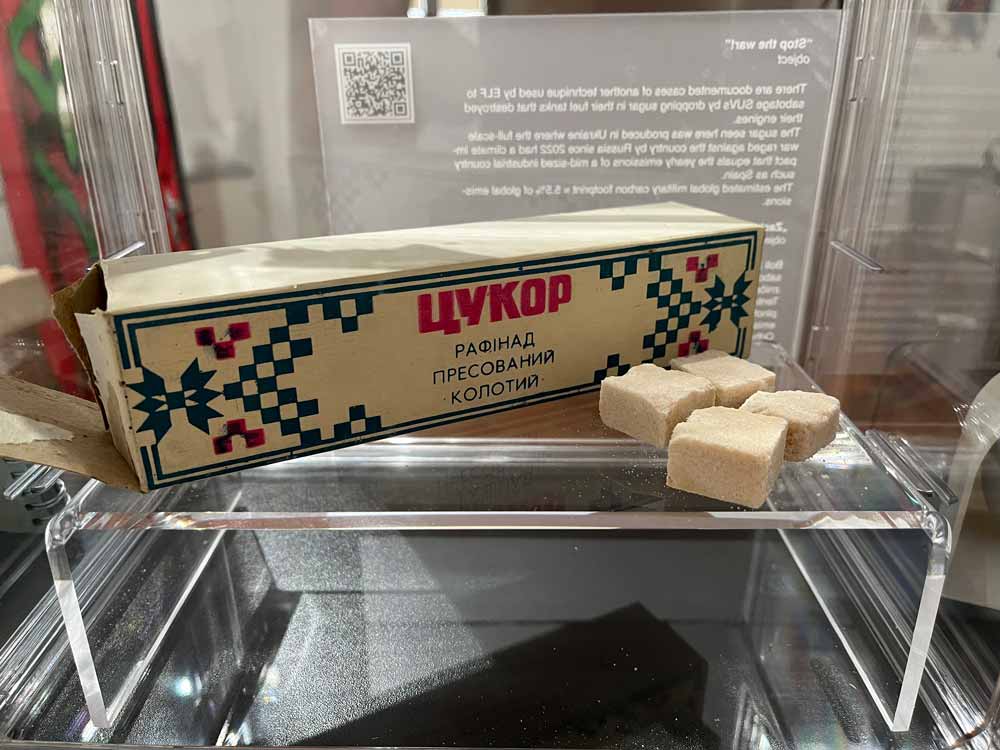
object, 20 x 5 x 5 cm
The title refers to one of the many ELF graffiti tags. There are documented cases of another technique used by ELF to sabotage SUVs by dropping sugar in their fuel tanks that destroyed their engines. …
The sugar seen here was produced in Ukraine where the full-scale war raged against the country by Russia since 2022 had a climate impact that equals the yearly emissions of a mid-sized industrial country such as Spain.
The estimated global military carbon footprint ≈ 5.5% of global emissions.
OpenAI. (2026). ChatGPT (GPT-5.6) [Large language model]. See prompts at the end
“Stop the War!”
Sugar sabotage, the military carbon footprint and the environmental history of warfare
Scope: The genealogy and evidentiary status of sugar-in-fuel sabotage; radical environmental action against machinery and SUVs; the standing environmental burden of military institutions; and the environmental effects of warfare from pre-industrial conflict to Russia’s full-scale invasion of Ukraine. Operational guidance for sabotage is excluded.
Abstract
The proposed label links the Earth Liberation Front (ELF) to destroying SUV engines with sugar placed in fuel tanks. The evidence supports a narrower conclusion. Sugar-in-fuel predates ELF as a popular sabotage trope and entered radical-environmentalist discussions through the wider repertoire of ‘monkeywrenching’, but the most precise academic example is a hypothetical action against bulldozers and road graders, not a documented ELF attack on SUVs. ELF anti-SUV actions are better documented as vandalism and arson. The claim of inevitable engine destruction is also mechanically overstated: sugar does not dissolve in petrol, although contamination can obstruct a fuel system.
Militaries create emissions before, during and after war through bases, procurement, fossil-fuelled operations, ecosystem damage and reconstruction. A modelled 2019 estimate places the global military carbon footprint at about 5.5% of global greenhouse-gas emissions, excluding much conflict damage. The latest four-year assessment attributes 311.4 MtCO2e to Russia’s full-scale war against Ukraine, comparable to France’s annual emissions. The object therefore requires a factual correction while retaining its connection between ecotage, militarism and undercounted climate violence.
Project links and cross-references: Stop the War! object · Sabotage / SUVization · ELF timeline · Container / Mount Scorluzzo
Contents
1. Sugar sabotage: origin, evidence and correction
2. Military industry and war: environmental history by period
3. Ukraine: quantified climate impact and revised object text
4. Interpretive synthesis
5. Numbered academic reference list
Appendix: User prompt
1. Sugar sabotage: origin, evidence and correction
|
Historical layer |
Documented finding |
|
General sabotage trope |
The precise origin is not traceable in reliable scholarship. By the twentieth century, sugar in a fuel tank circulated as a low-tech vehicle-sabotage story; it was not invented by ELF. |
|
Radical environmentalism, 1980s |
Earth First! placed covert property damage within “monkeywrenching” or ecotage: attacks on inanimate machinery understood as enabling extraction or habitat destruction. |
|
ELF, 1990s–2000s |
ELF inherited a decentralised direct-action repertoire. Anti-SUV attacks are documented chiefly as paint, smashed windows, tyre damage and arson, not as sugar destroying engines. |
|
Academic clarification, 2005 |
Vanderheiden’s much-cited sugar example is explicitly hypothetical and targets bulldozers and road graders. His separate SUV example is dealership arson and vandalism. It is not evidence of an actual ELF sugar attack. |
Technical correction: sucrose is poorly soluble in petrol. It may contaminate a tank or obstruct filters and pumps, requiring cleaning or replacement, but the familiar story that it dissolves, caramelises and inevitably destroys an engine is not technically supported. The report therefore avoids repeating “destroyed their engines” as an established result.
Academic source links: Religion, Violence and Radical Environmentalism | Eco-terrorism or Justified Resistance?
References: [1], 1–42; [2], 425–447, especially 441–443.
Technical evidence link: Sugar-in-fuel technical explainer
2. Military industry and war: environmental history by period
|
Period |
Dominant environmental mechanisms and historical shift |
|
Antiquity–c.1800 |
Scorched earth, siege fire, fortification, crop and livestock seizure, and intense local demand for timber, food and water. Damage could be severe but was usually constrained by pre-industrial transport and weaponry. |
|
c.1800–1914: industrialisation |
Railways, steam transport, coal, mining, mass metals and explosives enlarged armies and made permanent arms industries possible. Environmental burdens moved from battlefields into factories, mines, ports and supply corridors. |
|
1914–1945: total war |
Artillery, trenches, poison gas, motorisation and aerial bombing produced landscape cratering, chemical residues and urban-industrial destruction. Global mobilisation tied war to oil, rubber, aluminium, food and colonial resource systems. |
|
1945–1991: Cold War |
Nuclear weapons production and testing, permanent overseas bases, jet and naval fleets, and proxy wars created long-lived toxic and radioactive legacies. Herbicidal warfare in Vietnam helped generate the modern concept of “ecocide”. |
|
1991–present: expeditionary and urban war |
Fossil-fuel-intensive aviation and logistics combine with oil fires, damaged energy systems, displacement, rerouted transport, rubble and carbon-intensive reconstruction. The Gulf War, post-9/11 wars and Ukraine reveal different parts of this expanded footprint. |
Academic source links: The Environmental Footprint of War | Environmental Histories of the First World War | War and Nature | The Invention of Ecocide | The Pentagon, Climate Change, and War
References: [3], 405–421; [4], especially 1–18; [5]; [6]; [7].
2.1 The standing military carbon footprint
|
Measure |
Best estimate / interpretation |
|
Operational emissions |
About 500 MtCO2e per year, approximately 1.0% of global GHG emissions. |
|
Full military footprint |
About 2,750 MtCO2e per year, approximately 5.5%, after applying a supply-chain multiplier. |
|
Boundary warning |
The 5.5% estimate is modelled from incomplete 2019-era reporting and excludes many emissions caused by warfighting, ecosystem damage, infrastructure destruction and reconstruction. |
|
Spending link |
A 2025 peer-reviewed global study found a strong positive association between the military-expenditure share of GDP and CO2 emission intensity; this is a statistical relationship, not a complete inventory of war emissions. |
Academic source links: Rising military spending jeopardizes climate targets | The Pentagon, Climate Change, and War
References: [7]; [8].
Primary / institutional evidence link: Estimating the Military’s Global Greenhouse Gas Emissions
3. Ukraine: quantified climate impact and revised object text
The attached brief’s three-year total of 236.8 MtCO2e has been superseded. The sixth assessment, covering 24 February 2022–23 February 2026, estimates 311.4 MtCO2e: warfare 114.1 (37%); landscape fires 70.3 (23%); energy infrastructure 18.6 (6%); refugees 5.3 (2%); civil-aviation effects 29.8 (9%); and reconstruction 73.3 MtCO2e (23%). Its comparison is now France’s annual emissions. The former Spain comparison described the scale of an earlier total and should not be retained as the current wording.
Methodological caution: Bun et al.’s peer-reviewed estimate was 77 MtCO2e for the first 18 months, while the institutional series uses a broader and repeatedly updated boundary. The difference demonstrates why dates and included categories must always accompany war-emissions figures.
Academic source link: Tracking unaccounted greenhouse gas emissions due to the war in Ukraine since 2022
References: [9], article 169879.
Primary / institutional evidence link: Climate Damage Caused by Russia’s War in Ukraine — 48 months
4. Interpretive synthesis: small sabotage and industrialised violence
The object places a domestic commodity from Ukraine between two radically unequal scales of environmental violence. Sugar carries the mythology of improvised ecotage: clandestine damage to a machine presented as an instrument of ecological harm. The military system, by contrast, institutionalises fossil-fuel consumption, extraction, destruction and rebuilding at national and transnational scale, while much of its climate burden remains outside transparent inventories.
Primary / institutional evidence used
5. Numbered academic reference list
Appendix: User prompts related to this report
Prompts are reproduced chronologically as a research-process record.
1. Next object description is:
There are documented cases of another technique used by ELF to sabotage SUVs by dropping sugar in their fuel tanks that destroyed their engines. …
The sugar seen here was produced in Ukraine where the full-scale war raged against the country by Russia since 2022 had a climate impact that equals the yearly emissions of a mid-sized industrial country such as Spain.
The estimated global military carbon footprint ≈ 5.5% of global emissions.
1. research and describe the origins of this sabotage type,
2. review the attached report, expand the research on the environmental impact of military industry in general and wars in particular broken down on historical periods
3. keep the report under 4 pages
2. General remarks:
1. I have been asking you to create individual reports on different topics.
2. Nonetheless these materials should converge into a unity which is the archive itself and the supporting physical installation. This convergence should be based on a synthesys of all of my other topics, questions and criteria raised in all of the other chat sessions, which are all part of the same project the main scope of which is an art installation and a supporting archive that grows by time. The archive is meant for both professional and nonprofessional use, it should be informative within its artistic and pedagogical scope as well.
3. the main line of thoughts of the project departs from panoptic tourism and concludes to ecoterrorism in a narrative line. Therefore all the reports should follow this general direction in their approach and references.
4. The reports we are working on now will all serve as a background research material published on the project website for the set of objects that will be on display, Each object will have its own page (see: https://glacial-archaeology.net/category/exhibition/). See: Szabolcs KissPál – The sunshine find_for translation. I am also adding the brief description of the project’s general concept, see: Szabolcs KissPál – The sunshine find. The website will have a separate but interconnected section for both the exhibition and the supporting archive. https://glacial-archaeology.net/an-archive-of-narratives-on-global-warming-copy/ Inspect the site while note that it doesn’t have its final structure yet!
5. the scope with the reports is to produce a set of background research material for each object in part that should refer to each other, and should be unified in their narrative and typographic structure, tone, and scope. Pay attention to snychronise the focus points of different partial research tasks when possible with cross references!
6. I am attaching two of your previous reports (noahs_ark_expeditions_1959_1990_academic_sources_new_tab_links.docx, Container_Mount_Scorluzzo_WWI_Shelter_Research_Report). Please develop and and apply to these reports a uniform structure both content wise and in formal aspects while mostly keeping their original content.
7. Main further formal criteria:
– you should always start with an abstract summarizing your finds in a text no longer than 200 words.
– you should always enlist at the very end of the document all my prompts related to that topic
– the external links should always open in a different tab
– you should be using only valid, peer reviewed academic sources listed and numbered at the end of the documents
– you should apply a somewhat unified narrative structured and a unified formatting (including typeface styles, subtitles structure, etc.
8. – note and memorise the above in your cross-chat memory for rurther tasks