The cloud is not in the sky!
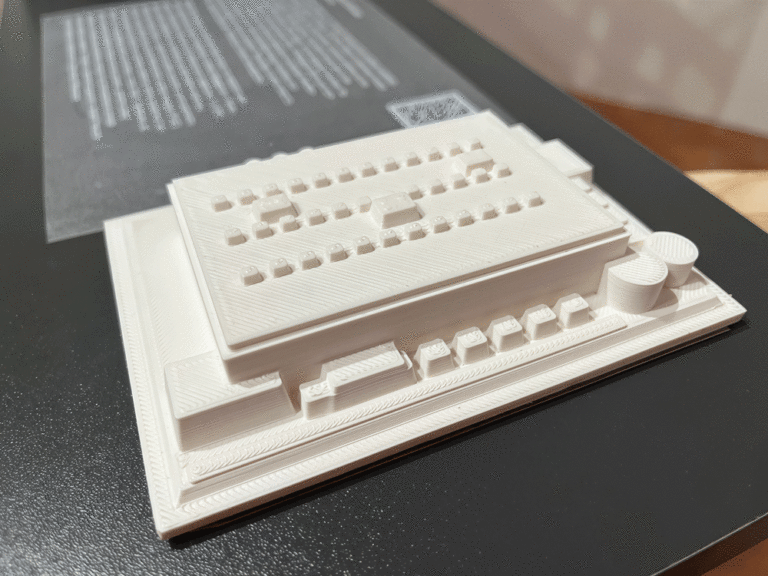
object (maquette), 13 x 9 cm
The SINES Data Campus is a privately financed but publicly enabled AI infrastructure project in Portugal, with €8.5 billion in planned investment and 1.2 GW capacity. Its sustainability narrative centres on renewable electricity, seawater cooling, brownfield reuse and a low Power Usage Effectiveness (PUE) target. At full capacity, however, its electricity demand could equal about 22% of Portugal’s 2025 grid consumption. Construction has already destroyed a protected Mediterranean temporary pond, while renewable-energy matching and operational emissions remain unaudited.
The project is also linked to the unresolved Operation Influencer criminal investigation.
OpenAI. (2026). ChatGPT (GPT-5.6) [Large language model]. See prompts at the end
Start Sines Data Campus
AI-scale infrastructure, sustainability claims, private capital, public enabling and contested ecological governance
Scope: The SINES Data Campus in Sines, Portugal, from its 2021 announcement to 27 July 2026. The report reviews development scale, electricity and cooling implications, biodiversity, investment structure, public enabling, legal and political controversy, and civic response. It is a desk review rather than a legal opinion, financial audit, engineering validation or environmental impact assessment.
Abstract
Start Campus is developing a six-building, 1.2 GW AI- and cloud-oriented data-centre campus in Sines, Portugal. Its first facility is operational; the project is backed by Davidson Kempner and Pioneer Point and carries an announced €8.5 billion developer programme to 2030, separate from Microsoft’s $10 billion AI-infrastructure commitment. The project has credible design advantages—reuse of former coal-station infrastructure, seawater heat exchange, LEED Gold for SIN01 and a PUE target of 1.1—but campus-wide sustainability is not independently demonstrated. At full advertised IT capacity and PUE 1.1, continuous operation would equal about 11.56 TWh per year, 21.8% of Portugal’s 2025 public-grid consumption. ‘100% renewable’, WUE 0 and net-zero claims lack publicly available hourly matching, operating, lifecycle and marine-monitoring data. Construction of SIN01 destroyed a protected Mediterranean temporary pond; later phases remain subject to ecological conditions. Direct capital appears private, but land, permitting, grid and strategic coordination are materially public. Operation Influencer remains unresolved, without a conviction or identified closure. Within The Sunshine Find, the campus makes visible the land, energy, water, financial and political systems hidden by the metaphor of ‘the cloud’.
Project links and cross-references: Project website · Exhibition pages · Supporting archive · Related objects: Future; Memory; Countdown; The Random Archive; Drill baby, drill!
Contents
1. Executive assessment
2. Project profile and development timeline
3. Sustainability claims and evidence status
4. Electricity demand and grid implications
5. Cooling, water and marine ecology
6. Land, habitats and biodiversity
7. Investment structure: private capital and public enabling
8. Political influence and Operation Influencer
9. Economic, ecological and political controversies
10. Civic and activist responses
11. Risk matrix and due-diligence questions
12. Interpretive synthesis: the cloud is not in the sky
13. Calculation notes and terminology
14. Primary, institutional and contemporaneous source register
15. Numbered academic reference list
Appendix: User prompts related to this report
1. Executive assessment
Overall judgement
Start Campus combines credible low-overhead design choices with an unusually large system-level electricity requirement and unresolved evidence gaps. Its sustainability is plausible at the building-design level but is not yet demonstrated at full-campus scale through independently assured operating data, hourly renewable matching, marine monitoring, lifecycle carbon accounting and enforceable biodiversity outcomes.
What is well supported
- SIN01 is operating. Start Campus currently advertises 37.5 MW for SIN01, 200 MW for the next planned facility and 1.2 GW for the full campus.
- The direct sponsors are private: Davidson Kempner Capital Management and Pioneer Point Partners. The widely reported €8.5 billion is a planned programme value to 2030, not verified expenditure already incurred.
- Reusing former coal-station seawater infrastructure can reduce direct freshwater demand and cooling electricity relative to evaporative systems, provided intake and thermal-discharge effects are controlled.
- SIN01 has LEED Gold BD+C v4 certification and the campus targets PUE 1.1. These are positive design indicators, not substitutes for audited annual performance.
- Official and independent reporting confirms that first-phase construction destroyed a protected temporary Mediterranean pond.
- Peer-reviewed research places Start Campus within cumulative Sines industrial expansion and debates over energy justice, procedural fairness and sacrifice-zone dynamics.
What remains unproven or unresolved
- No public independently audited dataset was located for annual electricity use, achieved PUE, water flows, Scope 1–3 emissions, backup generation, refrigerants or embodied carbon.
- The phrase “100% renewable energy” lacks enough public procurement detail to test additionality, geography, residual-grid treatment or hourly/24-7 matching. The February 2026 EDP announcement is a strategic agreement, not proof of achieved hourly matching.
- WUE 0 is a narrow site metric; it does not mean zero water or marine impact. The cooling system withdraws and returns seawater and uses some recirculated industrial water for dry coolers.
- The headline €8.5 billion is a future programme estimate. Later reporting suggested that the total could reach €10 billion; Microsoft’s separate $10 billion commitment concerns customer-side AI infrastructure rather than Start Campus construction alone.
- Operation Influencer remains a serious unresolved legal and reputational issue. No conviction was identified; a 2024 appeal-court decision rejected important prosecutorial inferences at the coercive-measures stage.
Issue | Public evidence | Assessment | Evidence needed |
Energy efficiency | PUE 1.1 design target; LEED Gold for SIN01 | Promising, not operationally verified | Annual audited PUE and total kWh by facility |
Renewable electricity | 100% claim; EDP strategic agreement | Procurement quality and hourly matching unclear | Contracts, assets, certificates, additionality and hourly CFE results |
Water and marine effects | Seawater cooling; WUE 0 claim; reported return up to +3°C | Low freshwater pressure; marine outcome unresolved | Flow, temperature, chemicals, plume modelling and independent ecology monitoring |
Biodiversity | Restoration commitments; protected pond destroyed during SIN01 | Material implementation failure | Enforceable restoration, finance, success criteria and independent oversight |
Economic benefit | Large jobs and GDP projections | Method and local distribution not independently audited | Local jobs, wages, procurement, tax, housing and service-cost reporting |
Governance | Formal permitting plus unresolved criminal investigation | High reputational uncertainty | Final judicial resolution and disclosure of public support and meetings |
Academic source links: Sines energy-transition case study | Data-centre energy-estimate review
References: [1], article 104068, especially sections 4–6; [4], 2032–2056.
Primary / institutional evidence links: Start Campus project website | APA environmental-assessment portal
2. Project profile and development timeline
Start Campus is developing a multi-building hyperscale and AI-oriented data-centre campus in the Zona Industrial e Logística de Sines (ZILS), south of Lisbon. The site is promoted as an Atlantic connectivity gateway near subsea cables, renewable generation and the former EDP coal-power station’s seawater infrastructure. The advertised end-state is six facilities and 1.2 GW of IT capacity.
Field | Documented information |
Developer | START – Sines TransAtlantic Renewable & Technology Campus, S.A. (Start Campus) |
Sponsors | Davidson Kempner Capital Management and Pioneer Point Partners |
Location | ZILS industrial area, Sines, Portugal; seawater intake/return linked to São Torpes coast infrastructure |
Current advertised live capacity | 37.5 MW for SIN01 |
Full-build advertised capacity | 1.2 GW IT load across six facilities |
Next announced building | SIN02, advertised at 200 MW |
Cooling concept | Seawater heat exchange using infrastructure associated with the former Sines coal plant; dry-cooler redundancy |
Headline targets | 100% renewable electricity; PUE 1.1; WUE 0; net zero by 2030 |
Headline developer programme | €8.5 billion planned by 2030; 2026 reporting said total could reach €10 billion |
Separate customer-side investment | Microsoft announced $10 billion for AI infrastructure associated with the Sines hub |
Connectivity update | Google connected the Nuvem transatlantic cable to Sines in July 2026, strengthening the region’s Atlantic data-gateway role |
Academic source links: Green, Innovative, and Unfair
References: [1], article 104068.
Primary / institutional evidence links: Start Campus Sines page | Pioneer Point portfolio | Reuters, April 2025 investment announcement | Reuters, July 2026 Nuvem cable connection
Development timeline
Date | Milestone | Interpretation |
March–April 2021 | PIN status and initial announcement: up to €3.5 billion, five buildings and 450 MW | Original concept and national-interest coordination framework. |
2022 | Construction of SIN01 begins | First building advanced before the later-phase full EIA; phasing became a procedural controversy. |
22 August 2023 | Conditioned favourable environmental decision for phases 2–6 (AIA 3633) | Expanded programme approved subject to conditions. |
7 November 2023 | Operation Influencer searches, detentions and formal-suspect designations | Start Campus licensing became one file in a wider criminal investigation; the prime minister resigned amid the broader case. |
August 2024 | REN power allocation supports expansion to 1.2 GW | More than doubled the original 450–495 MW concept. |
4 April 2025 | SIN01 officially inaugurated; €8.5 billion programme announced to 2030 | One of six planned buildings operating; programme value remained forward-looking. |
November 2025 | Microsoft announces $10 billion AI-infrastructure commitment | Separate customer/technology deployment, not developer construction capex. |
February–March 2026 | EDP strategic agreement; LEED Gold for SIN01 | Positive signals, but neither proves full-campus net-zero operation. |
June 2026 | Seawater-channel ownership dispute becomes public | Legal dependency on repurposed infrastructure creates continuity risk. |
21 July 2026 | Google Nuvem cable connected at Sines | Adds high-capacity Atlantic connectivity and strengthens the project’s geopolitical infrastructure context. |
27 July 2026 | Research cut-off | No independently assured full-year operating dataset or final Operation Influencer outcome located. |
Academic source links: Sines energy-transition case study
References: [1], article 104068.
Primary / institutional evidence links: APA AIA 3633 | Reuters, 2021 announcement | Start Campus and EDP agreement | Reuters, Nuvem cable
3. Sustainability claims and evidence status
The sustainability proposition rests on low facility overhead, seawater cooling without evaporative freshwater use, renewable electricity and redevelopment of an industrial site. Each claim has technical merit, but its scope is narrower than the project’s broad marketing language may suggest.
Claim | Supporting evidence | Important limitation | Assessment |
“100% renewable energy” | Company claim; Portugal has a high renewable share; EDP agreement signals intended procurement | No public asset-level and hourly matching disclosure; backup generation and residual mix unclear | Partially evidenced |
PUE 1.1 | Engineering target; certifications indicate efficient design | PUE is not total-energy or carbon accounting; no full-year audited achieved PUE located | Promising, unverified |
WUE 0 / no freshwater cooling | Primary cooling uses seawater heat exchange rather than evaporative freshwater cooling | WUE is a site metric; industrial water remains for dry coolers; marine withdrawal and thermal discharge remain | Partially evidenced |
Net zero by 2030 | Corporate target | No public campus-wide Scope 1–3 inventory, embodied-carbon baseline or neutralisation policy located | Weakly evidenced |
Brownfield regeneration | Reuses former coal-plant infrastructure and industrial land | Later phases intersect protected designations; brownfield status does not remove habitat obligations | Supported, with caveat |
Biodiversity enhancement | Restoration plans, conservation areas and pond rehabilitation | Protected temporary pond destroyed during SIN01; net gain not demonstrated | Material contradiction |
Local prosperity | Promoter cites 1,200 direct and 8,000 indirect/induced jobs and large GDP effects | Figures derive from promoter/commissioned analysis; no transparent local outcome audit located | Unverified projection |
Academic source links: Data-centre energy-estimate review | Temporal matching and green electricity claims | Data-centre carbon and water footprints
References: [4], 2032–2056; [5], article 9280; [6], article 101430.
Primary / institutional evidence links: Start Campus sustainability claims | SIN01–EDP strategic agreement
Why PUE is not a carbon certificate
Power Usage Effectiveness divides total facility electricity by IT-equipment electricity. A PUE of 1.1 means approximately 10% facility overhead above IT load under the measured conditions. It says nothing by itself about the absolute IT load, electricity carbon intensity and timing, server utilisation, embodied emissions, backup generators or the social value of the computing performed. An efficient very large facility may still impose a larger system burden than a less efficient small one.
Annual claims versus physical matching
The public record does not establish whether “100% renewable” means annual guarantees-of-origin matching, long-term power-purchase agreements, direct additional generation or hourly carbon-free supply. Peer-reviewed research shows that annual matching can conceal substantial daily and seasonal mismatch. Credible disclosure would identify contracted assets, commissioning dates, additionality, hourly matching percentage, storage, residual-grid consumption and certificate treatment.
Academic source links: Temporal matching as an accounting principle
References: [5], article 9280, Results and Discussion.
Primary / institutional evidence links: EDP strategic agreement
4. Electricity demand and grid implications
Electricity scale is the project’s most consequential sustainability question. Start Campus advertises 1.2 GW of IT capacity. Applying its target PUE of 1.1 yields 1.32 GW of facility demand at full IT utilisation. If sustained for a full year, this equals approximately 11.56 TWh—21.8% of the 53.1 TWh supplied through Portugal’s public grid in 2025. This is an upper-bound continuous-utilisation scenario, not a demand forecast.
Value | Meaning | Basis |
1.32 GW | Facility load at full build | 1.2 GW IT × PUE 1.1 |
11.56 TWh | Annual full-load electricity | Upper-bound utilisation scenario |
21.8% | Portugal 2025 public-grid comparison | Share of 53.1 TWh |
Figure 1. Electricity-scale comparison. Scenarios assume continuous full utilisation and are contextual upper bounds, not forecasts.
Scenario | IT capacity | PUE | Annual facility use | Portugal comparison |
Current SIN01 advertised capacity | 37.5 MW | 1.1 | 0.361 TWh | 0.68% |
Full campus advertised capacity | 1,200 MW | 1.1 | 11.563 TWh | 21.8% |
Sines industrial expansion: peer-reviewed estimate | — | — | 7.696 TWh | 14.5% of 2025 grid consumption; study reports 17.5% of 2023 generation |
Academic source links: Sines cumulative electricity-demand analysis | Sources of Data Center Energy Estimates
References: [1], article 104068, electricity scenarios; [4], 2032–2056.
Primary / institutional evidence links: REN 2025 consumption benchmark | Start Campus current capacity claims
What the peer-reviewed Sines study adds
Campos, Maraschin and Schwemmlein estimate that the wider planned Sines industrial portfolio—within which Start Campus is central—would add 7,696.1 GWh per year, equal to 17.5% of Portugal’s 2023 electricity generation in their baseline. Even in their full-renewable-supply scenario they identify a remaining annual deficit of 3,267.9 GWh. Their model is not a project-specific engineering forecast; its value is to demonstrate that cumulative regional demand cannot be assessed one project at a time.
System-level questions
- Opportunity cost: grid capacity and new renewable generation allocated to one campus may displace other electrification or industrial-decarbonisation uses unless genuinely additional supply is built.
- Firming and timing: AI data centres are high-load, near-continuous consumers; variable renewables require transmission, storage, flexibility or dispatchable backup.
- Cost allocation: the reviewed public record does not disclose who pays for all reinforcement, balancing and resilience measures associated with the 1.2 GW connection.
- Rebound: greater efficiency can reduce cost per computation while total electricity use rises because AI demand expands.
- Concentration: the IEA projects rapid global data-centre demand growth, but local effects can be much larger than the global percentage suggests.
5. Cooling, water and marine ecology
The seawater system is the project’s most distinctive sustainability feature. Reusing intake and return infrastructure from the former coal plant avoids the large freshwater withdrawals and evaporative losses associated with many conventional data centres. In a drought-prone region this is a meaningful advantage, but it should not be described as zero water impact.
Dimension | Positive feature | Residual question or risk |
Freshwater | Primary cooling uses seawater rather than evaporative freshwater cooling | Some recirculated industrial water is used for dry coolers; domestic and maintenance uses remain |
Direct site consumption | Closed heat exchange can avoid evaporation; WUE target is 0 | WUE excludes indirect water in electricity generation, construction and hardware supply chains |
Marine intake | Existing infrastructure reduces new coastal works | Flow, velocity, entrainment and impingement require monitoring under the data-centre operating profile |
Thermal discharge | Heat is returned through an established outfall | Company reporting said return water may be up to 3°C warmer; ecological significance depends on flow, season, mixing and permit limits |
Operational continuity | Legacy system is physically available | Ownership and concession rights became contested between EDP and the Portuguese state in 2026 |
Transparency | The concept has been publicly described | No independent peer-reviewed operational study of SIN01 marine effects was located |
Academic source links: Data Centre Water Consumption | AI data-centre carbon and water footprints
References: [3], article 11; [6], article 101430.
Primary / institutional evidence links: APA AIA 3633 | ECO, June 2026 cooling-infrastructure dispute
WUE 0 is normally expressed as litres of on-site water used per kWh of IT energy. A non-evaporative design may report WUE 0 while moving large volumes of seawater through heat exchangers. The most relevant marine indicators are abstraction flow, intake velocity, entrainment and impingement, treatment chemicals, return temperature, thermal-plume extent and ecological response—not WUE alone.
In June 2026 Start Campus acknowledged potential project effects from litigation between EDP and the Portuguese state over ownership of the former plant’s seawater circulation system. The dispute is an operational and legal dependency, not evidence of environmental damage; it nevertheless weakens the assumption that the cooling solution is institutionally secured for the full build-out.
6. Land, habitats and biodiversity
The development is frequently described as brownfield regeneration because it occupies an industrial zone and repurposes former power-station assets. Later phases nevertheless intersect areas subject to nature-conservation rules, and the record includes a confirmed priority-habitat loss during construction of the first building.
Issue | Documented information |
Confirmed impact | Following a November 2023 inspection, ICNF acknowledged that works associated with Start Campus destroyed a protected temporary Mediterranean pond. |
Habitat status | Mediterranean temporary ponds are EU priority habitat 3170*. Scholarly work in south-west Portugal shows that their condition is assessed through sensitive plant and faunal indicators and that restoration requires long-term monitoring. |
Administrative inconsistency | Investigative reporting noted that the pond had not been identified in an earlier ICNF opinion associated with national-interest screening. |
Phasing controversy | LPN argued that SIN01 and later phases were separated in a way that weakened early cumulative assessment. Formal EIA and RECAPE procedures cover the later programme. |
Overlap and mitigation | LPN reported approximately 45.9 ha overlap with the Costa Sudoeste Special Area of Conservation and 13.1 ha with the marine natural park, while also acknowledging a proposed conservation area and pond restoration. |
Unresolved test | Whether mitigation produces durable, additional and independently verified ecological gain after first-phase habitat loss remains unproven. |
Academic source links: Mediterranean temporary-pond conservation indicators | Sines energy justice and cumulative impacts | Sacrifice zones and environmental movements
References: [7], 187–199; [1], article 104068; [2], 1293–1312.
Primary / institutional evidence links: APA AIA 3633 | APA RECAPE 564 | Liga para a Protecção da Natureza
Minimum credible safeguards
- Independent baselines and public annual monitoring for ponds, vegetation translocation, terrestrial habitats and coastal ecology.
- A legally enforceable restoration timetable with measurable success criteria, ring-fenced long-term finance and consequences for failure.
- Independent governance separated from the developer’s communications and sponsorship functions.
- Cumulative assessment of data centres, hydrogen, port, petrochemical, transmission and renewable developments across Sines.
- No assumption that restoration elsewhere automatically substitutes for avoiding impacts on priority habitat.
7. Investment structure: private capital and public enabling
Start Campus is a joint venture backed by Davidson Kempner Capital Management, a United States investment manager, and Pioneer Point Partners, a United Kingdom infrastructure investor. Reuters reported in 2021 that the sponsors planned up to €3.5 billion for a 450 MW campus. By April 2025 the announced plan had expanded to €8.5 billion by 2030 and six buildings. The company stated that SIN01 was financed without subsidies, public funds or tax benefits, with support from a United States bank.
Layer | Actor / amount | Purpose | Assessment |
Project equity / sponsor capital | Davidson Kempner + Pioneer Point | Campus development platform and buildings | Private capital; exact committed and spent amount not independently audited |
Programme value | €8.5 billion by 2030; later reporting said potentially €10 billion | Six-building campus and related infrastructure | Forward-looking headline value, not current sunk cost |
Debt / bank support | Unnamed US bank referenced by the company for SIN01 | First facility financing | Private debt support; terms undisclosed |
Customer-side AI investment | Microsoft $10 billion; Nscale/NVIDIA deployment | GPU and AI infrastructure at Sines | Separate from Start Campus owner capex; may support leases and utilisation |
Public enabling | PIN process, state-owned industrial-zone manager, government coordination, regulated grid and water governance | Land/location, approvals, connectivity and system integration | Not a direct cash grant, but economically significant facilitation |
Academic source links: Sines political economy and energy justice
References: [1], article 104068.
Primary / institutional evidence links: Reuters, April 2021 | Reuters, April 2025 | Reuters, Microsoft investment | aicep Global Parques Atlantic Hub
The most defensible description is privately financed with substantial public enabling. No reliable source reviewed identified a direct public grant, EU subsidy or tax incentive for SIN01, and the company explicitly denied using them. Delivery nevertheless depends on PIN coordination, industrial land managed by a state-owned entity, regulated grid allocation, environmental and water governance, high-level political promotion and infrastructure whose costs and terms are not fully public.
Unanswered public-value questions
- Do land lease or sale terms reflect market value?
- Who pays for transmission reinforcement, substations, balancing, resilience and future renewable capacity?
- Are municipal, property, payroll, energy or corporate-tax arrangements preferential?
- How much of €8.5–10 billion is owner construction capex, tenant equipment, financing cost or contingent future spend?
- What proportion of employment, procurement, tax revenue and skills development remains in Sines and Portugal?
8. Political influence and Operation Influencer
The Start Campus licensing process became part of Operation Influencer, a wider Portuguese criminal investigation concerning lithium, green hydrogen and the Sines data centre. The investigation produced extraordinary political consequences, but the evidentiary and procedural record is contested. “Arguido” is a formal procedural status carrying defence rights; it is not a finding of guilt.
Date | Development | Balanced interpretation |
7 November 2023 | Searches, detentions and formal-suspect designations involving Start Campus offices/executives and public officials | Prosecutors suspected improper influence around licensing and administrative changes. Allegations were not convictions. |
November 2023 | Prime Minister António Costa resigned; a snap election followed | The investigation involved several projects. It is misleading to attribute the government’s fall solely to Start Campus, though the data-centre file was central. |
17 April 2024 | Lisbon Court of Appeal rejected the prosecution appeal on coercive measures | The court found the presented material insufficient to establish indications of influence-peddling and criticised interpretations of wiretaps. |
July 2024 | €600,000 bond returned to Start Campus | Reduced the coercive burden; did not formally terminate the investigation. |
September–November 2025 | Prosecutor-General reporting said the investigation continued; Start Campus was still described as arguida | Latest specific procedural status located before the current cut-off. |
April–May 2026 | Wiretap reporting and political proposals for a parliamentary inquiry renewed controversy | Political scrutiny continued; reporting and inquiry proposals are not adjudicated proof. |
27 July 2026 | No official closure, indictment, trial or acquittal specific to Start Campus was located | Legal outcome remains unresolved; no conviction identified. |
References: This chronology relies on legal and contemporaneous reporting rather than scholarly adjudication.
Primary / institutional evidence links: Jornal de Negócios / Lusa, appeal-court decision | SÁBADO / Lusa, bond returned | ECO, investigation status in 2025 | Renascença, Start Campus status in November 2025
What is demonstrable is that the project received national-interest status, high-level political promotion and coordinated administrative attention, and that prosecutors investigated whether influence was improperly exercised. Criminal guilt is not established. The 2024 appeal-court decision materially weakened the evidentiary basis used for coercive measures at that stage, while later public reporting indicated that the wider investigation remained open.
Governance lessons independent of criminal liability
- Fast-track status should be accompanied by an auditable register of meetings, requests, legislative changes, decision rationales and conflicts of interest.
- Project phasing should not allow early works to predetermine later cumulative assessment.
- Community-benefit funding should be transparently governed and institutionally separated from permitting relationships.
- Large strategic projects require ex-post reporting on whether promised public benefits materialise.
9. Economic, ecological and political controversies
Controversy | Evidence and competing interpretations | Current assessment | Materiality |
Investment volume and certainty | Scale rose from €3.5bn/450 MW to €8.5bn/1.2 GW; later reporting suggested €10bn; Microsoft’s $10bn is separate | Announced programme is credible, but committed and spent amounts remain opaque | High |
National electricity burden | Full-load scenario equals 11.56 TWh/year, 21.8% of 2025 public-grid consumption | Not a forecast, but establishes exceptional system significance | High |
Renewable-energy claim | 100% claim, renewable Portuguese grid and EDP agreement; procurement and hourly matching undisclosed | Potentially low-carbon, not independently demonstrated as 24-7 carbon-free | High |
Freshwater versus marine impact | Seawater cooling lowers direct freshwater pressure; return may be up to 3°C warmer | Strong freshwater benefit with unresolved marine monitoring needs | Medium–High |
Priority habitat loss | ICNF confirmed destruction of a temporary Mediterranean pond; restoration is planned | Documented ecological failure requiring enforceable remedy and oversight | High |
Project phasing / EIA | LPN and academic research criticise segmentation; promoter proceeded through formal processes | Procedural legitimacy remains contested; cumulative assessment is essential | High |
Jobs and GDP claims | Promoter cites 1,200 direct and 8,000 indirect/induced jobs; commissioned modelling projects large GDP effects | Economic upside plausible; local distribution and additionality unaudited | Medium |
Community relationship | Company has a funding platform; Sines mayor criticised discontinuity of earlier support | Evidence of reputational strain and inconsistent social-licence practice | Medium |
Operation Influencer | Serious allegations and unresolved investigation; court rejected key inferences and no conviction exists | High reputational uncertainty; legal outcome unresolved | High |
Cooling-infrastructure rights | EDP–state litigation may affect access to legacy seawater channels | Operational dependency and delay risk | Medium–High |
Subsea-cable concentration | Nuvem and other links strengthen Sines as an Atlantic data gateway | Connectivity value increases strategic importance and infrastructure concentration | Medium–High |
Academic source links: Sines energy-transition case study | Sacrifice zones and movements | Data-centre water review
References: [1], article 104068; [2], 1293–1312; [3], article 11.
Primary / institutional evidence links: Start Campus sustainability claims | ECO, community-support interview | Reuters, Nuvem cable
A credible local-benefit assessment should report permanent full-time jobs, local residence, wage distribution, procurement, tax paid, housing effects and public-service costs. Gross investment value and multiplier models do not by themselves establish durable benefit for the host municipality.
10. Civic and activist responses
No evidence was located of a large, sustained mass campaign devoted exclusively to stopping Start Campus. Opposition has instead taken the form of technical NGO submissions, habitat-protection advocacy, investigative journalism, legal scrutiny and broader regional mobilisation against cumulative industrial and energy projects.
Actor / network | Form of action | Main concerns | Relation to Start Campus |
Liga para a Protecção da Natureza (LPN) | Environmental-consultation submissions and technical notes | Phasing, protected habitats, repeated disturbance, mitigation and independent oversight | Direct and technically detailed |
ICNF | Inspection and regulatory findings | Destruction of temporary Mediterranean pond and habitat compliance | Official intervention, not activism |
ZERO / European Environmental Bureau network | Advocacy framing Operation Influencer as environmental-governance and corruption risk | Protected areas, administrative influence and weak safeguards | Direct advocacy and broader national framing |
Research participants and regional civic groups documented by Campos et al. | Civic resistance, demonstrations and networks | Energy justice, sacrifice-zone dynamics, cumulative industrialisation and participation | Start Campus is one of several major Sines projects |
Tira as Mãos do Litoral Alentejano and related networks | Regional mobilisation and demonstrations | Megaprojects, land-use change and local democratic control | Broader regional context, not a dedicated anti-data-centre campaign |
Municipal leadership and associations | Public criticism of corporate social responsibility and calls for service support | Housing, public services, continuity of community funding and local return | Pressure for stronger benefits rather than categorical opposition |
Academic source links: Civic resistance and unfair transition in Sines | New environmental movements in Portugal
References: [1], article 104068; [2], 1293–1312.
Primary / institutional evidence links: LPN | European Environmental Bureau / New Leaf | Municipality of Sines, May 2026
The project retains strong institutional support and has continued to expand. Its social licence nevertheless remains vulnerable because documented habitat damage, legal scrutiny and large resource demand can make discretionary community sponsorship appear peripheral. More durable legitimacy would require formal roles for local representatives, independent scientists and conservation bodies, together with public monitoring and binding commitments.
11. Risk matrix and due-diligence questions
The matrix is a qualitative desk-research assessment. “Likelihood” means the chance that the issue will require active management; “impact” indicates potential consequences for delivery, sustainability credibility or public value. It is not an actuarial model.
Risk | Likelihood | Impact | Evidence basis | Priority mitigation |
Power procurement does not deliver additional hourly low-carbon supply | Medium | High | Scale and limited contract detail | Publish portfolio and hourly CFE performance; add storage/flexibility |
Grid reinforcement or connection delays/cost disputes | Medium | High | 1.2 GW scale and system integration | Disclose milestones, cost allocation and contingency plans |
Marine thermal or intake effects exceed expectations | Medium | High | Large seawater flow, +3°C disclosure, no independent operating study | Independent baseline, continuous monitoring and public thresholds |
Biodiversity restoration fails | Medium | High | Past priority-habitat loss and complex mitigation | Ring-fenced finance, measurable outcomes and independent governance |
Seawater-channel litigation disrupts build-out | Medium | High | EDP–state ownership dispute acknowledged by company | Secure durable legal rights and redundant low-water cooling |
Investment programme or tenant demand changes | Medium | Medium–High | Capex escalation and fast-changing AI market | Stage-gate finance disclosure and modular development |
Operation Influencer causes further legal/reputational harm | Medium | High | Investigation last confirmed ongoing; no conviction | Transparent cooperation, governance review and status updates |
Local backlash over housing, services or benefit distribution | Medium | Medium | Mayor’s criticism and regional justice literature | Binding community-benefit agreement and impact reporting |
Efficiency claims underperform in operation | Low–Medium | Medium | Design targets not independently audited | Third-party annual verification of PUE, WUE and emissions |
Academic source links: Sines energy-transition case study | Temporal matching | Data Centre Water Consumption
References: [1], article 104068; [5], article 9280; [3], article 11.
Due-diligence information that should be requested
- 1. Facility-level monthly electricity, IT load, achieved PUE and energy-source data for SIN01, independently assured.
- 2. All renewable procurement instruments: PPAs, guarantees of origin, asset locations, commissioning dates, additionality and hourly matching results.
- 3. Grid-connection agreements, reinforcement scope, cost allocation, curtailment rules and resilience studies.
- 4. Scope 1, 2 and 3 greenhouse-gas inventory, including construction materials, backup generation, refrigerants and customer-hardware boundaries.
- 5. Seawater abstraction and discharge permits, design flow, intake velocity, treatment chemicals, temperature limits and thermal-plume modelling.
- 6. Independent marine monitoring before and after operation, including entrainment, impingement and ecological response.
- 7. A full habitat-loss and restoration ledger with pond monitoring, success criteria, finance and enforcement mechanisms.
- 8. Land terms, PIN benefits, tax treatment, public-support register and all public-infrastructure contributions.
- 9. Breakdown of €8.5–10 billion into committed, financed, contracted and spent amounts, separating owner capex from tenant equipment.
- 10. Local economic dashboard: permanent jobs, resident workforce, wages, procurement, tax, housing and public-service costs.
- 11. Current procedural status of Operation Influencer as it concerns the company and former/current executives.
- 12. Governance of community programmes, selection criteria, multi-year budget and separation from permitting relationships.
12. Interpretive synthesis: the cloud is not in the sky
“Cloud” computing is physically grounded in buildings, transformers, transmission lines, backup generation, cooling channels, seabed cables, mineral-intensive servers, financial contracts and administrative decisions. Start Campus makes this substrate unusually visible because its advertised scale can be compared directly with a national electricity system and because its cooling strategy depends on the afterlife of a coal-fired power station.
13. Calculation notes and terminology
13.1 Full-build electricity scenario
Advertised IT capacity: 1.2 GW. Target PUE: 1.1. Total facility load at full utilisation = 1.2 × 1.1 = 1.32 GW. Annual electricity = 1.32 × 8,760 hours = 11,563.2 GWh = 11.5632 TWh. REN reports 53.1 TWh supplied through Portugal’s public grid in 2025. Comparison = 11.5632 ÷ 53.1 = 21.78%. Actual consumption depends on phased construction, contracted customers, server utilisation, maintenance, achieved PUE and operational flexibility.
13.2 SIN01 scenario
Current advertised live IT capacity: 37.5 MW. At PUE 1.1 and continuous full utilisation, annual facility electricity would equal 361.4 GWh (0.361 TWh), or 0.68% of Portugal’s 2025 public-grid consumption. The April 2025 inauguration announcement described 26 MW; the current advertised 37.5 MW is used as the latest public figure.
13.3 Relation to the peer-reviewed Sines estimate
Campos, Maraschin and Schwemmlein estimate 7,696.1 GWh/year for a broader portfolio of planned Sines industrial projects and report this as 17.5% of Portugal’s 2023 generation. It is not interchangeable with the full-campus calculation, which uses Start Campus’s current advertised 1.2 GW IT capacity and target PUE.
Term | Meaning in this report |
AIA | Avaliação de Impacte Ambiental — Portuguese environmental impact assessment process. |
CFE | Carbon-free energy. A 24-7 CFE claim seeks hourly and geographical matching, not only annual certificates. |
ICNF | Instituto da Conservação da Natureza e das Florestas — Portuguese nature-conservation authority. |
IT capacity | Power available to servers, storage and networking, excluding cooling and other facility overhead. |
LEED BD+C | Building Design and Construction certification; it does not certify all operating emissions or marine/ecological effects. |
Net zero | Balance between greenhouse-gas emissions and removals/credible neutralisation within a defined boundary and target year. |
PIN | Projecto de Potencial Interesse Nacional — coordinated administrative status for projects considered nationally significant. |
PPA | Power-purchase agreement. Environmental value depends on asset, additionality, geography, timing and accounting. |
PUE | Power Usage Effectiveness = total data-centre facility electricity ÷ IT-equipment electricity. |
RECAPE | Relatório de Conformidade Ambiental do Projeto de Execução — conformity report for the execution project. |
WUE | Water Usage Effectiveness, normally on-site water per IT energy; it does not automatically include indirect water or marine effects. |
Academic source links: Data-centre energy-estimate review | Data Centre Water Consumption
References: [4], 2032–2056; [3], article 11.
Primary / institutional evidence links: EU data-centre rating regulation
14. Primary, institutional and contemporaneous source register
These sources document current claims, regulations, project events and controversies. They are not included in the numbered academic bibliography and are not presented as peer-reviewed scholarship.
A. Start Campus — project homepage — Current capacity, facilities, announcements and corporate claims.
B. Start Campus — sustainability — PUE, WUE, renewable-energy, net-zero, biodiversity and economic targets.
C. Start Campus — Sines campus — Location, advertised scale and connectivity positioning.
D. Agência Portuguesa do Ambiente — AIA 3633 — Official environmental-assessment record for Data Center Sines 4.0.
E. Agência Portuguesa do Ambiente — RECAPE 564 — Official execution-project conformity record.
F. REN — Electricity Consumption Reaches Highest Ever Level in 2025 — Official 53.1 TWh public-grid benchmark.
G. European Commission Delegated Regulation (EU) 2024/1364 — EU reporting and rating framework for data-centre energy and water performance.
H. Reuters, 23 April 2021 — initial investment announcement — Independent confirmation of the original €3.5bn and 450 MW concept.
I. Reuters, 4 April 2025 — €8.5bn programme — Independent confirmation of the 2030 developer programme and SIN01 operation.
J. Reuters, 11 November 2025 — Microsoft AI investment — Separates customer-side AI infrastructure from developer capex.
K. Start Campus and EDP, 25 February 2026 — strategic agreement — Intent regarding renewable supply, grid resilience and future cooperation; not audited performance.
L. ECO, 26 June 2026 — seawater-infrastructure dispute — Operational disclosure on cooling and the EDP–state legal dependency.
M. Reuters, 21 July 2026 — Google Nuvem cable connected to Sines — Current connectivity development and Atlantic gateway context.
N. Liga para a Protecção da Natureza — Environmental consultation and advocacy material on phasing, habitat damage and mitigation.
O. Jornal de Negócios / Lusa, 17 April 2024 — appeal-court decision — Key contemporaneous report on the court’s evidentiary criticism.
P. ECO, 17 September 2025 — investigation continued — Prosecutorial status reporting.
Q. Renascença, 11 November 2025 — Start Campus still described as arguida — Latest specific company procedural status located.
R. Municipality of Sines, 13 May 2026 — Local-authority call for stronger responses to housing, demographic and public-service impacts.
S. International Energy Agency — Energy and AI — Authoritative global context for AI-driven electricity demand.
Source gaps requiring direct access
- Complete power-purchase, renewable-attribute and hourly matching documentation.
- REN connection and reinforcement agreements and cost allocation.
- SIN01 full-year EU data-centre reporting and independently assured operating KPIs.
- Full seawater abstraction/discharge permit and monitoring datasets.
- Detailed land, tax and financing terms.
- A current official prosecutorial status notice specific to Start Campus after November 2025.
15. Numbered Academic Reference List
Chicago bibliography style. This numbered list contains only verified scholarly sources.
1. Campos, Inês, Sérgio Maraschin, and Kaya Maria Schwemmlein. “Green, Innovative, and Unfair: The Case of Unjust Energy Transitions and Civic Resistance and Opposition in Portugal.” Energy Research & Social Science 124 (2025): 104068. https://doi.org/10.1016/j.erss.2025.104068
2. Wallace, Ross, Kaya Schwemmlein, and Susana Batel. “Solar Industrialization, ‘Sacrifice Zones,’ and New Environmental Movements: Emerging Discourses of Commonality and Critique in Portugal’s Energy Transition.” Sustainability Science 20 (2025): 1293–1312. https://doi.org/10.1007/s11625-025-01661-3
3. Mytton, David. “Data Centre Water Consumption.” npj Clean Water 4 (2021): 11. https://doi.org/10.1038/s41545-021-00101-w
4. Mytton, David, and Masaō Ashtine. “Sources of Data Center Energy Estimates: A Comprehensive Review.” Joule 6, no. 9 (2022): 2032–2056. https://doi.org/10.1016/j.joule.2022.07.011
5. Scholta, Hanna F., and Maximilian J. Blaschke. “Temporal Matching as an Accounting Principle for Green Electricity Claims.” Nature Communications 16 (2025): 9280. https://doi.org/10.1038/s41467-025-65125-z
6. de Vries-Gao, Alex. “The Carbon and Water Footprints of Data Centers and What This Could Mean for Artificial Intelligence.” Patterns 7, no. 1 (2026): 101430. https://doi.org/10.1016/j.patter.2025.101430
7. Lumbreras, A., J. T. Marques, A. F. Belo, M. Cristo, M. Fernandes, D. Galioto, M. Machado, A. Mira, P. Sá-Sousa, R. Silva, L. G. Sousa, and C. Pinto-Cruz. “Assessing the Conservation Status of Mediterranean Temporary Ponds Using Biodiversity: A New Tool for Practitioners.” Hydrobiologia 782 (2016): 187–199. https://doi.org/10.1007/s10750-016-2697-7
Appendix: User prompts related to this report
Prompts are reproduced chronologically as a research-process record. Typographic normalisation is limited to spacing and line breaks.
Prompt 1
1. Review this project: https://www.startcampus.pt
2. search for external sources that critically analyze the sustainability features of it
3. research on the investment background of the project (private vs public money), possible political influence
4. search for possible economic, ecological and political controversies around the project, and possible public/activist campaigns against it
5. compile a structured word document with your findings, add at the end the precise list of reliable sources (preferably academic studies) addressing the volume of the investment and its sustainability
Prompt 2
Review the attached report and apply the standards and criteria.
2. General remarks and new request:
1. I have been asking you to create individual reports on different topics, in this case the train service and model of Glacier Express.
2. Nonetheless these materials should converge into a unity which is the archive itself and the supporting physical installation. This convergence should be based on a synthesys of all of my other topics, questions and criteria raised in all of the other chat sessions, which are all part of the same project the main scope of which is an art installation and a supporting archive that grows by time. The archive is meant for both professional and nonprofessional use, it should be informative within its artistic and pedagogical scope as well.
3. the main line of thoughts of the project departs from panoptic tourism and concludes to ecoterrorism in a narrative line. Therefore all the reports should follow this general direction in their approach and references.
4. The reports we are working on now will all serve as a background research material published on the project website for the set of objects that will be on display, Each object will have its own page (see: https://glacial-archaeology.net/category/exhibition/). See: Szabolcs KissPál – The sunshine find_for translation. I am also adding the brief description of the project’s general concept, see: Szabolcs KissPál – The sunshine find. The website will have a separate but interconnected section for both the exhibition and the supporting archive. https://glacial-archaeology.net/an-archive-of-narratives-on-global-warming-copy/ Inspect the site while note that it doesn’t have its final structure yet!
5. the scope with the reports is to produce a set of background research material for each object in part that should refer to each other, and should be unified in their narrative and typographic structure, tone, and scope. Pay attention to snychronise the focus points of different partial research tasks when possible with cross references!
6. I am attaching two of your previous reports (noahs_ark_expeditions_1959_1990_academic_sources_new_tab_links.docx, Container_Mount_Scorluzzo_WWI_Shelter_Research_Report). Please develop and and apply to these reports a uniform structure both content wise and in formal aspects while mostly keeping their original content.
7. Main further formal criteria:
– you should always start with an abstract summarizing your finds in a text no longer than 200 words.
– you should always enlist at the very end of the document all my prompts related to that topic
– the external links should always open in a different tab
– you should be using only valid, peer reviewed academic sources listed and numbered at the end of the documents
– you should apply a somewhat unified narrative structured and a unified formatting (including typeface styles, subtitles structure, etc.
8. – note and memorise the above in your cross-chat memory for rurther tasks
– return the three reports keeping their main content but slightly modified (!) according to the above